Wayne Woodrow Woody Hayes was an American college football coach best known for his 28-year tenure leading the Ohio State Buckeyes from 1951 to 1978. He compiled a career college coaching record of 238 wins, 72 losses, and 10 ties across stints at Denison University, Miami University, and Ohio State. Hayes's Ohio State teams won five national championships and 13 Big Ten Conference titles. His coaching career ended with his firing following an incident where he punched an opposing player during the 1978 Gator Bowl. Hayes was inducted into the College Football Hall of Fame in 1983 and died of a heart attack on March 12, 1987, at age 74.
Early Life and Playing Career
Woody Hayes was born on February 14, 1913, in Clifton, Ohio, to Wayne and Effie Hayes. He was the youngest of three children in the family. The family moved to Newcomerstown, Ohio, where Hayes played center for Newcomerstown High School. He attended Denison University, playing tackle under coach Tom Rogers. Hayes graduated from Denison in 1935 with a Bachelor of Arts in English and history. After college, he began his coaching career as an assistant at Mingo Junction High School in 1935 and 1936. He then served as an assistant at New Philadelphia High School in 1937. His first two seasons as head coach at New Philadelphia High School resulted in a combined record of 17 wins, 2 losses, and 1 tie. The 1940 season saw his team finish with a 1-9 record.
Military Service and Path to College Coaching
Woody Hayes enlisted in the United States Navy in July 1941, interrupting his coaching career. He served during World War II and rose to the rank of lieutenant commander. As the war neared its end, Denison University sought to restart its football program and contacted former coach Tom Rogers. Rogers declined the head coaching position but recommended his former player and team captain, Woody Hayes, for the job. Denison located Hayes and offered him the position just minutes before his ship was to begin a voyage through the Panama Canal. Hayes accepted the offer and returned to civilian life to begin his college head coaching career in 1946.
Head Coaching Tenure at Denison University
Woody Hayes began his college head coaching career at Denison University in 1946. His first season was difficult, with the team winning only two games, including the season finale against Wittenberg. That season-ending victory started a 19-game winning streak that propelled him into the head coaching position at Miami University. His overall record across three seasons at Denison was 19 wins and 6 losses. This successful run, particularly the long winning streak, brought him to the attention of larger programs and led to his next career move.
Head Coaching Tenure at Miami University
In 1949, Woody Hayes was hired as the head football coach at Miami University in Oxford, Ohio. His first season with the Miami Redskins resulted in a 5-4 record. The 1950 season was more successful, with the team compiling a 9-1 record. That season featured an eight-game winning streak and ended with a 34-21 win over Arizona State in the Salad Bowl. His two-year record at Miami was 14 wins and 5 losses. One of his players on the 1950 team was Bo Schembechler. Hayes's success at Miami, a school known as the Cradle of Coaches, positioned him for a major conference job. On February 18, 1951, he was hired as the head coach at Ohio State University, a controversial decision at the time as the university passed over more established names like Paul Brown.
Ohio State Tenure: Building a Dynasty
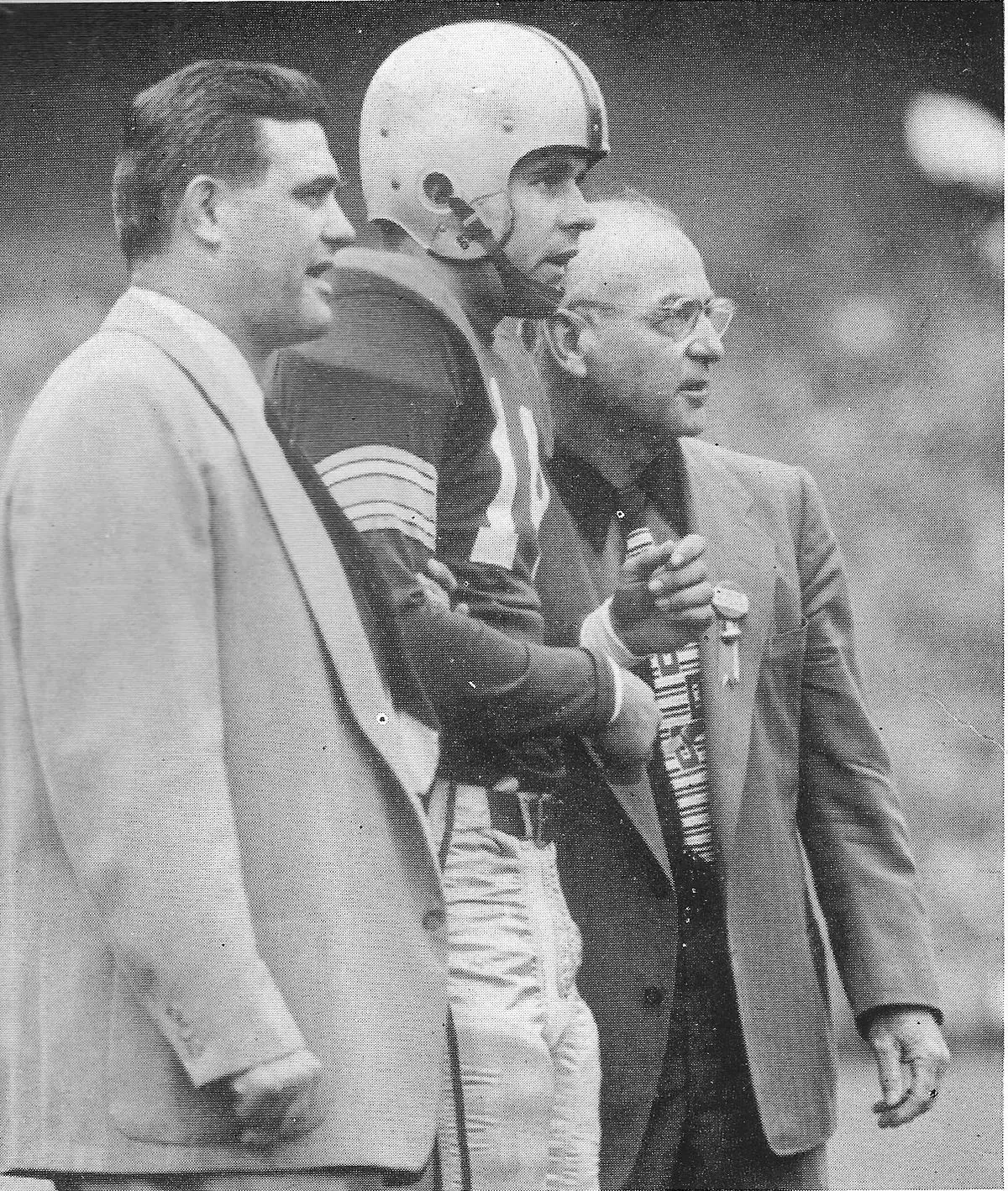
Woody Hayes took over an Ohio State program in 1951 that had employed five coaches in the previous 11 years, a period sometimes called the graveyard of coaches. His first season saw the team struggle to adapt to his preferred T-formation, finishing with a 4-3-2 record. This experience reinforced Hayes's belief in a powerful, run-oriented offense. His basic philosophy was that winning required a positive attitude and a willingness to pay the price of success. He often used historical events to make points and was deeply committed to the academic development of his players.
National Championships and Major Seasons
Woody Hayes led Ohio State to five national championship recognitions during his tenure. The first came in 1954 when the team finished with a perfect 10-0 record, culminating in a 20-7 Rose Bowl victory over Southern California. The 1957 team went 9-1 and was also named national champion. The 1961 squad finished 8-0-1 and won a national title. That victory was part of a 22-game winning streak. The 1970 team finished 9-1 and earned a national championship recognition as well. Hayes himself considered his 1969 team, which was upset by Michigan, to be his best, a point he made while staring down his rival Bo Schembechler at a banquet.
| Season | Record | Big Ten Finish | Bowl/Note |
|---|---|---|---|
| 1954 | 10-0 | 1st | Rose Bowl W, National Champion |
| 1957 | 9-1 | 1st | National Champion |
| 1961 | 8-0-1 | 1st | National Champion |
| 1968 | 10-0 | 1st | Rose Bowl W, National Champion |
| 1970 | 9-1 | 1st | National Champion |
| 1975 | 11-1 | 1st | Rose Bowl L |
Hayes's overall record at Ohio State was 205 wins, 61 losses, and 10 ties, a winning percentage of .761. His teams won 13 Big Ten Conference championships and made eight Rose Bowl appearances. His 205 wins were the most by a Big Ten coach at the time of his retirement, a record broken by Iowa coach Kirk Ferentz in 2025. He coached 58 players who earned All-America honors, including the only two-time Heisman Trophy winner, Archie Griffin, in 1974 and 1975.
Coaching Philosophy and Innovations
Woody Hayes's offensive philosophy was famously conservative and ground-based. It was often described as three yards and a cloud of dust, emphasizing a crunching, frontal assault of muscle against muscle. His bread-and-butter plays were a fullback off-guard run or a tailback off tackle play. He was deeply skeptical of the forward pass, frequently stating that only three things can happen when you pass and two of them are bad, referring to an incompletion and an interception. Despite this apparent resistance to change, Hayes was an innovator in other areas. He was one of the first major college head coaches to actively recruit and start African-American players in large numbers at Ohio State, beginning with Jim Parker on his 1954 national championship team. He also hired African-American assistant coaches. Hayes was an early adopter of using motion pictures as a teaching tool for his team. He held a position as a full professor of physical education at Ohio State, having earned a Master of Arts in educational administration from the university in 1948. He taught classes that were popular with students, who called him Professor Hayes. He also required his freshman football players to attend English and vocabulary classes he taught.
The Ten Year War and Rivalry with Michigan
The final decade of Woody Hayes's career, from 1969 to 1978, is known as the Ten Year War against the Michigan Wolverines, coached by his former player and assistant Bo Schembechler. During this period, either Ohio State or Michigan won or shared the Big Ten Conference championship every single season. Both teams were typically ranked nationally, and their annual matchup often decided the conference title and Rose Bowl berth. Hayes usually referred to Michigan as That School Up North, reportedly because he disliked saying the name Michigan. The rivalry reached its peak intensity during these years. In the 1968 game, with Ohio State already leading 42-14, Hayes called for a two-point conversion after another touchdown. When asked why, he replied that it was because the rules would not let him go for three. This period cemented the rivalry as one of the most fiercely contested in all of sports.
Controversies and Volatile Behavior
Woody Hayes's career was marked by numerous incidents of volatile behavior directed at opponents, officials, journalists, and even his own university. In 1959, following a 17-0 loss to USC, he threw a punch at Los Angeles Examiner sportswriter Al Bine, missed, and hit another person. At a Big Ten meeting in May 1965, he nearly started a fight with Iowa athletic director Forest Evashevski before being restrained. Prior to the 1973 Rose Bowl, he shoved a camera into a photographer's face, resulting in a three-game suspension and a $2,000 fine. In a 1971 game at Michigan, furious over a non-call, he stormed the field, tore up sideline markers, threw the penalty flag into the crowd, and was ejected, leading to a one-game suspension and a $1,000 fine. In 1977, he charged at an ABC cameraman during a game at Michigan, resulting in probation and a $2,000 fine.
Other major controversies occurred off the field. Hayes responded by confronting the alumni president who led the opposition, launching a profanity-laced tirade, and punching him in the stomach. In 1969, at a football banquet, he made controversial comments about the My Lai Massacre, stating the Vietnamese men deserved to die and casting doubt on the innocence of the women. The most consequential incident was the 1978 Gator Bowl. With Ohio State trailing Clemson 17-15 late, freshman quarterback Art Schlichter threw an interception to Clemson nose guard Charlie Bauman. After Bauman returned the interception and was run out of bounds near the Ohio State sideline, Hayes punched him in the throat, which started a bench-clearing brawl. According to a 1994 documentary, Hindman had placed Hayes on notice before the 1978 season for previous incidents, including hitting a player during practice.
Honors and Awards
Throughout his career, Woody Hayes received significant recognition for his coaching achievements. He was a three-time winner of the Paul Bear Bryant Award, then known as The College Football Coach of the Year Award, in 1957, 1968, and 1975. He won the Walter Camp Coach of the Year Award in 1968. Hayes served as president of the American Football Coaches Association in 1963. After his retirement, the College Football Hall of Fame inducted him as a coach in 1983. In 1986, he received the Amos Alonzo Stagg Award. These honors reflect his standing as one of the most successful and influential coaches in college football history, despite the controversies that ended his career.
Final Days, Death, and Legacy
After his dismissal, Woody Hayes lived in Upper Arlington, Ohio. On March 11, 1987, despite clearly failing health, he had someone drive him to Dayton to introduce Bo Schembechler at a banquet. He gave a lengthy introduction and stayed to hear Schembechler speak before returning home. The next morning, March 12, his wife Anne found him unconscious in his bed. Woody Hayes died of a heart attack at age 74. He was buried at Union Cemetery in Columbus, Ohio. His legacy is complex, defined by extraordinary on-field success, a profound coaching tree, a commitment to education and integration, and a temper that led to his downfall. For many, he embodied the intense passion and combative spirit of college football during his era.
Video
FAQ
Why did Woody Hayes refuse to play Notre Dame?
Woody Hayes publicly stated he refused to schedule Notre Dame because he feared polarizing the Catholic population in Ohio. However, Notre Dame's longtime athletic director Edward Moose Krause said Hayes told him a different reason. Hayes reportedly liked having Michigan as the only tough game on Ohio State's schedule and believed adding Notre Dame would detract from that rivalry. Despite this, Ohio State did schedule other major non-conference opponents during his tenure, including Nebraska, Washington, USC, UCLA, and Oklahoma.
What ended Woody Hayes's coaching career?
Woody Hayes's coaching career ended when he was fired by Ohio State on December 30, 1978. The dismissal came one day after he punched Clemson player Charlie Bauman in the throat during the Gator Bowl. After the game, athletic director Hugh Hindman confronted Hayes and offered him a chance to resign, which Hayes refused. Hindman then met with university president Harold Enarson, and they agreed to fire Hayes. Enarson stated that no university would permit a coach to physically assault a college athlete.
Did Woody Hayes ever apologize for the Gator Bowl incident?
There is no record of Woody Hayes offering a public apology to Charlie Bauman for punching him. Roughly two months after the incident, Hayes called Bauman in his dorm room, but he did not apologize for the attack. In his autobiography, Michigan coach Bo Schembechler wrote that he believed Hayes, who was diabetic, may not have believed he actually struck Bauman. Hayes contended he was merely trying to grab the football away from the Clemson player.
What was Woody Hayes's relationship with his players and the university community?
Woody Hayes had a complex relationship with his players and the broader Ohio State community. He was a strict disciplinarian known for his temper, with reports of him hitting a player during practice. However, he was also deeply committed to their education, teaching them English and vocabulary. He held a professorship and was popular with students, often walking across campus to talk with them. During the anti-war demonstrations of the late 1960s and early 1970s, he was one of the few authority figures students respected, and he used a bullhorn to urge protesters not to be destructive. He frequently ate at the university faculty club and interacted with administrators.
What happened in the 1962 Rose Bowl vote involving Ohio State?
After Ohio State won the Big Ten championship in 1961, the university's Faculty Council voted 28 to 25 against allowing the team to accept the Rose Bowl invitation. The decision was prompted by concerns over the over-emphasis on football harming the school's academic reputation. This sparked minor rioting on campus. Hayes later confronted the alumni president who led the charge against the bowl bid, launching a profanity-laced tirade and punching him in the stomach.
What was Woody Hayes's overall college football coaching record?
Woody Hayes compiled a career college football coaching record of 238 wins, 72 losses, and 10 ties. This record was achieved across his head coaching tenures at Denison University, Miami University of Ohio, and Ohio State University. At Ohio State specifically, his record was 205 wins, 61 losses, and 10 ties. His lifetime record is considered one of the best in NCAA history, and he was inducted into the College Football Hall of Fame as a coach in 1983.
Sources
- Woody Hayes (Wikipedia) Wikipedia
- Coach Woody Hayes dallasohiostatealumniclub.com
- Woody Hayes nndb.com