Robert F. Kennedy Memorial Stadium, known as RFK Stadium, was a multi-purpose stadium in Washington, D.C., located along the Anacostia River at 2400 East Capitol Street SE. It opened in 1961 as District of Columbia Stadium and was renamed in 1969 to honor the assassinated senator. The stadium was designed as one of the first major venues to host both football and baseball, pioneering the so-called cookie-cutter design. RFK Stadium was the long-time home of the Washington Commanders NFL franchise and hosted numerous other football teams and major events before closing in 2019 and being demolished. The site is now slated for a new 65,000-seat stadium for the Commanders, scheduled to open in 2030.
Construction and Financing
The push for a new stadium in Washington gained legislative force with the District of Columbia Stadium Act, which was signed into law by President Dwight D. Eisenhower on July 29, 1958. The initial estimated cost for the project ranged from $7.5 to $8.6 million. The first lease for the facility was signed by the D.C. Armory Board and the U.S. Department of the Interior on December 12, 1958. Actual construction began on July 8, 1960, with a final budget of $24 million, which equates to approximately $259 million in 2025 dollars. The general contractor for the project was Thomas McCloskey. The stadium was built to replace the aging Griffith Stadium, which was located about four miles northwest and had been the home for both the city's baseball and football teams. The design and construction were completed in just over 14 months, allowing the venue to open in the fall of 1961.
Design and Opening Events
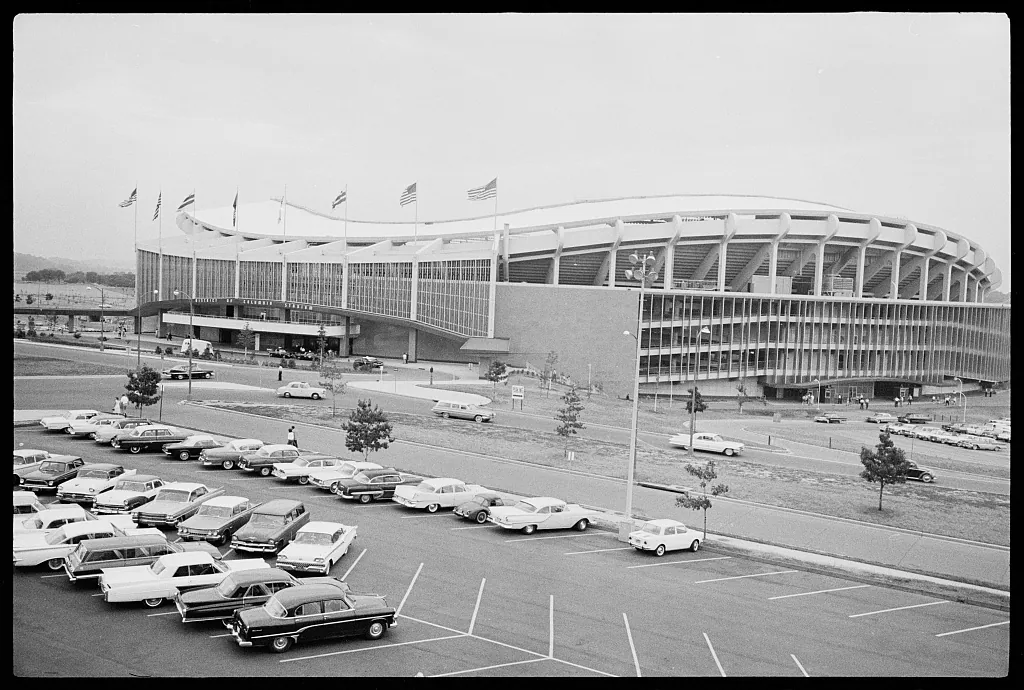
RFK Stadium was designed by architect George Dahl as a multi-sport facility, a novel concept at the time. The structural engineering was handled by Osborn Engineering, while Ewin Engineering Associates provided services engineering. The venue opened on October 1, 1961, for its first official event, an NFL regular season game where the Washington Commanders lost to the New York Giants 24-21. A crowd of 36,767 attended that game, which was slightly more than a previous attendance record at the old Griffith Stadium. The stadium's dedication game was a college football contest six days later on October 7, where George Washington University defeated Virginia Military Institute 30-6. The first sell-out event occurred on November 23, 1961, for a Thanksgiving Day high school football championship between Eastern and St. John's. The stadium's first baseball game was played on April 9, 1962, when President John F. Kennedy threw out the ceremonial first pitch.
Football Capacity and Physical Features
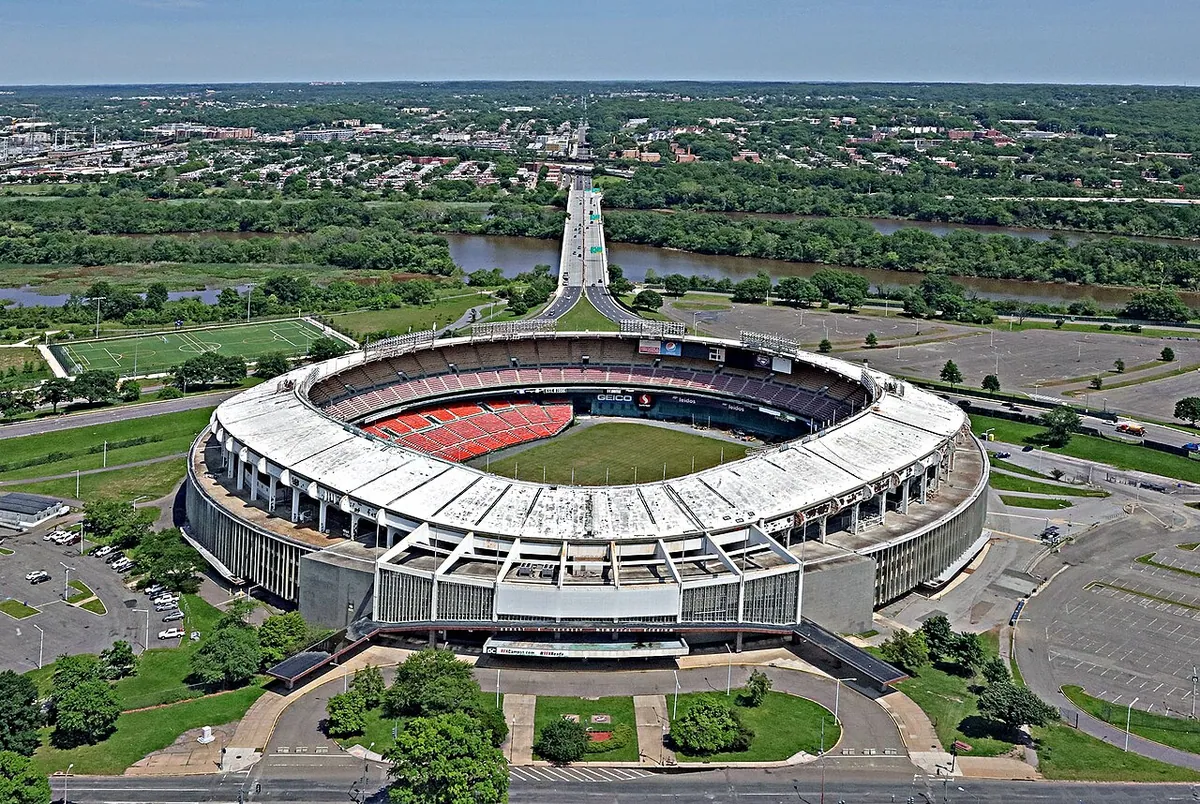
This was later reduced, and from 2005 until its closure, the football and soccer capacity was listed at 45,596. For Major League Soccer matches from 2012 to 2017, the capacity was further reduced to 20,000. The playing surface was Bermuda grass, and the football field dimensions were 120 yards long by 53.333 yards wide. The stadium's design featured two full tiers of seats encircling the field, creating a circular concrete bowl. A well-known characteristic of the upper deck was its noticeable sway when crowds stomped in unison during exciting moments. The field was also configured for baseball, with left and right field distances of 335 feet and a center field distance of 410 feet.
Primary NFL Tenant: The Washington Commanders
The Washington Commanders, known as the Redskins for most of their tenure, played at RFK Stadium from its opening in 1961 through the end of the 1996 NFL season. Over 36 seasons, the team played 278 regular season and playoff games at the venue before a total of 14.3 million fans. The Commanders' era at RFK included their most successful period, culminating in three Super Bowl championships (XVII, XXII, and XXVI). The final NFL game at the stadium was played on December 22, 1996, a 37-10 Commanders victory over the Dallas Cowboys. That game drew 56,454 fans, setting the stadium's all-time record for a football crowd. The team's departure was prompted by owner Jack Kent Cooke's desire for a modern stadium with luxury suites, leading to their move to Jack Kent Cooke Stadium in Maryland for the 1997 season. The Commanders' first win at the stadium also came against the Dallas Cowboys in 1961.
Integration and Social History
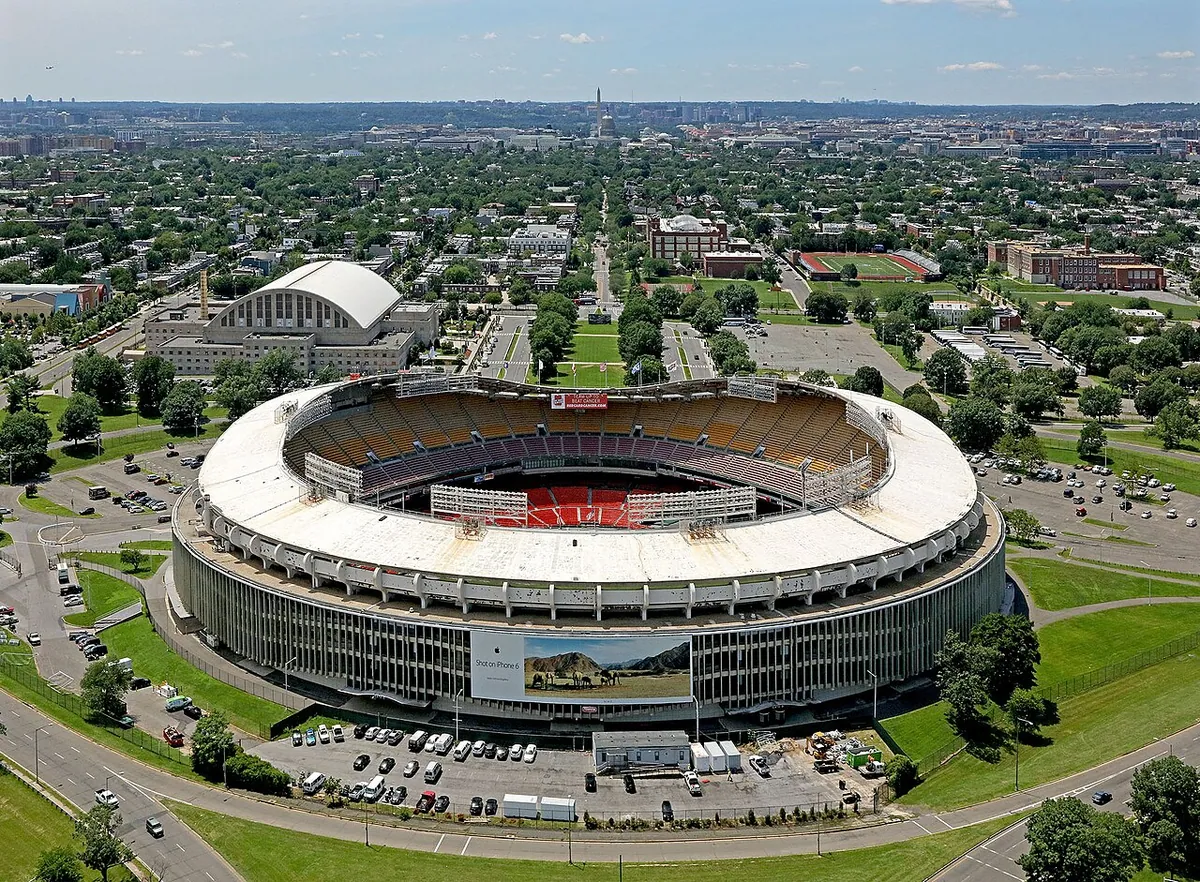
The opening of RFK Stadium was intertwined with the civil rights movement in Washington. The first game on October 1, 1961, drew over 100 picketers from the NAACP and the Congress of Racial Equality protesting the Commanders' segregationist owner, George Preston Marshall, who maintained the NFL's last all-white roster. In 1962, under pressure from the Kennedy Administration which threatened to bar the team from using the federally owned stadium, Marshall relented and integrated the team. He selected Ernie Davis first overall in the 1962 NFL Draft, though Davis refused to play for Washington and was traded for Bobby Mitchell. Marshall later signed four other Black players that season. A racially motivated riot also occurred at the stadium on November 22, 1962, following a high school championship game between St. John's and Eastern.
Other Football Tenants and Major Events
Beyond the Commanders, RFK Stadium hosted a variety of other football tenants and significant events. The stadium was home to the Washington Federals of the United States Football League for the 1983 and 1984 seasons. In college football, the George Washington University Colonials played their home games at RFK from 1961 until the program was discontinued after the 1966 season. The venue hosted the Military Bowl, a postseason college football game, from 2008 through 2012 before it relocated to Annapolis. The stadium also hosted nine soccer matches for the 1996 Summer Olympics and five matches for the 1994 FIFA World Cup.
Notable Football Games and Records
RFK Stadium was the stage for many memorable moments in football history. In the 1992 NFC Divisional Round playoff game, played in pouring rain, Commanders fans famously threw their yellow seat cushions onto the field as time expired in a 24-7 win over the Atlanta Falcons. The stadium's record attendance for any event was 58,012, set during a 1996 Olympic soccer match where the United States tied Portugal 1-1. The 1982 Cracker Jack Old Timers baseball game featured a 250-foot home run by 75-year-old Hall of Famer Luke Appling.
| Event | Date | Significance |
|---|---|---|
| Last NFL Game | December 22, 1996 | Record football crowd of 56,454 saw win over Cowboys. |
| Military Bowl Seasons | 2008 to 2012 | Hosted college football bowl game for five consecutive years. |
| 1994 World Cup | 1994 | Hosted five matches, including a Spain vs. Switzerland Round of 16 game. |
Post-NFL Tenants and Final Years
After the Commanders departed in 1996, D.C. United of Major League Soccer became the stadium's primary tenant from 1996 through 2017. The Washington Nationals baseball team used RFK as their temporary home from 2005 to 2007 while Nationals Park was constructed. The last professional sports game at RFK was an MLS match on October 22, 2017, where D.C. United lost 2-1 to the New York Red Bulls. The stadium was officially closed on September 15, 2019. During its final years, the venue also hosted concerts and other events, but the cost of maintaining the aging structure became prohibitive. Events DC, the operator, stated that closing the stadium would save $2 million per year in maintenance and $1.5 million in utilities. The facility then sat vacant for several years as plans for its demolition were finalized.
Renovations and Naming History
The most significant changes involved the replacement of seating over the years. The capacity was reduced to approximately 45,596 by 2005 when modifications were made to accommodate the temporary return of Major League Baseball with the Washington Nationals. The stadium never had a corporate naming rights sponsor. It opened as District of Columbia Stadium, a name often shortened to D.C. Stadium. On January 18, 1969, Secretary of the Interior Stewart Udall announced the venue would be renamed the Robert F. Kennedy Memorial Stadium in honor of the senator assassinated the previous June. The official dedication ceremony for the new name was held on June 7, 1969, though the RFK moniker was adopted quickly by the public and media. The name change occurred during the final days of the Johnson Administration.
Demolition Process and Timeline
The demolition of RFK Stadium was a multi-year process. After closing in 2019, the stadium sat idle on federal land managed by the National Park Service. Hazardous material removal began inside the structure in July 2022. In November 2022, a sale of stadium seats was announced ahead of the full demolition. The National Park Service granted final approval for the complete demolition in May 2024. Structural deconstruction work commenced in January 2025. Contractors ramped up activity on the RFK campus starting January 13, 2025, to prepare for the structural demolition. The demolition was expected to cost around $20 million.
Future: The New Stadium at RFK Campus
The future of the RFK site was secured with a major announcement in April 2025. D.C. Mayor Muriel Bowser, NFL Commissioner Roger Goodell, and Washington Commanders owner Josh Harris presented plans for a new $3.8 billion stadium project. The development, referred to as the New Stadium at RFK Campus, is designed to have a seating capacity of 65,000. Initial renderings released by lead architect HKS in January 2026 showed a design with a neoclassical-inspired colonnade exterior and a skylit, cable-net roof. The stadium is targeted to open in 2030. Critical to this plan was the transfer of the land from federal to District of Columbia control, which was accomplished through legislation passed by Congress and signed by President Joe Biden in 2024. A study released in June 2024 estimated that an NFL team in the city would generate $1.26 billion in annual economic output and $26 million in tax revenue. The new venue is intended to potentially lure the Commanders back to Washington from their current home in Maryland after the 2027 season.
Video
FAQ
What was the capacity of RFK Stadium?
RFK Stadium's original football capacity upon opening in 1961 was 56,692 spectators. This figure was later adjusted, and from 2005 until the stadium's closure in 2019, its listed capacity for football and soccer was 45,596. The largest football crowd ever recorded at the venue was 56,454 for the Washington Commanders' final game on December 22, 1996. For Major League Soccer matches from 2012 to 2017, the capacity was configured down to 20,000 to create a more intimate atmosphere for soccer.
When was RFK Stadium built and opened?
Groundbreaking for RFK Stadium occurred on July 8, 1960, following the passage of the District of Columbia Stadium Act in 1958. Construction took just over 14 months at a cost of $24 million. The stadium opened for its first official event on October 1, 1961, which was an NFL game between the Washington Commanders and New York Giants. It was originally named District of Columbia Stadium before being renamed in honor of Robert F. Kennedy in January 1969.
What NFL team played at RFK Stadium and for how long?
The Washington Commanders, originally known as the Washington Redskins, were the primary NFL tenant at RFK Stadium. They played there for 36 consecutive seasons, from the stadium's opening in 1961 through the conclusion of the 1996 NFL season. During this tenure, the team played 278 games at RFK and won three Super Bowl championships while based at the venue. The team moved to Jack Kent Cooke Stadium in Landover, Maryland, for the 1997 season.
Is RFK Stadium still standing?
No, RFK Stadium has been completely demolished. The stadium closed in September 2019 and sat vacant for several years. After receiving final approval from the National Park Service in May 2024, structural demolition began in January 2025. The process continued throughout 2025 and 2026, with the last structural steel removed by March 2026 and all demolition work finished by August 2026. The site is now cleared for new development.
What is being built on the old RFK Stadium site?
A new stadium called the New Stadium at RFK Campus is planned for the site. The project was announced in April 2025 by city and NFL officials with a projected cost of $3.8 billion. The design calls for a 65,000-seat venue with a roof and a neoclassical exterior. The stadium is scheduled to open in 2030 and is intended to be the potential future home of the Washington Commanders, aiming to bring the NFL franchise back to Washington, D.C., proper.
What was the original name of RFK Stadium when it opened?
The stadium originally opened as District of Columbia Stadium in October 1961. It was often shortened to D.C. Stadium by the media and the public. The name was officially changed to Robert F. Kennedy Memorial Stadium in January 1969 to honor the U.S. Senator and presidential candidate who was assassinated in 1968. The dedication ceremony for the new name was held on June 7, 1969, but many had already begun referring to it as RFK Stadium by that time.
Sources
- Robert F. Kennedy Memorial Stadium (Wikipedia) Wikipedia
- Venue History, RFK Stadium eventsdc.com
- RFK Stadium, History, Photos & More of the former NFL.. Stadiums of Pro Football
- RFK Stadium demolition to begin late January, officials say fox11online.com
- RFK Stadium: History, Demolition & New Commanders Stadium, ThrillZing thrillzing.com
- Exploring the Noted Legacy of Washington DC's RFK Stadium allegiantgoods.co