Ross-Ade Stadium is a college football stadium located on the campus of Purdue University in West Lafayette, Indiana. It is the home field of the Purdue Boilermakers football team of the Big Ten Conference. The stadium opened on November 22, 1924, with a seating capacity of 13,500 and standing room for an additional 5,000. Named for principal benefactors and alumni David E. Ross and George Ade, the venue has undergone numerous expansions and renovations, with its current capacity standing at 61,441 as of 2023. The stadium features a natural grass playing surface and has been the site of Purdue football for over a century, hosting more than 500 games since its debut.
Construction and Early History
The idea for Ross-Ade Stadium was conceived by alumnus David E. Ross, who selected the site for the new facility. In 1922, Ross and fellow alumnus George Ade purchased a 65-acre tract of land and presented it to Purdue University for the stadium and other athletic facilities. Groundbreaking occurred on June 2, 1924, with A.E. Kemmer serving as the general contractor. The stadium was completed rapidly and dedicated on November 22, 1924. The first game was a homecoming victory over intrastate rival Indiana, with Purdue winning 26-7. The original configuration featured grandstands on the east and west sides with a seating capacity of 13,500 and standing room for 5,000 more in the north end zone, replacing the team's former home, Stuart Field.
Expansions and Capacity Evolution
Ross-Ade Stadium has been expanded six times since its opening to accommodate growing fan interest. The first expansion came in 1930 with the addition of 5,000 seats in the north end zone. Permanent stands were added on the east side in 1955, increasing capacity to 55,500. In 1963, the playing field was lowered to allow for 13 additional rows of seating around the field. The final section of temporary seating was eliminated in 1969 when permanent stands were constructed in the north end zone, bringing the official seating capacity to 62,500. The stadium's all-time record attendance of 71,629 was set on November 22, 1980, for a game against Indiana. Following a 2023 renovation, the current official capacity is 61,441.
Major 21st Century Renovations
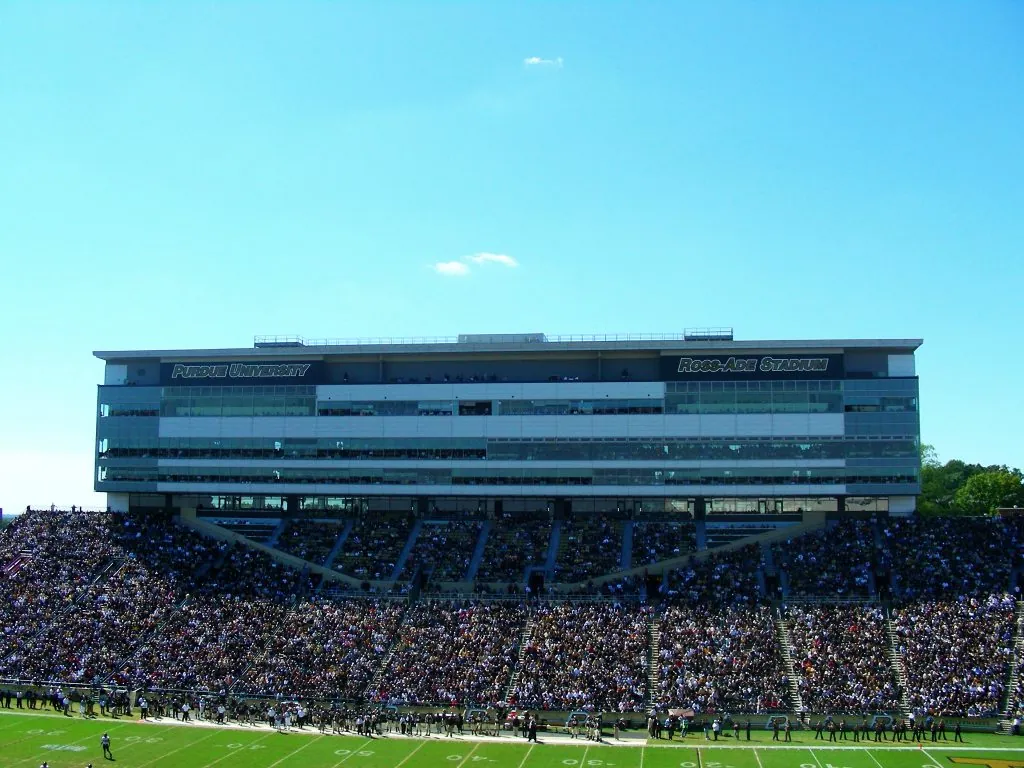
The first project, spanning 2001 to 2003, involved a $70 million investment. This renovation replaced the 50-year-old Woodworth Memorial Press Box with a modern four-story pavilion. The new structure housed the Shively Media Center, 34 luxury suites, and a 200-seat indoor club level. The project also included several other fan-focused improvements.
- Addition of outdoor club seats with exclusive access to the pavilion's suites.
- Expansion of the main concourse throughout the stadium.
- Installation of new bathrooms and concession stands for improved amenities.
- Construction of a new grand staircase at the south end of the stadium.
- Replacement of all concrete and benches in the seating areas.
The second major project, dubbed "Your Ross-Ade," began after the 2022 season. Its $45.4 million Phase I, completed for the 2023 season, added a new south end zone stand with approximately 4,500 seats, safe standing areas, and patio decks. This phase also constructed the Tiller Tunnel, connecting the stadium to the Kozuch Football Performance Center, and converted the north-end team shop into a student-athlete dining facility. Phase II and Phase III of the original 2000s master plan, which proposed adding upper decks to the east side and north bend, were never completed.
Technology and Surface Upgrades
Ross-Ade Stadium has received significant technological and playing surface upgrades over the decades. In 2006, the Kentucky bluegrass was replaced by a cold-tolerant Bermuda grass, a first for a Big Ten stadium. The field uses the Prescription Athletic Turf drainage system, a network of pipes and pumps created by Purdue staff members William H. Daniel and Melvin Robey in the early 1970s. This system was installed in the stadium in 1975 at a cost of about $125,000 and is designed to quickly remove water from the grass, maintaining playability during heavy rainfall. Major video displays have been added in stages, including a 31-by-68-foot Daktronics board in 2007, a 575-by-10-foot ribbon board in 2019, and a massive 150.33-by-56.75-foot HDR display in the south end zone in 2020 as part of a $10 million project. Permanent lighting was installed in 2017 for $5.6 million, eliminating the need to rent lights for night games.
Purdue Football Tenure and Records
Ross-Ade Stadium has been the exclusive home of Purdue Boilermakers football since 1924. Through the 2022 season, the team's all-time record at the stadium is 297 wins, 198 losses, and 13 ties, representing a .581 winning percentage. The Boilermakers played their 500th game at Ross-Ade on September 4, 2021, a 30-21 victory over Oregon State. The 2023 season was the 100th campaign of Purdue football at the venue. Significant night game results include a 49-20 victory over the second-ranked Ohio State Buckeyes on October 20, 2018, and a 43-37 win over Nebraska on October 15, 2022. Other notable night games include a 44-21 win over Ohio on September 8, 2017, and a 31-35 loss to Penn State on September 1, 2022.
Memorials and Naming History
In 2019, the Tyler Trent Student Gate was installed on the east side to honor the Purdue superfan who died that year at age 20. The gate was later relocated during the 2023 renovations. The Tiller Tunnel, completed in 2023, is named for the late head coach Joe Tiller. While the stadium itself retains the name Ross-Ade Stadium, the playing surface was renamed Rohrman Field at Ross-Ade Stadium in December 2019 following a $15 million gift. This naming rights arrangement is separate from the stadium's overarching title, which continues to honor its original patrons, David E. Ross and George Ade.
Financing and Cost History
The original construction cost was $237,500, financed largely by the benefactors for whom it is named, David E. Ross and George Ade. The 2001 to 2003 renovation cost $70 million. The 2023 south end zone renovation had a price tag of $45.4 million, raised entirely from donors. Additional projects have had specific price tags, such as the $5.6 million for permanent lighting in 2017 and the $10 million for the south end zone video display in 2020. The Prescription Athletic Turf system installation in 1975 cost approximately $125,000. The 2007 video board was priced at $1.7 million, financed through a ten-year partnership with Action Sports Media.
Stadium Configuration and Fan Experience
The 2023 renovations increased student seating capacity by 5 percent and moved the student section to the south end zone and the area east of it. The stadium features safe standing seats, patio areas, deck areas, and rail seating in the new south end zone stand. The venue is also a sensory-inclusive environment, a partnership established with KultureCity ahead of the 2024 season. The main concourse was expanded during the 2001 to 2003 renovation, which also added new bathrooms and concession stands. The four-story pavilion on the west side provides 34 luxury suites and outdoor club seats with exclusive pavilion access.
Video
FAQ
Where is Ross-Ade Stadium located?
Ross-Ade Stadium is located at 850 Steven Beering Drive on the campus of Purdue University in West Lafayette, Indiana. It sits on the northern edge of the university campus on a 65-acre tract of land. The site was originally a dairy farm purchased and donated by alumni David Ross and George Ade. The address places it within the university's athletic facilities complex.
What is the capacity of Ross-Ade Stadium?
The seating capacity of Ross-Ade Stadium is 61,441 as of the 2023 renovation. This figure represents the current official capacity, which was increased from a previous lower number by adding approximately 4,500 seats in the south end zone. The all-time record attendance is 71,629, set during a game against Indiana on November 22, 1980. The original capacity in 1924 was 13,500 seats with standing room for 5,000 additional spectators.
When was Ross-Ade Stadium built and opened?
Construction on Ross-Ade Stadium began on June 2, 1924. The stadium opened just a few months later on November 22, 1924. The first game was a 26-7 Purdue victory over the Indiana Hoosiers. The stadium was built to replace the team's previous home, Stuart Field, which had been used since 1892. The general contractor for the original construction was A.E. Kemmer.
Does Ross-Ade Stadium have grass or artificial turf?
Ross-Ade Stadium has always had a natural grass playing surface. In June 2006, the previous Kentucky bluegrass was replaced with a cold-tolerant strain of Bermuda grass. This installation made Purdue the first Big Ten Conference stadium to feature a Bermuda grass surface. The field also employs the Prescription Athletic Turf drainage system to manage water and maintain field conditions.
Who are Ross-Ade Stadium's namesakes?
The stadium is named for two Purdue alumni and principal benefactors: David E. Ross and George Ade. Ross conceived the idea for the stadium and selected its site. In 1922, Ross and Ade purchased the 65-acre tract of land and presented it to the university for the stadium's construction. They also provided additional financial support to fund the building of the facility, which opened in 1924.
What was the original seating capacity of Ross-Ade Stadium when it opened?
Ross-Ade Stadium originally had a seating capacity of 13,500 when it opened on November 22, 1924. There was also standing room for an additional 5,000 people in the north end of the stadium. This initial configuration roughly corresponds to the lower portion of the current facility's west grandstand. The stadium was built to replace the older Stuart Field and was dedicated with a homecoming victory over intrastate rival Indiana.
Sources
- Ross, Ade Stadium (Wikipedia) Wikipedia
- Ross-Ade Stadium purduesports.com
- Ross Ade Stadium, Facts, figures, pictures and more of the Purdue Boilermakers.. collegegridirons.com