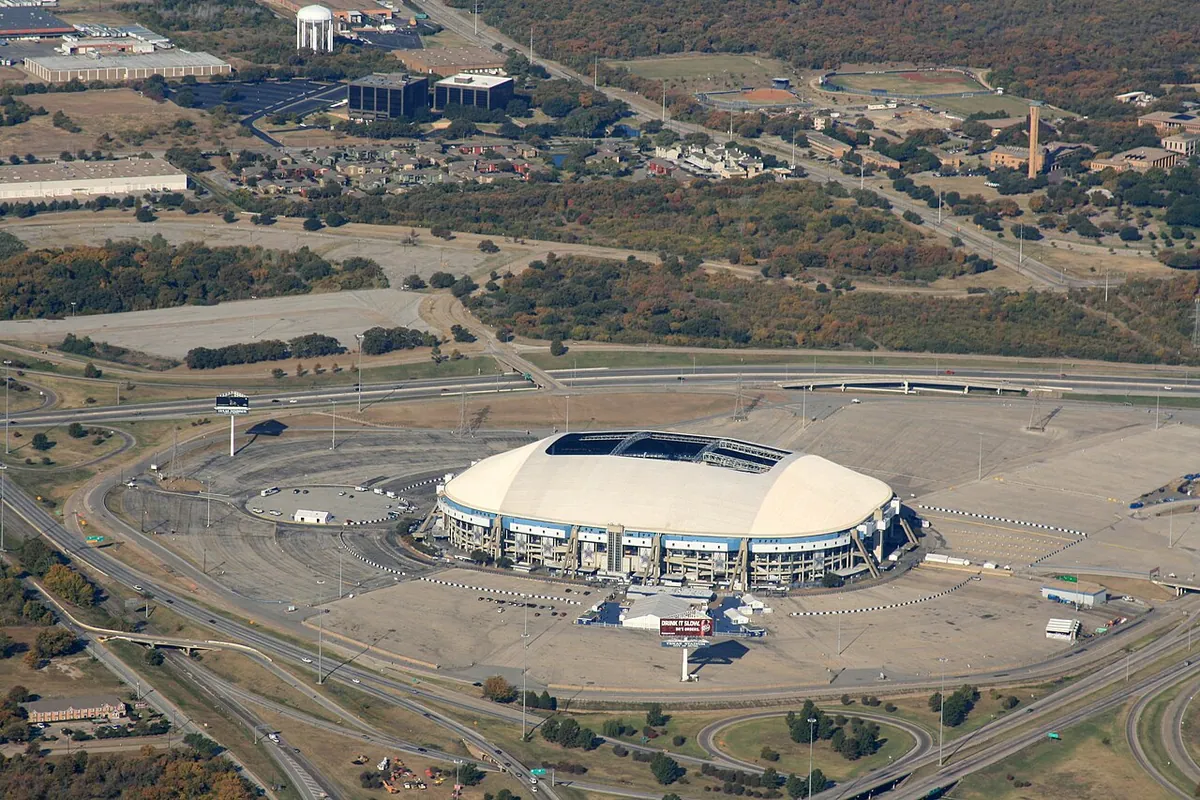
The venue was an American football stadium situated in Irving, Texas, a community located to the west of Dallas. Its first event was held on October 24, 1971, and it functioned as the primary stadium for the NFL's Dallas Cowboys across 38 seasons until 2008. The facility was recognized for its unique partial roof featuring an opening above the playing field, a design that emerged from scrapped plans for a movable roof. With a final official seating figure of 65,675, it was the site of many NFL contests, college football games, and other significant gatherings before its closure in 2008 and subsequent demolition by implosion on April 11, 2010. The stadium's design included a blue wall with white stars around the field, and it was part of a wave of football-only venues built after the AFL-NFL merger.
Construction and Financing
Initial plans for a new Cowboys stadium were driven by owner Clint Murchison Jr., who felt the team's former home area, Fair Park, had become unsafe. After a request to build in downtown Dallas was denied by the mayor, Murchison and general manager Tex Schramm announced a plan in 1967 to construct a stadium in Irving. The city's voters approved the measure by a two-to-one margin to construct a new stadium. Groundbreaking took place on January 26, 1969, with construction managed by the JW Bateson Co. The total construction cost was $35 million. The stadium was part of a new wave of football-only facilities built after the AFL-NFL merger, and it stood out for its large number of 381 luxury suites, which provided the team with a significant new revenue source not subject to league sharing.
The financing model involved a construction bond rather than increased taxes, an approach supported by Irving City Councilman Robert Power. The stadium was named simply for its location. The architectural design was handled by A. Warren Morey. The project faced the challenge of a planned retractable roof, but engineers found the structure could not bear the extra weight required for that mechanism. This led to the permanent partial roof design that became the stadium's signature feature. The first event was a Billy Graham religious crusade held in September 1971.
Design and Roof Feature
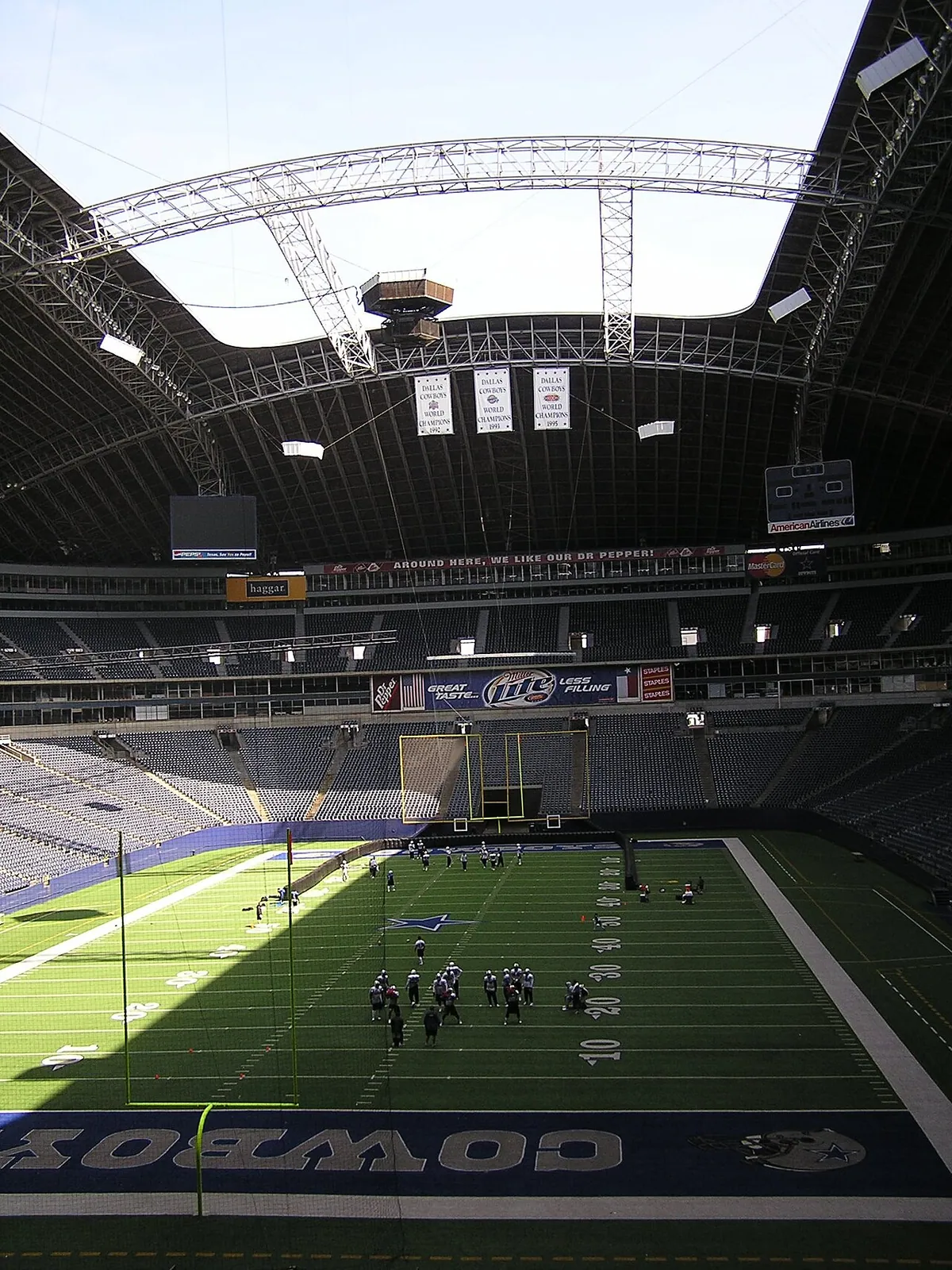
The most recognizable aspect of Texas Stadium was its fixed partial roof, which covered the spectator stands but left the playing field exposed to the weather. This was the only such roof design in the NFL. The opening was a consequence of the abandoned retractable roof plan. Cowboys linebacker D.D. Lewis later remarked that the stadium had a hole in its roof so God could watch His favorite team. The open design allowed snow to fall on the field during a 1993 Thanksgiving Day game against the Miami Dolphins. It also created lighting challenges for television broadcasts, as sunlight would shift across parts of the field.
In 2006, the city of Irving, which owned the stadium, undertook a project to repaint the roof structure. This maintenance work was the first time the roof had been repainted since the facility opened. The interior design featured a blue wall around the field that was originally plain concrete gray in 1971. It was painted blue for the 1972 season, and white stars were added in 1975, creating a look that would later be echoed in AT&T Stadium. The field itself was aligned southwest-to-northeast, which was perpendicular to the alignment of the Cotton Bowl.
Capacity and Seating Evolution
Seating capacity at Texas Stadium was modified several times during its operational history due to renovations and reconfigurations of seating areas. When the stadium opened for the 1971 season, it could accommodate 65,000 fans. The capacity saw adjustments over the years, reflecting changes in suite configurations and general seating. It reached its highest point of 65,812 during the 1995 and 1996 seasons. For the majority of its final decade, from 1997 to 2008, the capacity hovered around 65,675. The stadium featured two tiers of blue seats that completely encircled the football field.
| Years | Capacity |
|---|---|
| 1971 to 1972 | 65,000 |
| 1973 | 65,111 |
| 1974 to 1984 | 65,101 |
| 1985 to 1988 | 63,855 |
| 1989 to 1994 | 65,024 |
| 1995 to 1996 | 65,812 |
| 1997 to 2000 | 65,675 |
| 2001 to 2002 | 65,639 |
| 2003 to 2008 | 65,529 |
Amenities included a stadium club for gatherings and The Corral, an area that provided food, beverages, and large-screen televisions for fans. The venue also featured two DiamondVision scoreboard and video boards. Flags representing the Cowboys' five Super Bowl championships were displayed from the roof structure. By the late 1990s, however, newer NFL stadiums began offering more extensive club and luxury seating, which contributed to the push for a replacement facility.
NFL Tenancy and Game History
The Dallas Cowboys were the sole NFL tenant for the stadium's entire existence. The team's first game there was a 44-21 victory over the New England Patriots on October 24, 1971. The Cowboys entered that season as the defending NFC champions and would win Super Bowl VI in January 1972. The highest combined score in those games was 80 points, when the Cowboys defeated the New York Giants 45-35 on September 9, 2007.
The stadium hosted five NFC Championship Games during the Cowboys' successful runs. The Cowboys lost their final game at the venue 33-24 to the Baltimore Ravens on December 20, 2008. The 1973 Pro Bowl was also held at Texas Stadium, drawing a crowd of 47,879 spectators. The playing surface changed over the years, starting with Texas Turf from 1971 to 1995, switching to AstroTurf from 1996 to 2002, and finally using RealGrass from 2002 to 2008. Game records listed the roof condition as outdoors due to the open field.
- First Cowboys Game: October 24, 1971 vs. New England Patriots (Win 44-21)
- Total Seasons as Cowboys Home: 38 (1971 to 2008) is stated in some notes, but others say 37.
- NFC Championship Games Hosted: 5
- Pro Bowl Hosted: 1973
College and High School Football
Texas Stadium served as an important venue for football at other levels. The first football game of any kind played there was a college contest on October 15, 1971, where Texas Southern University defeated Bishop College 34-21. The stadium hosted the 2001 Big 12 Championship Game. It was also a major site for Texas high school football playoffs, frequently hosting tripleheaders.
The stadium holds two of the largest attendance records for Texas high school playoff games. In 1977, Plano High School defeated Port Neches-Groves 13-10 before a record crowd of 49,953. In 2006, a second-round playoff game between Trinity High School (Euless) and Carroll Senior High School (Southlake) drew 46,339 spectators. The stadium also temporarily housed the Plano Senior High School team in 1979 after its home field was damaged, and Highland Park High School during construction of its on-campus stadium. The 1988 Class 5A state championship game was held there, where Dallas Carter defeated Converse Judson 31-14 before later being stripped of the title.
Other Sporting and Entertainment Events
The stadium's use extended far beyond American football. It was the home stadium for the Dallas Tornado of the North American Soccer League from 1972 to 1975 and again from 1980 to 1981. On November 21, 1991, the United States men's national soccer team faced Costa Rica in an international friendly match at the stadium, with the final result being a 1-1 tie. The venue hosted a round of the AMA Supercross Championship nearly every year from 1975 to 1977 and from 1983 to 2008. The Professional Bull Riders held Bud Light Cup events known as the Battle of the Bulls in 1994 and 1995, both won by Adriano Morães.
Texas Stadium was a major concert venue. The Jacksons performed there on July 13, 1984, on their Victory Tour to an audience of 120,000, generating $3,564,090 in revenue. Other notable concerts included Crosby, Stills, Nash & Young in 1974, Madonna in 1987, Paul McCartney in 1990, and Farm Aid VI in 1992. Evangelist Carman drew a crowd of 71,132 for a concert on October 22, 1994. The stadium also hosted World Class Championship Wrestling's annual David Von Erich Memorial Parade of Champions cards from 1984 to 1988, with the 1984 event drawing over 40,000 fans.
Departure of the Cowboys and Closure
By the early 2000s, the Cowboys organization sought a new stadium to keep pace with the revenue-generating capabilities of newer NFL venues. In November 2004, voters in Arlington approved a half-cent sales tax to fund $325 million of a new stadium, with Cowboys owner Jerry Jones covering cost overruns. Following the team's move to Cowboys Stadium (AT&T Stadium) in Arlington for the 2009 season, Texas Stadium was scheduled for demolition. In September 2009, the City of Irving awarded the demolition contract to a local Dallas company named Weir Brothers Inc. Many items from the stadium, including seats and the scoreboard, were auctioned off as memorabilia. The City of Irving also announced a deal with the Texas Department of Transportation to lease the site for 10 years as a staging area for the State Highway 114 and Loop 12 interchange project, for which TxDOT paid $15.4 million. This agreement allowed the city to relocate the staging area if redevelopment plans materialized. The area around the former stadium site was the epicenter for at least 46 small earthquakes between 2013 and 2015, with magnitudes ranging from 1.6 to 3.6.
Demolition and Site Redevelopment
The demolition was executed by controlled implosion on April 11, 2010, at 7:07 a.m. CDT. The implosion sequence took approximately 25 seconds for the structure to completely fall. Kraft Foods sponsored the event through a $75,000 payment and a $75,000 food donation to local food banks, promoting its Cheddar Explosion macaroni and cheese. The company ran a national essay contest, and the winner, 11-year-old Casey Rogers, was given the honor of turning the key to trigger the explosions. Debris removal continued at the site until July 2010.
Long-term redevelopment plans for the site have been proposed. In March 2025, the Irving Zoning Commission approved zoning changes to allow for a planned integrated resort by Las Vegas Sands. The initial proposal included a casino, but that element was dropped shortly after being revealed due to community opposition. For such a resort to be built, Texas would need to change its gambling laws, which had not occurred as of 2025.
Pop Culture Appearances and Legacy
Texas Stadium appeared frequently in television and film, establishing its place in popular culture. It was featured in the opening credits of every episode of the long-running television series Dallas, which aired on CBS for 13 seasons. The stadium also appeared in numerous episodes of Walker, Texas Ranger, which was filmed in the Dallas-Fort Worth area. The 1999 Oliver Stone film Any Given Sunday used the stadium as the home of the fictional Dallas Knights. The stadium served as a setting for the state championship game in the season one finale of the television series Friday Night Lights. One of the most famous commercials filmed at the stadium was the 1979 Coca-Cola ad featuring Pittsburgh Steelers defensive tackle Mean Joe Greene and a young fan named Tommy Okon. The stadium was also featured on MTV's Headbangers Ball in 1994, where members of the band Pantera were interviewed on the field. The legacy of the stadium's design is carried forward at AT&T Stadium, which incorporates a symbolic representation of a hole in its retractable roof system and replicates the blue star-lined walls as a direct homage to its predecessor.
Recent games
| Date | Game | Week |
|---|---|---|
| Dec 20, 2008 | Baltimore Ravens 33 at Dallas Cowboys 24 | Week 16 |
| Dec 14, 2008 | New York Giants 8 at Dallas Cowboys 20 | Week 15 |
| Nov 27, 2008 | Seattle Seahawks 9 at Dallas Cowboys 34 | Week 13 |
| Nov 23, 2008 | San Francisco 49ers 22 at Dallas Cowboys 35 | Week 12 |
| Oct 26, 2008 | Tampa Bay Buccaneers 9 at Dallas Cowboys 13 | Week 8 |
| Oct 5, 2008 | Cincinnati Bengals 22 at Dallas Cowboys 31 | Week 5 |
| Sep 28, 2008 | Washington Redskins 26 at Dallas Cowboys 24 | Week 4 |
| Sep 15, 2008 | Philadelphia Eagles 37 at Dallas Cowboys 41 | Week 2 |
| Jan 13, 2008 | New York Giants 21 at Dallas Cowboys 17 | Divisional |
| Dec 16, 2007 | Philadelphia Eagles 10 at Dallas Cowboys 6 | Week 15 |
| Nov 29, 2007 | Green Bay Packers 27 at Dallas Cowboys 37 | Week 13 |
| Nov 22, 2007 | New York Jets 3 at Dallas Cowboys 34 | Week 12 |
FAQ
What was the capacity of Texas Stadium?
The seating capacity of Texas Stadium changed several times during its history. When it opened in 1971, it held 65,000 people. The capacity reached a peak of 65,812 in the mid-1990s. For its final years of operation from 2003 to 2008, the official capacity was 65,529. The stadium featured two tiers of blue seats that extended around the entire football field.
Why did Texas Stadium have a hole in the roof?
Texas Stadium had a hole in its roof because the original design called for a retractable roof. During construction, it was discovered that the structure could not support the additional weight of a fully retractable system. This resulted in a permanent partial roof that covered the stands but left the playing field open to the sky. The distinctive feature became widely recognized and was famously referenced by Cowboys player D.D. Lewis.
When was Texas Stadium demolished?
Texas Stadium was demolished by controlled implosion on April 11, 2010. The implosion occurred at 7:07 a.m. Central Daylight Time and took approximately 25 seconds for the structure to fully collapse. The demolition was part of a sponsorship deal with Kraft Foods, which included a national essay contest for a child to trigger the explosion. Debris removal from the site continued until July 2010.
What replaced Texas Stadium?
Texas Stadium was replaced by Cowboys Stadium, which opened in 2009 in Arlington, Texas. That venue was later renamed AT&T Stadium. The new stadium, which features a fully retractable roof, was designed with a symbolic hole in its roof configuration as a tribute to Texas Stadium. AT&T Stadium has a much larger standard seating capacity of 80,000 and hosts the Dallas Cowboys, major concerts, and events like Super Bowls.
Did Texas Stadium host any college football games?
Yes, Texas Stadium hosted numerous college football games. The first football game ever played there was a college matchup between Texas Southern and Bishop on October 15, 1971. The SMU Mustangs used the stadium as their home field for eight seasons from 1979 through 1986. The stadium also hosted the 2001 Big 12 Championship Game. Furthermore, it was a major venue for Texas high school football playoff games, setting state attendance records.
What was the highest scoring NFL game played at Texas Stadium?
The highest combined score for an NFL game at Texas Stadium was 80 points, when the Dallas Cowboys defeated the New York Giants 45 to 35 on September 9, 2007. This game occurred during the Cowboys' final seasons at the stadium, which hosted NFL games from 1999 through 2008. The playing surface at that time was FieldTurf, following earlier periods of AstroTurf and Texas Turf. Texas Stadium was the exclusive home field for the Cowboys during its entire operational history.
Sources
- Texas Stadium (Wikipedia) Wikipedia
- Texas Stadium, History, Photos & More of the former NFL stadium of the Dallas Cowboys Stadiums of Pro Football
- AT&T Stadium hksinc.com
- Texas Stadium: Looking Back at a Legend irvingtexas.com
- nflverse game, roster and draft data nflverse (CC BY 4.0)