Super Bowl XXXIV
January 30, 2000 · Georgia Dome, Atlanta, GeorgiaScoring summary
Game leaders
Game story
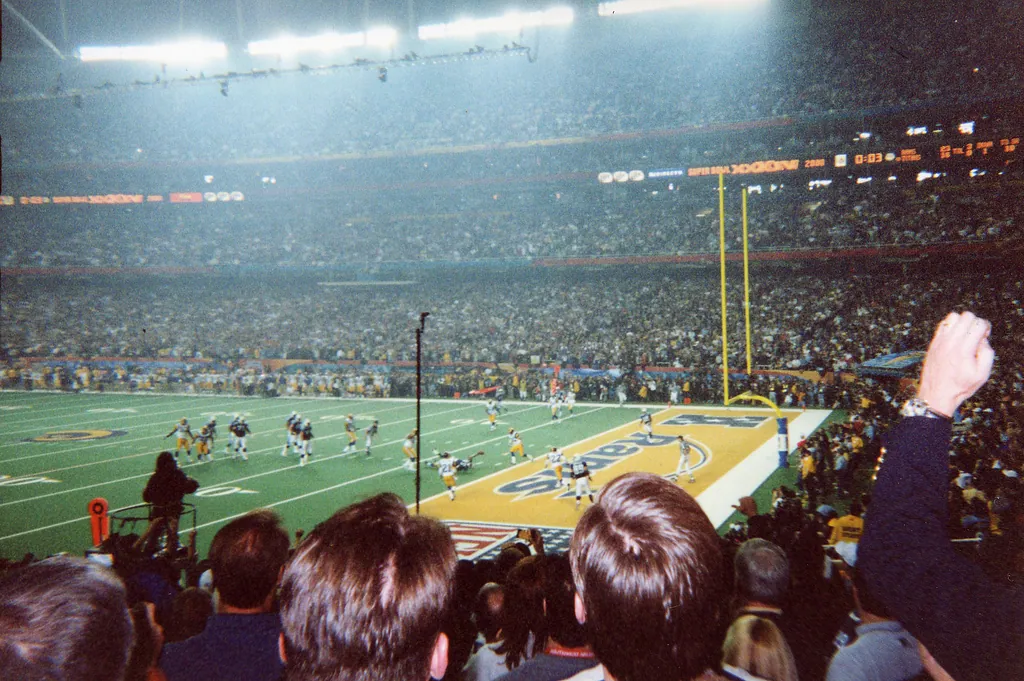
Super Bowl XXXIV was the championship game of the 1999 NFL season, played on January 30, 2000, at the Georgia Dome in Atlanta, Georgia. The game featured the NFC champion St. Louis Rams against the AFC champion Tennessee Titans, with the Rams winning 23-16 to claim their first Super Bowl title. This victory marked the franchise's first NFL championship since 1951. The contest is most remembered for its dramatic final play, where Rams linebacker Mike Jones tackled Titans receiver Kevin Dyson one yard short of the goal line as time expired. It remains the most recent Super Bowl in which both participating franchises were seeking their first Lombardi Trophy, and is often cited as one of the greatest Super Bowls of all time.
Host Selection and Pre-Game Conditions
NFL owners awarded Super Bowl XXXIV to Atlanta during a meeting on October 31, 1996, in New Orleans. The selection process involved bids from five cities: Miami, Atlanta, Tampa, Phoenix, and Los Angeles. The Los Angeles bid was dismissed due to concerns that planned stadium renovations would not be completed in time. Owners initially planned to select hosts for only Super Bowls XXXIII and XXXIV but added a third game, Super Bowl XXXV, after strong presentations. Miami, Atlanta, and Tampa were chosen to host XXXIII, XXXIV, and XXXV respectively. The decision was influenced in part by a sympathy vote for Atlanta Falcons owner Rankin Smith, who was terminally ill at the time. During the week of the game in January 2000, two ice storms struck the Atlanta area. Despite the adverse weather, city and state crews kept streets clear and public transport operational, and the indoor game at the Georgia Dome was unaffected.
The St. Louis Rams' 1999 Season
The Rams entered the 1999 season with low expectations, having won just five games in 1997 and four in 1998 under head coach Dick Vermeil. One national sports magazine predicted the Rams would finish as the worst team in the entire NFL that year. The season outlook changed dramatically when starting quarterback Trent Green suffered a season-ending knee injury in the preseason. His replacement was Kurt Warner, an undrafted quarterback who had played in the Arena Football League and NFL Europe. Warner led the league with a 109.2 passer rating, throwing for 4,353 yards and 41 touchdowns against 13 interceptions to win the NFL MVP award. The Rams' offense, coordinated by Mike Martz and nicknamed The Greatest Show on Turf, led the league in total yards (6,639) and scoring (526 points). Running back Marshall Faulk, acquired in an offseason trade, won the NFL Offensive Player of the Year award after gaining 2,429 total yards from scrimmage. He rushed for 1,381 yards and caught 87 passes for 1,048 yards, becoming the second player to record 1,000 yards both rushing and receiving in a season. The offensive line featured Pro Bowlers Orlando Pace and Adam Timmerman. Defensive end Kevin Carter led the NFL with 17 sacks, while Grant Wistrom added 8.5 sacks and returned two interceptions for touchdowns.
The Tennessee Titans' 1999 Season
The team played its first season in its new stadium, Adelphia Coliseum in Nashville. Coached by Jeff Fisher, the Titans finished with a 13-3 record, second in the AFC Central behind the 14-2 Jacksonville Jaguars. The offense was led by quarterback Steve McNair and running back Eddie George. McNair passed for 2,179 yards and 12 touchdowns despite missing five games due to injury, and he also rushed for 337 yards and eight scores. Backup Neil O'Donnell filled in capably, throwing for 1,382 yards and 10 touchdowns. Eddie George rushed for 1,304 yards, caught 47 passes, and scored 13 total touchdowns, earning his third consecutive Pro Bowl selection. Fullback Lorenzo Neal was a key blocker, while the receiving targets included tight end Frank Wycheck (69 receptions), wide receiver Kevin Dyson (54 receptions), and Yancey Thigpen (38 receptions). The offensive line was anchored by veteran Pro Bowl tackle Bruce Matthews. The Titans' defense was spearheaded by rookie defensive end Jevon Kearse, who recorded 14.5 sacks and eight forced fumbles on his way to winning Defensive Rookie of the Year. The secondary was led by cornerback Samari Rolle, who had a team-high four interceptions. The Titans' special teams unit featured returner Derrick Mason, who amassed 1,030 combined return yards. The team's three regular-season losses forced them to enter the playoffs as a wild card, setting up their dramatic postseason run.
Road Through the Playoffs
The Rams entered the playoffs as the NFC's top seed. In the divisional round, they hosted the Minnesota Vikings. In his first playoff game, Kurt Warner threw for 395 yards and five touchdowns as the Rams defeated the Vikings 49-37. Isaac Bruce caught four passes for 133 yards and a touchdown in the victory. The NFC Championship Game was a defensive battle against the Tampa Bay Buccaneers. The Rams won 11-6, with the only touchdown being a 30-yard pass from Warner to Ricky Proehl with 4:44 remaining. The Titans' playoff journey began as a wild card. They faced the Buffalo Bills in a game decided by the Music City Miracle. With 16 seconds left and trailing by one, the Titans executed a trick kickoff return where Frank Wycheck lateraled across the field to Kevin Dyson, who ran 75 yards for the game-winning touchdown. The play was reviewed and upheld, giving Tennessee a 22-16 win. In the divisional round, the Titans defeated the Indianapolis Colts 19-16 on the road, powered by a 162-yard rushing performance from Eddie George and four field goals by Al Del Greco. The Titans' defense forced six turnovers and dominated the second half, winning 33-14. Steve McNair rushed for 91 yards and two touchdowns, and Derrick Mason returned a kickoff 80 yards for a score to seal the victory.
Game Summary by Quarters
The first half was a story of Rams offensive movement paired with red zone struggles. St. Louis drove inside the Tennessee 20-yard line six times in the first half but came away with three field goals and one touchdown. The Rams' defense held firm, forcing a missed field goal attempt by Titans kicker Al Del Greco. The half ended with the Rams leading 16-0. In the third quarter, the Rams finally found the end zone. Kurt Warner connected with rookie wide receiver Torry Holt on a 9-yard touchdown pass, capping a drive to extend the lead to 16-0.
Tennessee running back Eddie George scored a touchdown run to cut the deficit. The Titans then successfully recovered an onside kick and capitalized on the opportunity with another drive, culminating in a second touchdown run by George. The extra point after the second touchdown was no good, leaving the score at 16-13. On the very first play of the ensuing Rams drive, Warner dropped back and launched a deep pass to Isaac Bruce, who caught it in stride and raced 73 yards for a touchdown to put St. Louis back ahead 23-16 with 1:54 left. The Titans mounted a final, desperate drive from their own 12-yard line. Steve McNair led the team down the field, converting a critical fourth down with a completion and scrambling for key yards. The drive reached the Rams' 10-yard line with six seconds remaining. On the game's final play, McNair completed a pass over the middle to wide receiver Kevin Dyson at the 5-yard line. Rams linebacker Mike Jones made the tackle, wrapping up Dyson and stopping him one yard short of the goal line as time expired.
Key Statistics and Super Bowl Records
Rams quarterback Kurt Warner was named Super Bowl MVP after a record-setting performance. He completed 24 of 45 passes for 414 yards, setting a new Super Bowl record for passing yards, and threw two touchdowns with no interceptions. Warner's 45 pass attempts without an interception also set a Super Bowl record. He became the first undrafted quarterback to win a Super Bowl and the sixth player to win both the Super Bowl MVP and NFL MVP awards in the same season. Isaac Bruce led all receivers with 162 yards on six catches, including the decisive 73-yard score. For the Titans, Eddie George rushed for 95 yards and two touchdowns. The Rams' defense sacked McNair four times.
Halftime Show and Pregame Entertainment
The halftime show for Super Bowl XXXIV featured performances by pop and R&B stars Christina Aguilera and Toni Braxton, rock musician Phil Collins, and Latin pop singer Enrique Iglesias. Actor Edward James Olmos served as a presenter for the segment. The pregame entertainment included a performance by country music singer Travis Tritt. The national anthem was sung by country star Faith Hill prior to kickoff. The ceremonial coin toss was handled by a group of individuals associated with Super Bowl IV, including former coaches and players from that game.
Broadcast Details and Cultural Impact
Super Bowl XXXIV was broadcast in the United States by ABC. The announcing team consisted of play-by-play announcer Al Michaels, color commentator Boomer Esiason, and sideline reporters Lesley Visser and Lynn Swann. The national radio broadcast was carried by Westwood One with Howard David, Matt Millen, and John Dockery calling the action. The game earned a Nielsen rating of 43.3, which translated to an estimated 88.5 million viewers and a 63 market share. A 30-second commercial during the broadcast cost advertisers $1.9 million. The game is often called the Dot-com Super Bowl due to the large number of advertisements purchased by internet companies during the peak of the dot-com bubble. This reflected the economic and cultural moment at the turn of the millennium. The high cost of advertising and massive viewership cemented the Super Bowl's status as the premier event for American television marketing.
Legacy and Historical Significance
Super Bowl XXXIV is consistently ranked among the greatest and most exciting Super Bowls ever played. It is remembered for the Titans' historic comeback from a 16-0 deficit, the record-setting performance by Kurt Warner, and the final-play tackle by Mike Jones. The game has been featured on NFL Films series such as NFL's Greatest Games under the title The Longest Yard. For the Rams, the victory capped a season and validated The Greatest Show on Turf offense. The game holds the distinction of being the most recent Super Bowl where neither team had previously won a Lombardi Trophy. The Rams' white and yellow uniforms worn in the game were their final appearance before a team rebranding the following season. Key elements of the game's lasting legacy include.
- The final-play tackle by Mike Jones to stop Kevin Dyson one yard short as time expired, a moment simply known as The Tackle.
- Kurt Warner's 414-yard passing performance, a Super Bowl record at the time.
- The Titans becoming the first team in Super Bowl history to erase a deficit of more than 10 points and tie the game.
- Isaac Bruce's 73-yard game-winning touchdown reception with 1:54 remaining.
- Its status as the Dot-com Super Bowl due to the era's advertising landscape.
- The fact that both teams finished the 1999 regular season with identical 13-3 records.
FAQ
Who won Super Bowl XXXIV in 2000?
The St. Louis Rams won Super Bowl XXXIV, defeating the Tennessee Titans by a score of 23-16. The game was played on January 30, 2000, at the Georgia Dome in Atlanta. The Rams claimed their first Super Bowl championship and their first NFL title since 1951 with the victory. The win concluded a season where the Rams improved from winning just four games in 1998 to a 13-3 record and the NFC's top seed.
What was the final play of Super Bowl XXXIV?
The final play of Super Bowl XXXIV is known as The Tackle or One Yard Short. With six seconds left and the Titans on the Rams' 10-yard line, Tennessee quarterback Steve McNair completed a pass to wide receiver Kevin Dyson over the middle. Rams linebacker Mike Jones tackled Dyson at the 1-yard line, stretching him out but preventing him from reaching the end zone as the clock hit zero. The play stopped a potential game-tying touchdown that could have forced overtime.
Who was the MVP of Super Bowl 34?
St. Louis Rams quarterback Kurt Warner was named the Most Valuable Player of Super Bowl XXXIV. Warner set a Super Bowl record with 414 passing yards, completing 24 of 45 attempts for two touchdowns and no interceptions. He was also the NFL's regular season MVP for the 1999 season. Warner became the first undrafted quarterback to win a Super Bowl and the sixth player to win both the Super Bowl MVP and NFL MVP awards in the same year.
Who performed at the Super Bowl XXXIV halftime show?
The Super Bowl XXXIV halftime show featured performances by Christina Aguilera, Toni Braxton, Phil Collins, and Enrique Iglesias. Actor Edward James Olmos served as a presenter for the show. The segment included a tribute to rock and soul legend Tina Turner, who also performed. The pregame national anthem was performed by country music star Faith Hill.
What were the team records for the Rams and Titans in 1999?
Both the St. Louis Rams and Tennessee Titans finished the 1999 NFL regular season with 13-3 records. The Rams won the NFC West division and secured the top seed in the NFC playoffs. The Titans finished second in the AFC Central behind the 14-2 Jacksonville Jaguars and entered the postseason as a wild card team. Both teams had improved from the previous season, with the Rams winning just four games in 1998.
What was the score of Super Bowl XXXIV and when was it played?
Super Bowl XXXIV ended with a final score of St. Louis Rams 23, Tennessee Titans 16. The game was played on January 30, 2000. It was held at the Georgia Dome in Atlanta, Georgia, and it determined the NFL champion for the 1999 season. The Rams' victory marked their first Super Bowl win and first NFL championship since 1951. This game is also notable as the most recent Super Bowl where both teams were seeking their first Super Bowl title.
Sources
- Super Bowl XXXIV (Wikipedia) Wikipedia
- Super Bowl XXXIV NFL
- THROWBACK PHOTOS: Take a look back at the Rams Super Bowl XXXIV victory therams.com
- Super Bowl XXXIV Flashback tennesseetitans.com
- Super Bowl XXXIV Facts for Kids kids.kiddle.co
- nflverse game, roster and draft data nflverse (CC BY 4.0)