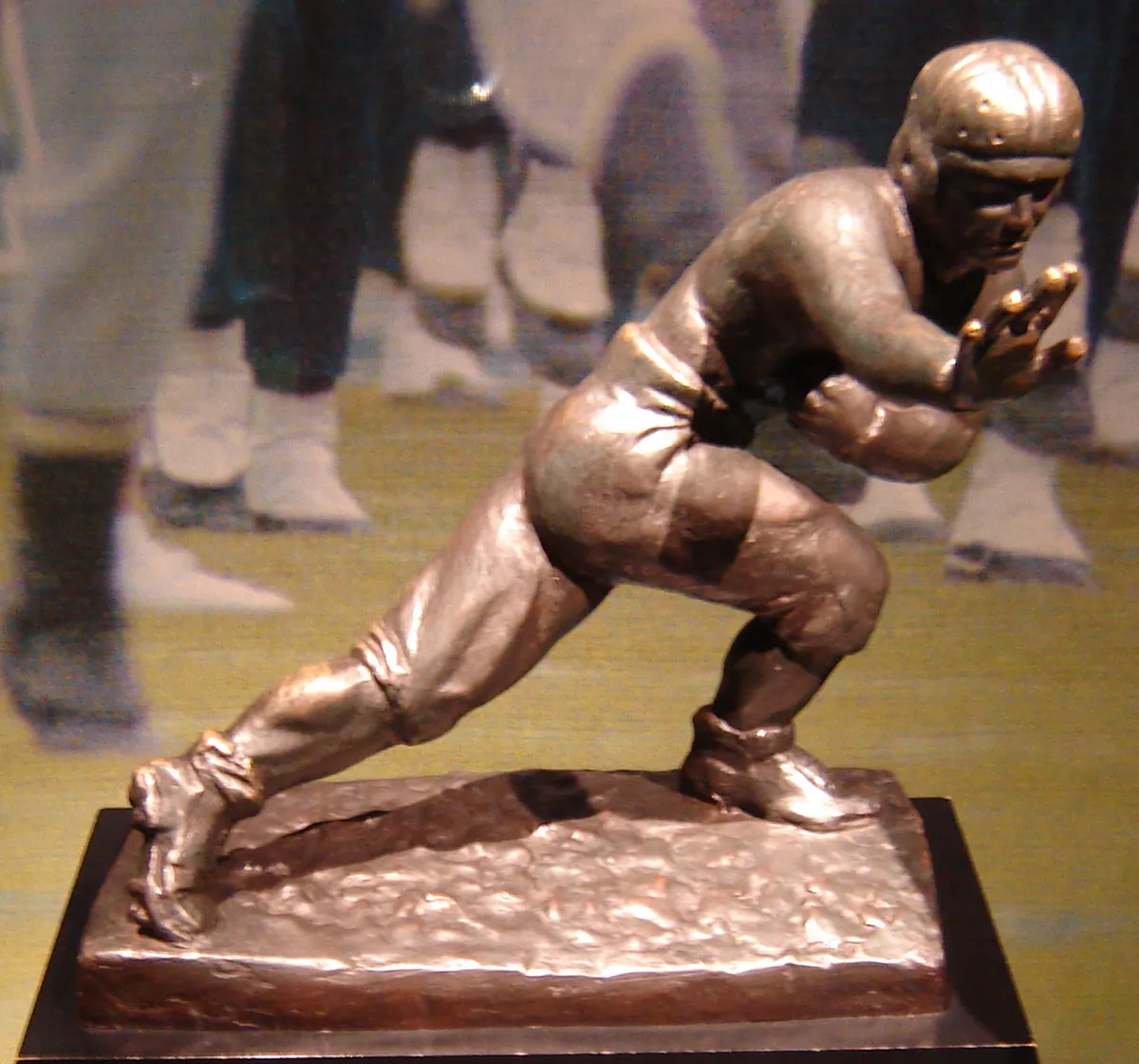
The Heisman Trophy is the most prestigious individual award in college football, presented annually to the player deemed the most outstanding. The winner is selected through a points-based vote by 870 sports journalists, every living former Heisman winner, and a single vote determined by a fan survey. First awarded in 1935 as the DAC Trophy, it was renamed in 1936 to honor the late athletic director John Heisman. The most recent recipient is Indiana quarterback Fernando Mendoza, who won the 2025 award. The trophy is a bronze statue modeled after former player Ed Smith and is presented each December.
What the Heisman Trophy Honors
The Heisman Memorial Trophy is awarded for outstanding performance that best exhibits the pursuit of excellence with integrity. Winners are intended to epitomize great ability combined with diligence, perseverance, and hard work. The award is given after the college football regular season concludes, typically in December. It recognizes the top player across all divisions of college football, though winners have almost exclusively come from the Football Bowl Subdivision. The trophy itself is a bronze statue of a football player in a stiff-arm pose, standing 13 inches tall and weighing 45 pounds. The sculpture was modeled after Ed Smith, a former New York University player, by artist Frank Eliscu. Smith did not realize the sculpture had become the Heisman Trophy until 1982, and the Downtown Athletic Club presented him with his own trophy in 1985.
The trophy has been manufactured by several companies over its history. From its inception in 1935, the statue was cast by Dieges & Clust until 1980. Since 2005 the trophy has been made by MTM Recognition in Del City, Oklahoma. The award is presented by the Heisman Trophy Trust, which took over from the Downtown Athletic Club in 2003. Since 1966, two trophies have been issued: one to the individual winner and a replica to his university.
Selection Process and Voters
The Heisman winner is chosen through a points-based voting system. Eligible voters include 870 sports journalists divided into six regions, every living former Heisman winner, and a single collective vote determined by a fan survey. Each voter ranks their top three selections, awarding three points for a first-place vote, two for second, and one for third. Voters must select three different players or their ballot is invalid. The accounting firm Deloitte tabulates the votes, with the process moving almost entirely online since 2007. The award originally only considered players east of the Mississippi River, but this geographic restriction was removed in 1936 when the award was renamed for John Heisman.
The voting regions are structured so each of the six areas receives 145 media votes, representing 16.67 percent of the total media vote each. This has led to discussions about regional bias, as the population distribution across these regions is not equal. For instance, the Far West region contains about 21.2 percent of the national population but receives the same number of votes as the Northeast, which has about 11.9 percent. Critics have argued this structure, combined with television coverage patterns and time zone differences, has historically disadvantaged players from West Coast schools. Between 1981 and 2002, no player from the Pac-10 Conference won the award, a drought broken by USC's Carson Palmer in 2002. The fan vote, conducted through a dedicated website and social media, constitutes one full vote weighted the same as any media member or former winner. There are currently 60 living former winners eligible to vote, though they are not required to participate. The system is designed so that sports journalists, deemed informed and impartial, are the primary determinants of the award.
History and Namesake John Heisman
The award was created by the Downtown Athletic Club in New York City and first presented in 1935 as the DAC Trophy. The inaugural winner was University of Chicago halfback Jay Berwanger, who was later drafted by the Philadelphia Eagles but never played professionally. Following the death of the club's athletic director, John Heisman, in 1936, the award was renamed in his honor. John Heisman was a player and coach who served as the DAC's athletic director. The trophy presentation was held at the Downtown Athletic Club from 1935 until 2000. After the club filed for bankruptcy and its neighborhood was impacted by the September 11 attacks, the ceremony moved to various New York venues.
The ceremony has been held at multiple locations including the New York Marriott Marquis, the Yale Club, and the Palladium Times Square. Due to the COVID-19 pandemic, the 2020 ceremony was a virtual event broadcast from ESPN headquarters in Bristol, Connecticut. Since 2021, the event has been held at the Appel Room at Jazz at Lincoln Center in New York. Television coverage has included broadcasts on CBS from 1977 to 1980 and from 1986 to 1990, on syndication from 1981 to 1985, and on ESPN from 1994 to the present. The most-watched ceremony was in 2009 for Mark Ingram II's win.
The first African American player to win the Heisman was Syracuse running back Ernie Davis in 1961. Davis died of leukemia in 1963 before playing a professional down. In a notable gesture in 1966, winner Steve Spurrier gave his trophy to the University of Florida president so it could be shared by the university community, prompting the school to fund a replacement for him. Several older trophies have been sold, with the record price belonging to the trophy won by Minnesota halfback Bruce Smith in 1941, which sold for $395,240. O.J. Simpson's 1968 trophy sold for $230,000 in 1999.
Records and Notable Winners
Ohio State running back Archie Griffin is the only player to win the Heisman Trophy twice, capturing the award in 1974 and 1975. The University of Southern California leads all schools with eight winners. Ohio State, Oklahoma, and Notre Dame are tied for second with seven winners each. A school has had a Heisman winner in back-to-back years six times: Yale in 1936 and 1937, Army in 1945 and 1946, Ohio State in 1974 and 1975, USC in 2004 and 2005, Oklahoma in 2017 and 2018, and Alabama in 2020 and 2021. The closest margin of victory occurred in 2009 when Alabama's Mark Ingram II edged Stanford's Toby Gerhart.
Ten Heisman Trophy winners are in the Pro Football Hall of Fame. Some winners, like Bo Jackson and Charlie Ward, achieved significant success in other professional sports. Two winners, Pete Dawkins and Dick Kazmaier, did not pursue professional sports careers, instead building distinguished careers in the military and business, respectively. The youngest winner ever is Lamar Jackson, who was 19 years and 338 days old when he won in 2016. The oldest winner is Chris Weinke, who was 28 when he won in 2000 after a minor league baseball career.
- School with most winners: USC (8).
- Closest vote: 2009 (Mark Ingram II over Toby Gerhart).
- First freshman winner: Johnny Manziel (Texas A&M, 2012).
- First winner: Jay Berwanger (Chicago, 1935).
- First African American winner: Ernie Davis (Syracuse, 1961).
- Only primarily defensive winners: Charles Woodson (1997) and Travis Hunter (2024).
- Players who finished second twice: Glenn Davis, Charlie Justice, Darren McFadden, Andrew Luck.
Winners by Position and Class Trends
The Heisman Trophy has historically been awarded to offensive backs, with quarterbacks and running backs dominating the winners' list. Only four wide receivers have won: Tim Brown in 1987, Desmond Howard in 1991, DeVonta Smith in 2020, and Travis Hunter in 2024. Two tight ends, Larry Kelley in 1936 and Leon Hart in 1949, have also won. No interior lineman on offense or defense has ever won the award, though several have finished as high as second place, such as defensive end Hugh Green in 1980 and linebacker Manti Te'o in 2012.
For most of its history, the award was given to seniors. The trend shifted in the 21st century with younger winners. Texas A&M quarterback Johnny Manziel became the first freshman to win in 2012, followed by Florida State's Jameis Winston in 2013. Both were redshirt freshmen. The first sophomore winner was Florida's Tim Tebow in 2007, breaking a 72-year streak. He was followed by consecutive sophomore winners Sam Bradford in 2008 and Mark Ingram II in 2009. Lamar Jackson became the fourth sophomore winner in 2016. Five players finished in the top three of the voting as freshmen or sophomores before later winning the award as upperclassmen, including Doc Blanchard and Herschel Walker.
While some young players eventually won the award, eight others finished in the top three as freshmen or sophomores but never secured a Heisman victory. This group includes notable names such as Marshall Faulk, Michael Vick, Rex Grossman, Larry Fitzgerald, Adrian Peterson, Deshaun Watson, and Christian McCaffrey. The award has seen stretches dominated by certain positions, such as 11 consecutive running back winners from 1972 to 1982, broken by Boston College quarterback Doug Flutie in 1984. Quarterbacks have frequently won the award in the 2000s, including winners like Carson Palmer, Matt Leinart, and Tim Tebow.
Recent Heisman Trophy Winners (2016 to 2025)
Fernando Mendoza's win in 2025 marked the first Heisman Trophy for Indiana University. The 2024 winner, Travis Hunter, was notable for being the second primarily defensive player to win the award and the first to do so while playing both wide receiver and defensive back. Oklahoma produced back-to-back winners in 2017 and 2018 with Baker Mayfield and Kyler Murray, the sixth time a school achieved that feat. Alabama also had consecutive winners with DeVonta Smith in 2020 and Bryce Young in 2021.
| Year | Winner | School | Position |
|---|---|---|---|
| 2016 | Lamar Jackson | Louisville | Quarterback |
| 2017 | Baker Mayfield | Oklahoma | Quarterback |
| 2018 | Kyler Murray | Oklahoma | Quarterback |
| 2019 | Joe Burrow | LSU | Quarterback |
| 2020 | DeVonta Smith | Alabama | Wide Receiver |
| 2021 | Bryce Young | Alabama | Quarterback |
| 2022 | Caleb Williams | USC | Quarterback |
| 2023 | Jayden Daniels | LSU | Quarterback |
| 2024 | Travis Hunter | Colorado | Wide Receiver/Defensive Back |
| 2025 | Fernando Mendoza | Indiana | Quarterback |
Controversies and the 2005 Award
The Heisman Trophy has not been without controversy, particularly regarding the 2005 award given to USC running back Reggie Bush. In 2010, following an NCAA investigation that found Bush had received impermissible benefits while in college, he voluntarily forfeited his Heisman. The Heisman Trust announced the 2005 award would remain vacated and removed all mention of it from its official website. Bush returned the physical trophy to the Trust in 2012. The decision was met with significant criticism from media members who felt the punishment came too late or was unfairly applied to the player alone.
In April 2024, the Heisman Trust formally reinstated Reggie Bush's trophy and returned him to the official list of winners. The Trust cited fundamental changes in the college football landscape, including new rules allowing student-athlete compensation and a 2021 Supreme Court decision against the NCAA, as reasons for the reversal. Other controversies have centered on perceived regional bias against West Coast players and the voting system's structure. A gap between non-USC West Coast winners, from Stanford's Jim Plunkett in 1970 to Oregon's Marcus Mariota in 2014, fueled this debate. Several Stanford players, including Andrew Luck and Christian McCaffrey, finished second during that period.
Heisman Trophy Ceremony Venues and Broadcast
The location of the Heisman Trophy presentation has changed several times throughout its history. From 1935 to 2000, the ceremony was held at the Downtown Athletic Club in Lower Manhattan. After the September 11 attacks limited access to the area, the 2001 event moved to the New York Marriott Marquis. Following the DAC's bankruptcy in 2002, the ceremony was held at the Yale Club in 2002 and 2003, then at the Hilton New York in 2004. From 2005 until its closure in 2019, the presentation was held at Palladium Times Square, except in 2017 when it was moved back to the Marriott Marquis. Since 2021, the in-person ceremony has been held at Jazz at Lincoln Center.
Television coverage of the award has also evolved. Before 1977, the presentation was not a stand-alone special but a quick in-game feature, usually at halftime of the last major national telecast on ABC. CBS broadcast the ceremonies from 1977 to 1980 and again from 1986 to 1990. Coverage also aired on syndication from 1981 to 1985 and on NBC owned-and-operated stations in 1985. ESPN has held the broadcast rights since 1994 and currently airs the ceremony live. The 2008 Heisman press conference was held at the now-closed Sports Museum of America, which featured a gallery dedicated to the trophy.
Statistical Performance Records
While the Heisman honors overall excellence, some winners have posted notable statistical seasons. According to Heisman.com records, the highest yards per play for a winner since 1999 belongs to Jayden Daniels, who averaged 10.71 yards per play in his 2023 winning season. He is followed by Kyler Murray (10.68 in 2018) and Baker Mayfield (10.24 in 2017). The award has seen periods of positional streaks, such as 11 straight running back winners from 1972 to 1982. Several players have come close to winning multiple times. Four players have finished second in the voting in consecutive years: Army's Glenn Davis (1944, 1945), North Carolina's Charlie Justice (1948, 1949), Arkansas's Darren McFadden (2006, 2007), and Stanford's Andrew Luck (2010, 2011). Oklahoma's Jason White, who won in 2003, is the last Heisman winner to go undrafted. Four winners have also been named Most Valuable Player in a Super Bowl. The award has seen winners from a variety of conferences, with USC's eight wins leading the Pac-12 tradition and schools like Ohio State and Oklahoma representing the Big Ten and Big 12 conferences prominently.
Video
FAQ
Who just won the Heisman Trophy?
The most recent Heisman Trophy winner is Indiana quarterback Fernando Mendoza, who won the award in 2025. Mendoza is the first player from Indiana University to receive the honor. He was selected first overall in the 2026 NFL Draft. The winner before Mendoza was Colorado's Travis Hunter, a two-way player at wide receiver and defensive back, who won in 2024.
Who votes for the Heisman Trophy?
Three groups contribute to the Heisman Trophy vote. The largest bloc is 870 sports journalists divided into six geographic regions. Every living former Heisman winner also has a vote. Finally, a single vote is determined by a fan survey conducted online. Each voter ranks their top three choices, awarding three points for first place, two for second, and one for third. The accounting firm Deloitte tabulates all the ballots.
Has anyone won the Heisman Trophy twice?
Yes, only one player has won the Heisman Trophy twice. Ohio State running back Archie Griffin won the award in back-to-back seasons in 1974 and 1975. No other player has accomplished this feat. Six schools have had winners in consecutive years, including USC, Oklahoma, and Alabama most recently. Griffin's record of two wins remains unique in the award's history.
What position wins the Heisman most often?
Quarterbacks and running backs win the Heisman Trophy most often. These offensive back positions have claimed the vast majority of awards. Only four wide receivers have ever won: Tim Brown, Desmond Howard, DeVonta Smith, and Travis Hunter. Two tight ends have won, and only two primarily defensive players have won, both defensive backs. No interior lineman on either offense or defense has ever won the Heisman.
Who was the first freshman to win the Heisman?
The first freshman to win the Heisman Trophy was Texas A&M quarterback Johnny Manziel in 2012. Manziel was a redshirt freshman, meaning he practiced but did not play in games during his first year of college. The following year, Florida State quarterback Jameis Winston, also a redshirt freshman, won the award in 2013. No true freshman, who plays in their first year of college attendance, has won the Heisman.
What schools have the most Heisman Trophy winners?
The University of Southern California has the most Heisman Trophy winners with eight. Ohio State, Oklahoma, and Notre Dame are tied for second with seven winners each. Ohio State has had six different players win its seven awards, as Archie Griffin won twice. Schools with multiple winners include several with three or more, such as Army, Florida, and Michigan.
Further reading
- About the Heisman Heisman Trophy Trust. The trust that awards the trophy explains its history and the voting process.
Sources
- Heisman Trophy (Wikipedia) Wikipedia
- Heisman Trophy winners, runners-up since 1935 NCAA
- Heisman Trophy winners of past 25 years power rankings NFL
- Heisman Trophy winners, 1935 to 2014 projects.oregonlive.com