The New Hampshire Wildcats football program represents the University of New Hampshire in NCAA Division I Football Championship Subdivision (FCS) competition. Founded in 1893, the team has competed annually with only brief interruptions during the World Wars. The Wildcats are members of the Coastal Athletic Association (CAA) and play their home games at Wildcat Stadium in Durham. The program has an all-time record of 623 wins, 514 losses, and 54 ties, has made 19 FCS playoff appearances, and has produced 36 Consensus All-Americans. As of the 2026 season, the team is led by first-year head coach Sean Goldrich.
Program Founding and Early History
The New Hampshire Wildcats played their first football game on November 4, 1893, traveling to Newmarket for the contest. For its first three decades, the program operated as an independent entity without a formal head coach. From 1893 through 1901, teams were organized without a designated head coach, compiling a record of 16 wins, 32 losses, and 2 ties over 50 games. The university appointed its first formal head coach, John Scannell, for the 1902 season. Early schedules were irregular and often featured games against high school, military, and local college teams. The program survived the suspensions of play during World War I and World War II, with a limited four-game schedule in 1944 featuring 17-year-olds and returning veterans.
Conference Affiliation History
The Wildcats have been members of five conferences throughout their history. They began as an independent program from 1893 through 1922. In 1923, they helped found the New England Conference, where they remained until 1946. When the Yankee Conference football league was absorbed, New Hampshire moved to the Atlantic 10 Conference for football from 1997 through 2006. Since the 2007 season, the Wildcats have been a football-only member of the Coastal Athletic Association, commonly known as the CAA, which is one of the premier conferences in the FCS. This conference affiliation has provided the platform for their sustained playoff success in the 21st century.
Head Coaching Eras and Records
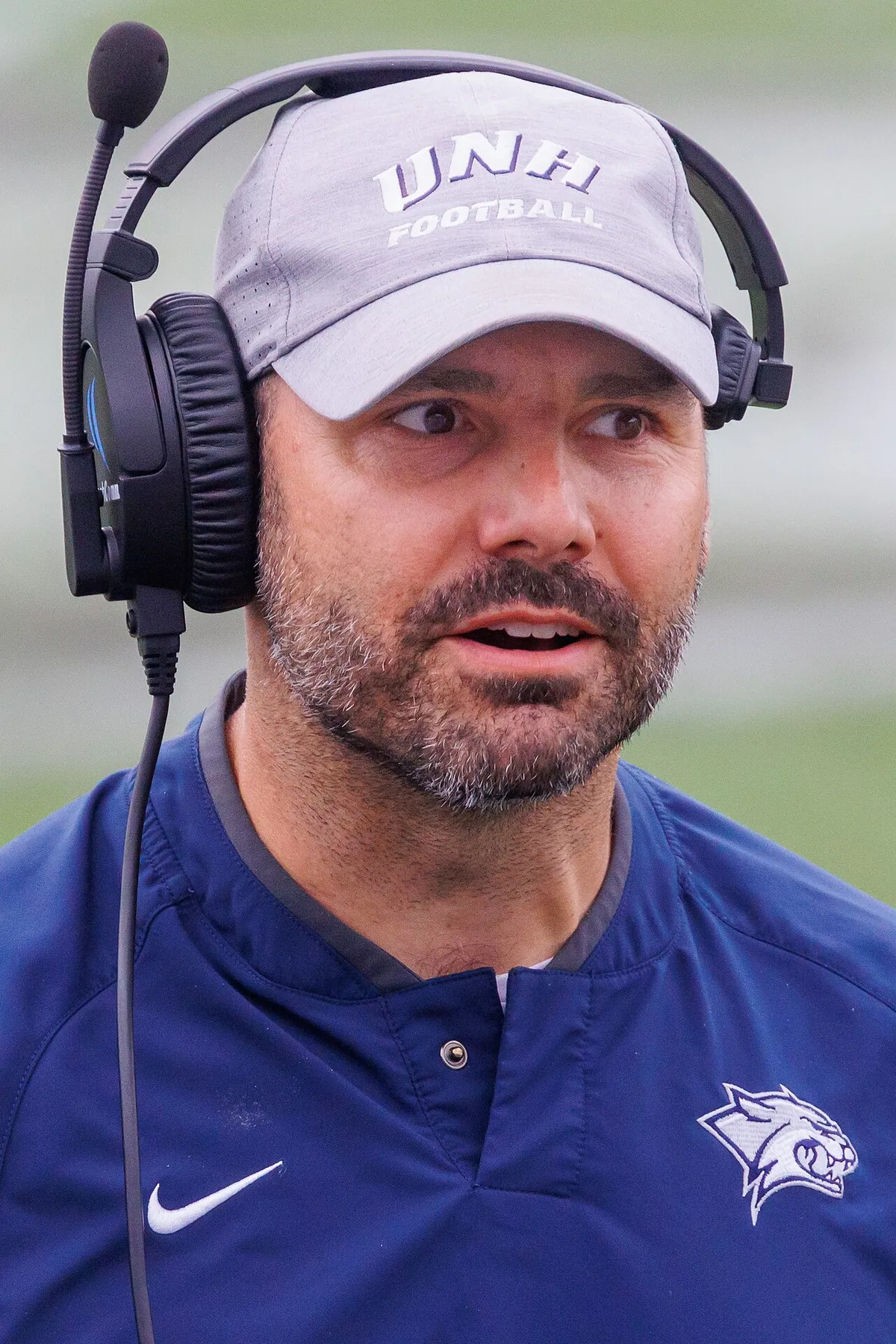
The program's modern identity was shaped by several long-tenured and successful head coaches. Butch Cowell, who coached from 1915 to 1936 with a break for World War I, was the first to bring stability, amassing 87 wins. Bill Bowes, head coach from 1972 to 1998, is the program's all-time wins leader and a College Football Hall of Fame inductee. Bowes compiled a 175-106-5 record, won four conference titles, and guided the team to playoff appearances. Sean McDonnell, a former Wildcat player, led the program from 1999 to 2021, posting a 157-104 record. McDonnell's teams won two conference championships and made 14 FCS playoff appearances, reaching the national semifinals in 2013 and 2014. Ricky Santos, the star quarterback of those playoff teams, served as head coach from 2022 to 2025, winning one conference title. Sean Goldrich, another former UNH quarterback, took over as head coach for the 2026 season.
| Coach | Years | Overall Record | Conference Titles | Playoff Record |
|---|---|---|---|---|
| Bill Bowes | 1972 to 1998 | 175-106-5 | 4 | 4-4 |
| Sean McDonnell | 1999 to 2021 | 157-104-0 | 2 | 14-14 |
| Ricky Santos | 2022 to 2025 | 37-24-0 | 1 | 1-3 |
| Sean Goldrich | 2026 to present | 5-7-0 | 0 | 0-0 |
Championships and Postseason History
The program has never won an NCAA national championship. Its postseason history includes appearances in the Division II playoffs in the 1970s and extensive participation in the FCS playoffs since 1991. The Wildcats have qualified for the FCS playoffs 19 times, playing 34 games with a 15-19 record. The deepest playoff runs came in 2013 and 2014 under Sean McDonnell, when the team advanced to the national semifinals. In 2013, they defeated Lafayette, Maine, and Southeastern Louisiana before falling to North Dakota State. The following year, they beat Fordham and Chattanooga before a narrow loss to Illinois State in the semifinals. The team also participated in one bowl game, the 1947 Glass Bowl, where they lost to Toledo 20-14.
- Conference Championships: multiple.
- FCS Playoff Appearances: 19 (first in 1991).
- FCS Playoff Record: 15 wins, 19 losses.
- Best FCS Finish: National Semifinals (2013, 2014).
- Bowl Game Appearances: 1 (1947 Glass Bowl).
Home Stadium: Wildcat Stadium
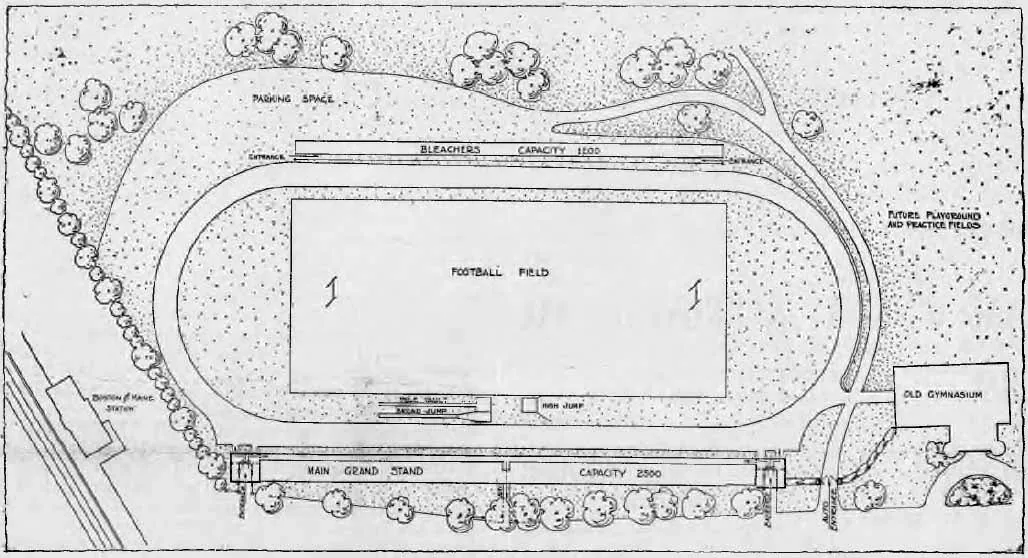
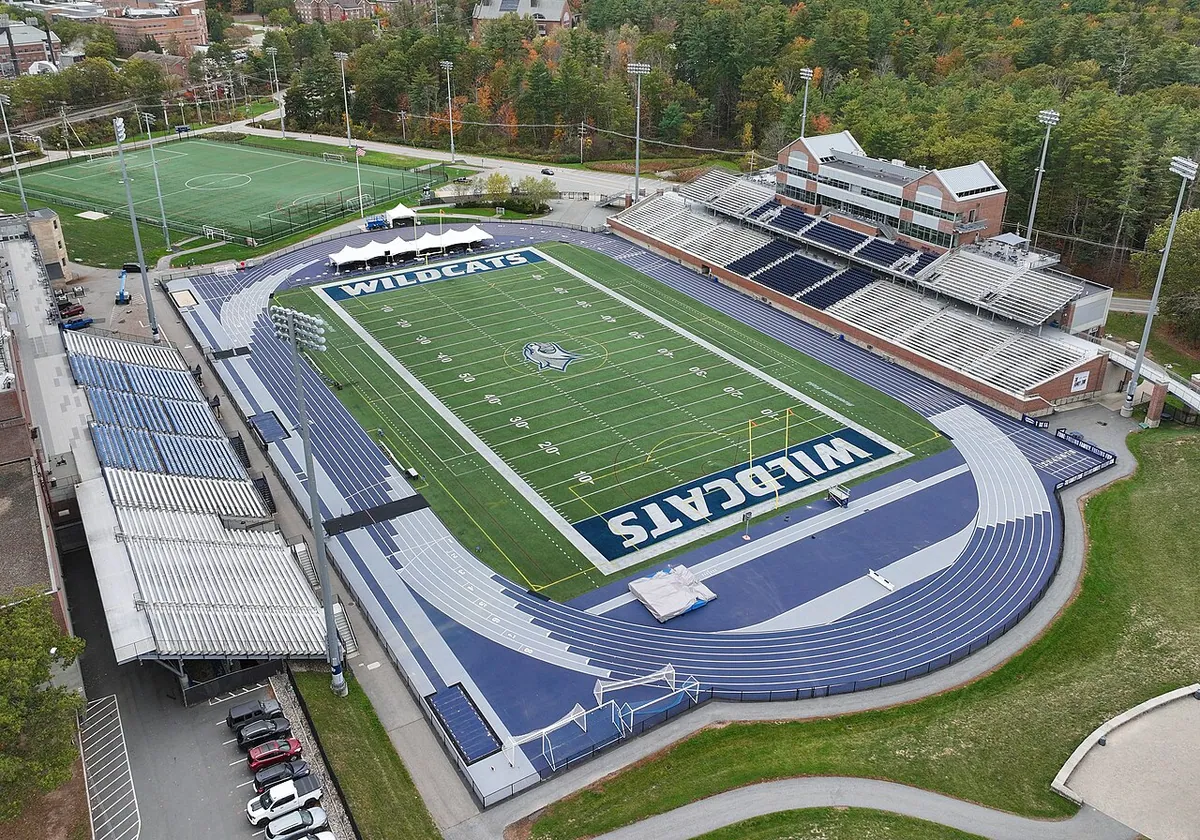
The Wildcats have played their home games at their current stadium site since 1936. The facility opened on September 26, 1936, as Lewis Field and was dedicated on October 10, 1936, in a game against rival Maine. It was renamed Cowell Stadium in 1952 in honor of former coach Butch Cowell and retained that name for over six decades. In 2016, the stadium underwent a significant renovation and was renamed Wildcat Stadium. The modern venue has a seating capacity of 11,015 spectators. A notable addition was a new video scoreboard funded in part by a controversial $1 million allocation from a $4 million donation by university librarian Robert Morin in 2015. Prior to 1936, the team played at Memorial Field from 1921 to 1935.
Notable NFL Players and Alumni
While no Wildcat has won the Heisman Trophy, the program has sent 29 players to the NFL since 1974, with 10 of those being drafted. No New Hampshire player has been selected in the first round of the NFL Draft. Notable NFL alumni include defensive back Jerry Azumah, who played for the Chicago Bears from 1999 to 2005. Wide receiver David Ball had a notable career at UNH before a brief NFL career. Linebacker Dwayne Gordon played in the NFL. In recent years, running back Dylan Laube was drafted by the Las Vegas Raiders in 2024. As of the 2026 NFL season, three Wildcats are on active rosters: Laube, defensive back Wande Owens (Buffalo Bills), and quarterback Max Brosmer (Minnesota Vikings). The program has also produced notable coaches, including Ohio State head coach Ryan Day, who played quarterback at UNH, and Chip Kelly, who played defensive back at UNH and became an NCAA and NFL coach.
Main Rivalries
The Wildcats maintain three primary football rivalries. The most prominent is with the Maine Black Bears, a series that began in 1903 and has been played annually since 1922 with few exceptions. The rivalry with the Massachusetts Minutemen dates to 1897, though it has been dormant since UMass moved to the FBS in 2011. The winner of that matchup was awarded the Bill Knight Trophy from 1986 onward. The third rivalry is with the Dartmouth Big Green, an Ivy League opponent, with the most recent meeting occurring in 2025. These games represent some of the longest continuously played series in New England college football history.
Recent Seasons and Current Era
Under head coach Ricky Santos from 2022 to 2025, the Wildcats remained competitive in the CAA, winning the conference championship in 2022. That season, they defeated Fordham in the first round of the FCS playoffs before losing to Holy Cross in the second round. The team returned to the playoffs in 2024 and 2025, suffering first-round losses to UT Martin and South Dakota State, respectively. Sean Goldrich, the starting quarterback for the 2014 semifinal team, was hired as head coach prior to the 2026 season. In his first year, Goldrich led the team to a 5-7 overall record and a 4-4 mark in CAA play, missing the postseason. The program continues to schedule challenging non-conference games, including future matchups against FBS opponents Syracuse in 2026, Ohio State in 2027, and Boston College in 2028. The Wildcats made playoff appearances each year from 2004 to 2017.
NFL players from New Hampshire
| Player | Pos | Years | Main team |
|---|---|---|---|
| Corey Graham | FS | 2007–2018 | Chicago Bears |
| Jerry Azumah | CB | 1999–2005 | Chicago Bears |
| Dan Kreider | FB | 2000–2009 | Pittsburgh Steelers |
| Dwayne Gordon | LB | 1993–2000 | New York Jets |
| Bruce Huther | MLB | 1977–1983 | Dallas Cowboys |
| Randal Williams | TE | 2001–2006 | Dallas Cowboys |
| Steve Doig | LB | 1982–1987 | Detroit Lions |
| Ilia Jarostchuk | LB | 1987–1991 | New England Patriots |
| Dylan Laube | RB | 2024– | Las Vegas Raiders |
| Dwayne Sabb | OLB | 1992–1996 | New England Patriots |
| Max Brosmer | QB | 2025– | Minnesota Vikings |
| Andrew Lauderdale | OT | 2017–2020 | San Francisco 49ers |
| Dave Rozumek | LB | 1976–1979 | Kansas City Chiefs |
| Jason Ball | C | 2002–2004 | San Diego Chargers |
| Scott Curtis | ILB | 1988–1990 | Denver Broncos |
Video
FAQ
What conference is New Hampshire football in?
The New Hampshire Wildcats football team competes in the Coastal Athletic Association (CAA). They have been a football-only member of this conference since the 2007 season. Prior to that, they were members of the Atlantic 10 Conference from 1997 to 2006, the Yankee Conference from 1947 to 1996, and the New England Conference from 1923 to 1946. The CAA is widely regarded as one of the top conferences in the Football Championship Subdivision (FCS).
Who is the head coach of New Hampshire football?
As of the 2026 season, the head coach of the New Hampshire Wildcats is Sean Goldrich. Goldrich, a former Wildcats quarterback who led the team to the 2014 FCS semifinals, is in his first season as head coach. He succeeded Ricky Santos, who was head coach from 2022 to 2025. The most successful and longest-tenured coaches in program history are Bill Bowes from 1972 to 1998, a College Football Hall of Famer, and Sean McDonnell from 1999 to 2021, who guided the team to 14 playoff appearances.
Has UNH won a national championship in football?
No, the University of New Hampshire has never won an NCAA national championship in football. The program's best postseason finishes were appearances in the FCS national semifinals in 2013 and 2014. The Wildcats have won 10 conference championships across the Yankee Conference, Atlantic 10, and CAA. They have also participated in the Division II playoffs in the 1970s and have made 19 appearances in the FCS playoffs since 1991.
Who are New Hampshire's main football rivals?
New Hampshire's primary football rival is the Maine Black Bears. The teams have played for the Brice-Cowell Musket since 1948, and it is one of the oldest continuous rivalries in FCS football. A historic rivalry also exists with the Massachusetts Minutemen, though the series has been inactive since UMass moved to the FBS in 2011. The Wildcats also maintain a rivalry with the Dartmouth Big Green of the Ivy League, with games played intermittently throughout their history, most recently in 2025.
What is the name and capacity of New Hampshire's current football stadium?
The New Hampshire Wildcats play their home games at Wildcat Stadium, which has a capacity of 11,015. The stadium was originally known as Lewis Stadium when it opened in 1936, with its first game on September 26 of that year. It was later named Cowell Stadium from 1952 until it was renamed Wildcat Stadium in 2016. The team has played at this location in Durham since 1936.
What is New Hampshire's all time win loss record in football?
The New Hampshire Wildcats have an all time record of 623 wins, 514 losses, and 54 ties, which is a winning percentage of .546. The program has been competing since 1893. This record includes games across various conference affiliations and NCAA divisions. The team has also produced 36 Consensus All Americans throughout its history.
Sources
- New Hampshire Wildcats football (Wikipedia) Wikipedia
- New Hampshire Wildcats Logos History, NCAA n-r sportslogos.net
- nflverse game, roster and draft data nflverse (CC BY 4.0)