The Oklahoma Sooners football program represents the University of Oklahoma in NCAA Division I FBS competition. Founded in 1895, the Sooners are one of the most successful programs in college football history, claiming seven national championships and 50 conference titles. The team plays its home games at Gaylord Family Oklahoma Memorial Stadium in Norman and has produced seven Heisman Trophy winners. As of 2026, the Sooners compete in the Southeastern Conference (SEC) under head coach Brent Venables.
Program Founding and Early History
Student John A. Harts organized the first team, which played its only game on December 14, 1895, losing 34-0 to a more experienced team from Oklahoma City. The program operated without a dedicated coach for the 1896 season. In 1897, professor Vernon Louis Parrington, a Harvard football alumnus, became head coach and compiled a 9-2-1 record over four seasons before stepping down to focus on teaching. The early years saw several short-term coaches, including Fred Roberts (3-2 in 1901), Mark McMahon (11-7-3 from 1902-03), and Fred Ewing (4-3-1 in 1904). The 1904 season featured the inaugural Bedlam Series game against Oklahoma A&M, which the Sooners won 75-0.
Bennie Owen, the program's first long-term head coach, had been a quarterback for the undefeated 1899 Kansas Jayhawks and had previously coached under Fielding Yost at Michigan. His first two years were split between Norman and Arkansas City due to budgetary constraints. Despite this, Owen's teams found early success, including a 2-0 victory over rival Texas in 1905, the program's first win in eight attempts against the Longhorns. Owen's 1908 team finished 8-1-1, losing only to an undefeated Kansas team. His 1911 squad went 8-0, relying on a fast-paced offensive style.
The Bennie Owen Era (1905 to 1926)
Bennie Owen coached the Sooners for 22 seasons, establishing the program's first period of sustained success. His teams achieved undefeated seasons in 1915 and 1918. In 1920, Oklahoma moved from the Southwest Conference to the Missouri Valley Intercollegiate Athletic Association, winning the conference title in its first season with a 6-0-1 record. Owen retired after the 1926 season with an overall record of 122-54-16, a .677 winning percentage. He won three conference championships and had four undefeated seasons during his tenure. In 1951, Owen became Oklahoma's first inductee into the College Football Hall of Fame.
Between Owen and Wilkinson (1927 to 1946)
Adrian Lindsey succeeded Owen in 1927 and went 19-19-6 in five seasons, a stretch that included a 20-7 win over Nebraska in 1930. Lawrence 'Biff' Jones coached for two seasons, going 9-6-3 and later being inducted into the Hall of Fame. Dewey "Snorter" Luster coached from 1941 to 1945, winning two conference titles with a 27-18-3 record. Jim Tatum was hired as head coach for the 1946 season, going 8-3 and winning the Gator Bowl . Tatum left after one season for Maryland, but he had brought assistant Bud Wilkinson with him to Norman. University athletic director Lawrence Haskell was particularly impressed with Wilkinson during the hiring process. When Tatum departed, Wilkinson was promoted to head coach, beginning one of the most dominant eras in college football history.
The Bud Wilkinson Dynasty (1947 to 1963)
Bud Wilkinson took over as head coach in 1947 and immediately established Oklahoma as a national power. In his first 11 years, his teams went 114-10-3, a .909 winning percentage. This period included winning streaks of 31 and 47 games. Wilkinson's Sooners claimed national championships in 1950, 1955, and 1956. From 1946 to 1959, Oklahoma won 14 consecutive conference titles, a streak that began under Jim Tatum and continued through 13 of Wilkinson's seasons. Wilkinson retired after the 1963 season with a record of 145-29-4, 14 conference titles, and 123 consecutive games without being shut out.
A significant social milestone occurred during Wilkinson's tenure when Prentice Gautt became the first black football player at the University of Oklahoma. Gautt was a standout from Douglass High School in Oklahoma City and was twice named to the All-Conference team. He scored a touchdown in the 1959 Orange Bowl . Some teammates initially resisted playing with him, but most supported him, including an instance where the entire team left a restaurant in Tulsa that refused to serve him.
The 47-Game Winning Streak
From October 1953 to November 1957, no college football team could beat Oklahoma, resulting in 47 straight victories, the longest winning streak in Division I history. The streak began after a loss to Notre Dame and a tie with Pitt to open the 1953 season and continued through perfect 10-0 and 11-0 seasons in 1954 and 1955. The 1955 team won the national championship. The streak reached 40 games at the start of the 1957 season, and the Sooners won their first seven games that year before falling to Notre Dame on November 16, 1957. During the 47-game streak, Oklahoma outscored its opponents 1,620 to 269 and recorded 23 shutouts. Quarterback Jimmy Harris started 25 games during this period and never lost a game.
The record has never been seriously challenged in the decades since. The closest any FBS school has come since is a 35-game streak. Harris and Toledo's Chuck Ealey are the only two FBS quarterbacks to make at least 25 starts without a loss. The 14 consecutive conference titles won from 1946 to 1959 included this entire period, with the team's conference record blemished only by two ties.
Coaches Jones, Mackenzie, and Fairbanks (1964 to 1972)
Following Wilkinson's retirement, his assistant Gomer Jones was promoted to head coach but struggled to maintain the same level of success. After Jones went 3-7 in his second season, Arkansas assistant Jim Mackenzie replaced him, set a curfew, required players to enroll in a physical education class, and led the team to a 6-4 record that included a win over rival Texas. Tragically, Mackenzie died of a heart attack on April 28, 1967, at age 37. Assistant Chuck Fairbanks succeeded him. Fairbanks' first season in 1967 was highly successful, as the Sooners went 10-1, beat second-ranked Tennessee in the Orange Bowl, and finished the season ranked third nationally. The next three seasons saw four losses each, but a highlight was running back Steve Owens winning the Heisman Trophy in 1969. Fairbanks and offensive coordinator Barry Switzer were early adopters of the wishbone offense in the early 1970s, a run-based scheme that would define the next era of Oklahoma football.
The Barry Switzer Era (1973 to 1988)
Barry Switzer ascended to head coach in 1973, beginning a 16-year tenure marked by extraordinary success and controversy. His start was overshadowed by a scandal involving the alteration of a player's transcript, leading to the forfeiture of eight 1972 wins, a two-year bowl ban (1973-74), and a two-year television ban (1974-75). Despite these sanctions, Switzer's teams were dominant. From 1973 to 1975, Oklahoma went 32-1-1, winning three straight conference championships and claiming back-to-back national championships in 1974 and 1975, the two years they were banned from television during the regular season. Switzer's Oklahoma teams won 157 games over his 16 seasons. He won three national titles and multiple conference championships. His 1985 team won the program's sixth claimed national championship.
National and Conference Championships
The Oklahoma Sooners claim seven consensus national championships, awarded by the Associated Press and/or coaches polls. These titles came in 1950, 1955, 1956, 1974, 1975, 1985, and 2000. The 2000 championship was secured under the Bowl Championship Series (BCS) format. According to NCAA records, which recognize selections from various organizations, the Sooners have been named national champion in 17 different seasons, including 1915, 1949, 1953, 1957, 1967, 1973, 1978, 1980, 1986, and 2003 in addition to their seven claimed titles. The program's dominance is further illustrated by its 50 conference championships, spanning the Southwest Conference, Missouri Valley, Big Six/Seven/Eight, and Big 12 . Since 2001, the Sooners have won 13 Big 12 championships.
- Claimed National Championships: 1950, 1955, 1956, 1974, 1975, 1985, 2000.
- Most Recent National Championship: 2000 (13-0 season, BCS title).
- Conference Championships: 50 total.
- Big 12 Championships: 13.
- Longest Conference Title Streak: 14 seasons (1946 to 1959).
Bowl Game History
Oklahoma has an all-time bowl game record of 31 wins, 26 losses, and 1 tie, for a .543 winning percentage. Oklahoma's first bowl game came after the 1938 season, an Orange Bowl loss to Tennessee. The team played in four BCS National Championship Games, after the 2000, 2003, 2004, and 2008 seasons, and won the title after the 2000 season. The Sooners have appeared in the AP poll 923 times, including 101 No. 1 rankings, both the third-highest totals in history.
Main Rivalries
Oklahoma maintains several historic and intense rivalries. The Red River Rivalry against the Texas Longhorns is a premier rivalry, and Oklahoma's 2-0 win in 1905 was its first in eight tries against Texas. The Bedlam Series against in-state foe Oklahoma State began with a 75-0 Oklahoma win in 1904 at Mineral Wells Park in Guthrie. The rivalry with the Nebraska Cornhuskers included a Game of the Century matchup that top-ranked Nebraska won 35-31 over second-ranked Oklahoma. The rivalry with the Missouri Tigers has been renewed with Oklahoma's entry into the SEC. Entering the 99th meeting in 2026, the Sooners held a 68-25-5 series advantage over Missouri, having won 52 of the last 62 meetings. The Sooners lost their previous two games in Columbia, 36-27 in 2010 and 30-23 in 2024.
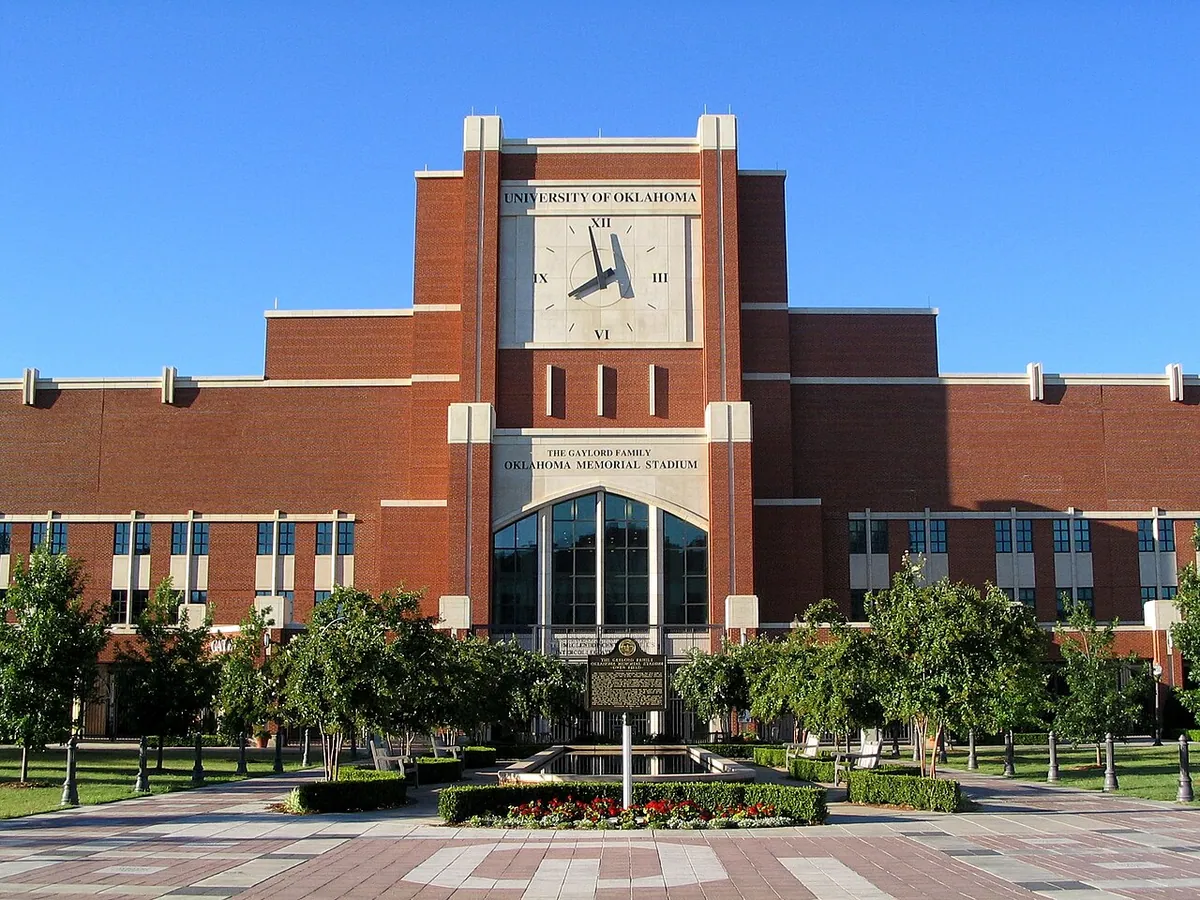
Gaylord Family Oklahoma Memorial Stadium
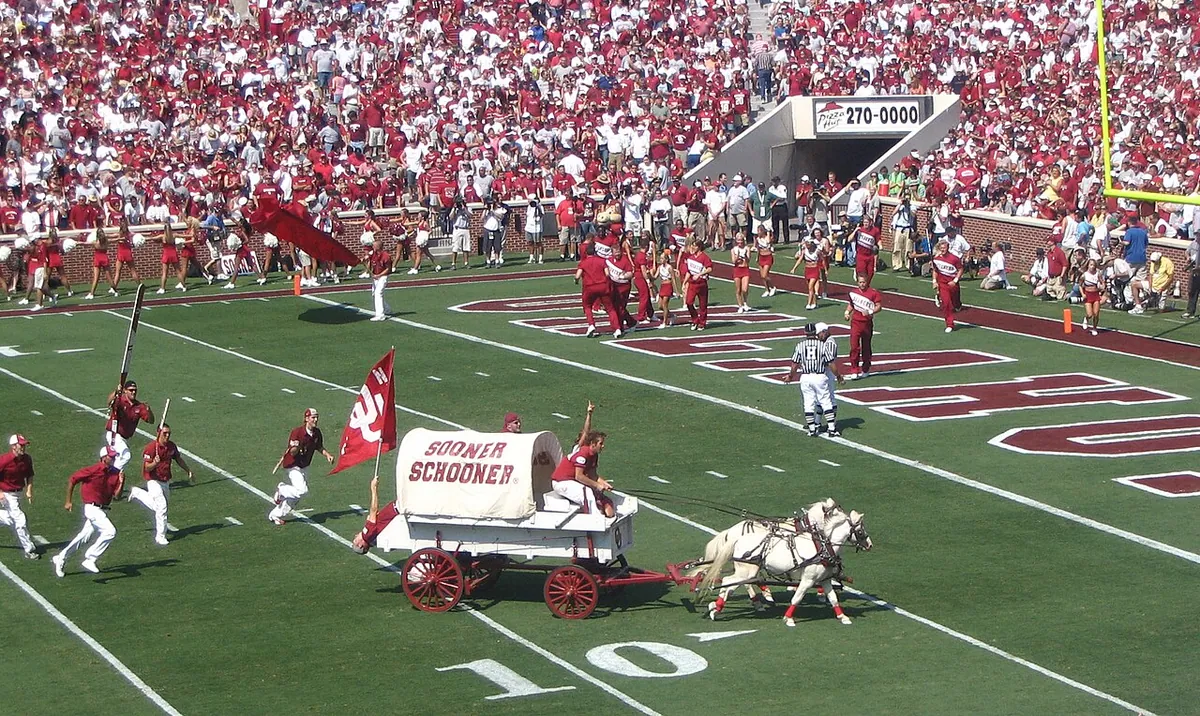
The Oklahoma Sooners play their home games at Gaylord Family Oklahoma Memorial Stadium in Norman, Oklahoma. The stadium has a capacity of 80,126. Its playing surface is Owen Field. Coach Lewie Hardage, who followed Adrian Lindsey, had the grass on Owen Field trimmed to help his teams play faster. Oklahoma played its first game in 1895 on a prairie grass field northwest of where Holmberg Hall now stands.
Heisman Trophy Winners
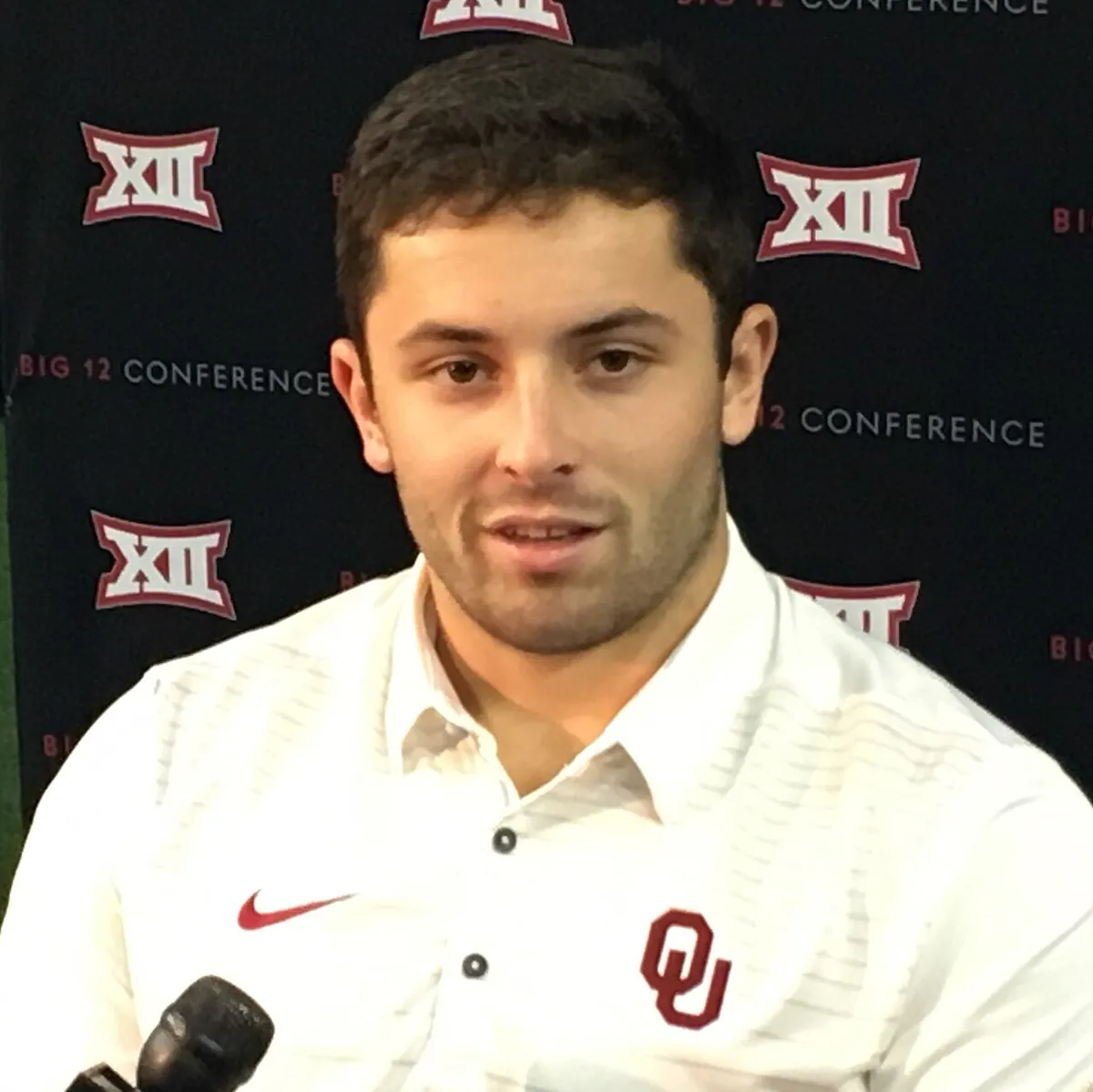
Oklahoma has produced seven Heisman Trophy winners. Billy Vessels won the award in 1952, becoming the program's first recipient. Steve Owens, a powerful running back, won in 1969. Billy Sims, another standout running back, claimed the Heisman in 1978. In the 21st century, quarterbacks have dominated the award for Oklahoma. Jason White won in 2003, followed by Sam Bradford in 2008. Baker Mayfield won in 2017 and Kyler Murray won in 2018, and both were then taken first overall in the NFL Draft.
Notable NFL Players and Draft History
The Oklahoma program is a prolific producer of NFL talent. Since 1974, 368 Oklahoma players have appeared on NFL rosters, with 244 being drafted. This group includes 38 first-round selections and 8 number one overall picks. Recent first overall picks include quarterbacks Baker Mayfield (2018), Kyler Murray (2019), and Caleb Williams (2024). Other notable first-round picks since 2010 include defensive tackle Gerald McCoy (2010), offensive tackle Trent Williams (2010), tight end Jermaine Gresham (2010), offensive tackle Lane Johnson (2013), wide receiver Marquise Brown (2019), wide receiver CeeDee Lamb (2020), linebacker Kenneth Murray Jr. (2020), offensive tackle Anton Harrison (2023), and offensive tackle Tyler Guyton (2024). As of the 2026 NFL season, 59 Oklahoma alumni were on active rosters. This group includes prominent players such as quarterback Jalen Hurts ( Philadelphia Eagles ), wide receiver CeeDee Lamb (Dallas Cowboys), tight end Mark Andrews (Baltimore Ravens), offensive linemen Creed Humphrey (Kansas City Chiefs) and Orlando Brown Jr. ( Cincinnati Bengals ), and defensive lineman Neville Gallimore ( Chicago Bears ). The program has averaged multiple draft picks per year, with 9 players drafted in 2026.
The Bob Stoops Era and Recent History (1999 to 2016)
Bob Stoops was hired as head coach in 1999 and quickly returned the program to national prominence. In his second season, he led the Sooners to a 13-0 record and the BCS national championship in 2000. His teams appeared in four BCS National Championship Games (2000, 2003, 2004, 2008). Under Stoops, the Sooners never had a losing season and produced two Heisman Trophy winners in Jason White (2003) and Sam Bradford (2008). Stoops coached 18 seasons from 1999 to 2016 and retired as the program's winningest coach with a school-record 190 victories.
Recent Seasons and 2026 Outlook
Following Bob Stoops' retirement, Lincoln Riley served as head coach from 2017 to 2021, continuing the offensive success with Heisman winners Baker Mayfield and Kyler Murray. Brent Venables took over as head coach prior to the 2022 season. The 2026 season is Oklahoma's third year in the Southeastern Conference (SEC) and Venables' fifth season. Entering late November, the Sooners held a 7-4 overall record and a 5-3 mark in SEC play. Results included a 14-6 win over New Mexico on September 19 and a loss at Georgia on September 26. The team aimed to finish the regular season with a win at Missouri, which would be its fourth consecutive victory. Venables entered the Missouri game with an 0-4 record in postseason games.
NFL players from Oklahoma
| Player | Pos | Years | Main team |
|---|---|---|---|
| Troy Aikman | QB | 1989–2000 | Dallas Cowboys |
| Trent Williams | OT | 2010– | Washington Redskins |
| Adrian Peterson | RB | 2007–2021 | Minnesota Vikings |
| Lane Johnson | OT | 2013– | Philadelphia Eagles |
| Keith Jackson | TE | 1988–1996 | Philadelphia Eagles |
| Gerald McCoy | DT | 2010–2021 | Tampa Bay Buccaneers |
| Creed Humphrey | C | 2021– | Kansas City Chiefs |
| CeeDee Lamb | WR | 2020– | Dallas Cowboys |
| Roy Williams | S | 2002–2010 | Dallas Cowboys |
| Mark Andrews | TE | 2018– | Baltimore Ravens |
| Orlando Brown | OT | 2018– | Cincinnati Bengals |
| DeMarco Murray | RB | 2011–2017 | Dallas Cowboys |
| Glyn Milburn | WR | 1993–2001 | Chicago Bears |
| Jammal Brown | OT | 2005–2011 | New Orleans Saints |
| Jalen Hurts | QB | 2020– | Philadelphia Eagles |
Video
FAQ
Who is the current head coach of the Oklahoma Sooners?
Brent Venables is the head coach of the Oklahoma Sooners. He was hired before the 2022 season and was in his fifth season in 2026, with a record of 39 wins and 24 losses at that point. Venables succeeded Lincoln Riley, who coached from 2017 to 2021 and produced two Heisman Trophy winners. Prior to Riley, Bob Stoops led the program for 18 seasons from 1999 to 2016, winning the 2000 national championship. Venables' tenure has overseen the program's transition into the competitive Southeastern Conference.
How many national championships has Oklahoma football won?
The Oklahoma Sooners claim seven consensus national championships in football. These titles were awarded in 1950, 1955, 1956, 1974, 1975, 1985, and 2000. The 2000 championship was won under the Bowl Championship Series (BCS) format. According to the NCAA record book, which recognizes selections from various historical organizations, Oklahoma has been named national champion in 17 different seasons. The program's most recent claimed national title was in 2000, under head coach Bob Stoops.
Which Oklahoma players have won the Heisman Trophy?
Seven Oklahoma Sooners have won the Heisman Trophy. The winners are Billy Vessels in 1952, Steve Owens in 1969, and Billy Sims in 1978. In the 21st century, quarterbacks have claimed the award for Oklahoma: Jason White in 2003, Sam Bradford in 2008, Baker Mayfield in 2017, and Kyler Murray in 2018. Mayfield and Murray were both later selected first overall in the NFL Draft, in 2018 and 2019. Billy Vessels, the first Oklahoma winner, was also the first thousand-yard rusher to win the Heisman.
What is Oklahoma's record in bowl games and the College Football Playoff?
Oklahoma has an all-time bowl record of 31 wins, 26 losses, and 1 tie. The Sooners have played in four BCS National Championship Games, winning in 2000 but losing in 2003, 2004, and 2008. In the College Football Playoff era, Oklahoma has made five appearances but has an 0-5 record in those playoff games. Oklahoma's first bowl game came after the 1938 season, when the Sooners lost the Orange Bowl to Tennessee.
Who was the first head football coach for the University of Oklahoma?
The first football game in university history was played in 1895, organized by student John A. Harts. However, the first official head coach was Vernon Louis Parrington, who took over in 1897. Parrington had played football at Harvard and compiled a 9-2-1 record over four seasons before stepping down after the 1900 season. He would later win the Pulitzer Prize for History in 1928 while at the University of Washington.
What is Oklahoma's historical record against the Missouri Tigers in football?
The Oklahoma Sooners entered their 99th meeting with the Missouri Tigers in 2026 holding a 68-25-5 all-time record in the series. Historically, Oklahoma has won 52 of the last 62 games against Missouri. The series includes notable periods of Sooner dominance, such as winning 24 of the first 28 games played at Missouri starting in 1947. Oklahoma's two most recent games in Columbia were losses, 36-27 in 2010 and 30-23 in 2024.
Sources
- Oklahoma Sooners football (Wikipedia) Wikipedia
- One Big Thing: Oklahoma Shouldn't Lose at Mizzou, And Yet.. Sports Illustrated
- Oklahoma Sooners football Facts for Kids kids.kiddle.co
- Oklahoma football: Ranking the the Sooner teams of the past seven decades stormininnorman.com
- National Championships, University of Oklahoma, Sooner Sports soonersports.com
- nflverse game, roster and draft data nflverse (CC BY 4.0)