The Virginia Cavaliers football program represents the University of Virginia in Division I FBS. Founded in 1887, the Cavaliers have compiled an all-time record of 703-657-48. Virginia has been a member of the Atlantic Coast Conference and plays its home games at the 61,500-seat Scott Stadium in Charlottesville. The program has produced 11 Consensus All-Americans and has participated in 22 bowl games, setting a school record with 11 wins in the 2025 season. The team's early history was marked by 12 Southern championships and a landmark victory over Yale in 1915.
Program Founding and Early History (1887 to 1911)
The Virginia Cavaliers football program began in the fall of 1887 after two graduate students, Charles Willcox and Richard Reid Rogers, introduced the sport to the university. The first organized game was a scoreless tie against Pantops Academy on November 13, 1887, with the first intercollegiate contest following in 1888, a 26-0 loss to Johns Hopkins. The program quickly established itself, claiming Southern championships in years such as 1889. Virginia played a role in the early development of football rules and safety, particularly after a player's death in a 1897 game against Georgia. The South's Oldest Rivalry with North Carolina began in 1892, and the team played its early home games at Lambeth Field, which opened in 1901. The 1900 team gave the Sewanee Tigers its first loss since 1897. The program's first consensus All-American was halfback Eugene "Buck" Mayer in 1915.
The 1915 season is one of the most significant in early program history. That year, Virginia became the first Southern program to defeat Yale, winning 10-0 at the Yale Bowl. The team's only loss was a 9-0 road game at Harvard. The James Howell Power Ratings retroactively named the 1915 Virginia team a national champion, though the university does not officially claim this title. The program had 28 consecutive winning seasons after its first season in 1887. The university's first athletic director, medical professor William Lambeth, served on the rules committees that worked to make football safer in the sport's formative years. The 1902 team beat Carlisle.
Conference Membership and Historical Transitions
Virginia's conference affiliation has evolved significantly over its history. The program was a charter member of the Southern Conference in 1921 after a brief stint in the South Atlantic Intercollegiate Athletic Association. In 1937, following the implementation of the Graham Plan which restricted athlete subsidies, Virginia left the Southern Conference to become an independent. This period included the Frank Murray era, highlighted by the play of 1941 Heisman Trophy finalist Bill Dudley. The university joined the Atlantic Coast Conference, a move that followed internal debate about the role of big-time football. President Colgate Darden had previously reduced scholarships by 80 percent and famously declined a 1952 Orange Bowl invitation. A period of struggle included a 28-game losing streak from 1958 to 1960 under coach Dick Voris, who finished with a 1-29 record. Voris's lone victory was a 15-12 home win against Duke. The program's conference timeline includes several key transitions.
- 1887 to 1911: Independent and early Southern champion.
- 1912 to 1921: Member of the South Atlantic Intercollegiate Athletic Association (SAIAA).
- 1922 to 1936: Charter member of the Southern Conference.
- 1937 to 1952: Independent status.
- 1953 to present: Member of the Atlantic Coast Conference (ACC).
Head Coaching History and Notable Eras
The Virginia Cavaliers have been led by many head coaches since 1887. The early 20th century saw frequent changes, but the program found stability and success under several key figures. Art Guepe led the team from 1946 to 1952, achieving winning records in each of his seven seasons before departing due to scholarship restrictions. The program's most successful coach was George Welsh, who coached from 1982 to 2000. Welsh engineered a dramatic turnaround, taking Virginia to its first dozen bowl games, achieving an AP No. 1 ranking for several weeks in 1990, and becoming the first ACC coach to reach 100 wins at a conference school. His 85 ACC wins ranked second only to Bobby Bowden at the time of his retirement. The current head coach is Tony Elliott, who is in his fifth season with a record of 27-31 through the 2026 season. Other notable coaches include Earle "Greasy" Neale, who led the first officially named "Cavaliers" teams from 1923 to 1928, and Fred Dawson, who coached during the opening of Scott Stadium in 1931.
Championships and Bowl History
Virginia football claims multiple Southern championships from the early era of the sport, spanning from 1889 to 1915. The 1915 team, which defeated Yale 10-0, is retroactively considered a national champion by the James Howell Power Ratings, though this title is not officially claimed by the university. The 1995 season was particularly notable as Virginia became the first ACC team to defeat a Florida State team coached by Bobby Bowden, ending the Seminoles' 29-0 conference start in a nationally televised game that led to the creation of the Jefferson-Eppes Trophy. The Cavaliers have appeared in 22 bowl games, compiling a 9-13 record. Their bowl appearances include four Peach Bowls, an Orange Bowl, a Sugar Bowl, and a Citrus Bowl.
The bowl history began much later than the program's early success due to administrative decisions. George Welsh took Virginia to its first dozen bowl games, and the program has since made additional postseason appearances. As of the 2026 season, the team has secured bowl eligibility again, with updated projections placing them in various postseason contests. The team's 9-13 bowl record reflects its 22 appearances. The 2025 season's 11 wins set a new school record for victories in a single season.
Scott Stadium and Game Day
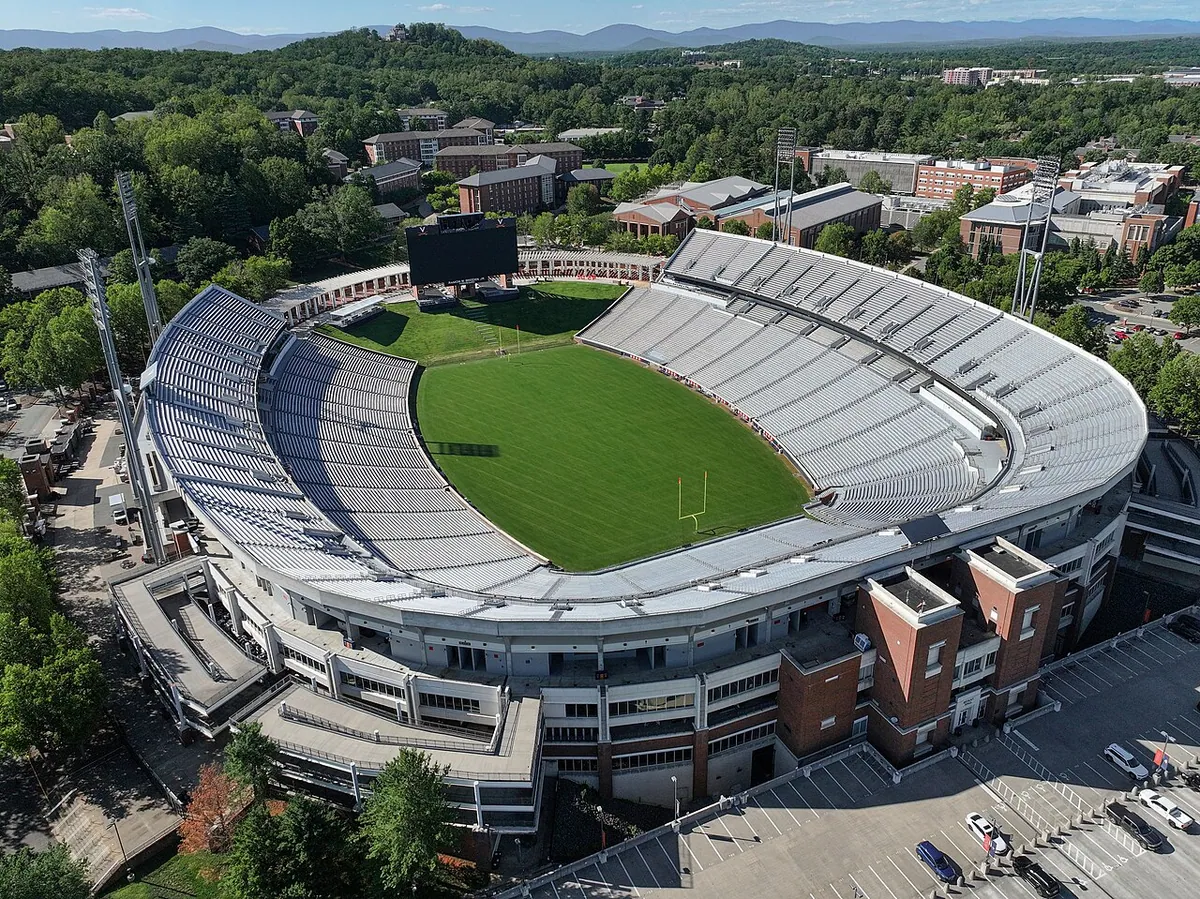
The Virginia Cavaliers have played their home games at Scott Stadium since it opened in 1931. The stadium, with a current capacity of 61,500, is located directly adjacent to the university's historic Academical Village, a UNESCO World Heritage Site. The playing surface is named David A. Harrison III Field at Carl Smith Center. Scott Stadium replaced the earlier Lambeth Field and Stadium, which served as the team's home from 1901 to 1931. The stadium's design and location provide a unique collegiate atmosphere, integrating the game day experience with the university's architectural heritage. The Cavalier Marching Band, known as the "Marching Cavaliers," performs at home games, and the team's mascot, CavMan, leads fan festivities. The stadium sits on grounds acquired in 1930 to solve overcrowding at the old Lambeth Field, where javelin throwers once disrupted spring football practice.
Game days at Scott Stadium are central to the university's culture. The stadium has hosted many significant moments, including the 1995 victory over Florida State. The facility's location near the Rotunda and the Lawn creates a distinctive environment that connects athletic tradition with academic history. The team's colors of orange and blue are displayed prominently, and the outfitter for the team is Nike. The stadium's capacity of 61,500 makes it one of the larger venues in the ACC, and it regularly hosts key conference matchups. Lambeth Stadium was built at a cost of $35,000 when it opened in 1913.
Rivalries
Virginia maintains several heated and historic football rivalries. The South's Oldest Rivalry is with the North Carolina Tar Heels, a series that began in 1892 with a split of two games. The most intense modern rivalry is with in-state foe Virginia Tech. Other ACC rivalries include contests against Duke and Florida State, the latter of which features the Jefferson-Eppes Trophy created after Virginia's 1995 win. Virginia also has a long-standing series with William & Mary dating back to 1908. The rivalry with Maryland, though less frequent since the Terrapins left the ACC, also holds historical significance. These games are central to the program's identity and schedule each season.
The clash with Virginia Tech is a key annual matchup. The 2026 edition is set to be played in Blacksburg. The rivalry with North Carolina often has implications for the ACC standings and bowl eligibility, as seen in the 2026 Senior Day 41-24 Virginia victory. The game against Florida State gained national prominence in 1995 when Virginia ended the Seminoles' perfect ACC record. The long history with William & Mary represents one of the program's oldest continuous series, reflecting Virginia's in-state connections.
NFL Players and Draft History
Notable first-round picks include defensive end Chris Long (2nd overall in 2008), offensive tackle D'Brickashaw Ferguson (4th overall in 2006), running back Thomas Jones (7th overall in 2000), and tight end Heath Miller (30th overall in 2005). As of the 2026 NFL season, 25 Virginia alumni are on active rosters, including players like Morgan Moses, Malik Washington, Olu Oluwatimi, and Dontayvion Wicks. The pipeline to the professional ranks is a point of pride for the program. Early stars like Bill Dudley set a standard, and modern players have excelled at various positions. The 2026 NFL rosters feature Virginia alumni across multiple teams, with positions ranging from offensive line to wide receiver and defensive back. This sustained production of professional talent demonstrates the program's ability to develop players for the next level. The list of Consensus All-Americans, which totals 11, often overlaps with those who had successful NFL careers.
Recent Seasons and the Tony Elliott Era
Under fifth-year head coach Tony Elliott, the Virginia program has shown progress. The 2026 season has seen the team secure bowl eligibility with a 41-24 Senior Day victory over North Carolina at Scott Stadium. The regular season concludes with the annual clash against rival Virginia Tech. The Cavaliers have been projected for various bowl games throughout the 2026 season. The team continues to build on the foundation laid by George Welsh, aiming for consistent competitiveness in the ACC.
The 2026 campaign included notable performances and challenges. The team earned a 36-7 victory over California and suffered a blowout loss to No. 14 Wake Forest. Weekly availability reports and PFF grades have been points of analysis throughout the season. As the team prepared for Virginia Tech, key storylines included carrying recent improvements into the rivalry game and the potential impact of a win on the program's trajectory. The staff and players have emphasized a belief in a new future for Virginia football. Players like Beau Pribula and Xavier Brown were highlighted in the win over North Carolina.
NFL players from Virginia
| Player | Pos | Years | Main team |
|---|---|---|---|
| Ronde Barber | FS | 1997–2012 | Tampa Bay Buccaneers |
| Herman Moore | WR | 1991–2002 | Detroit Lions |
| James Farrior | ILB | 1997–2011 | Pittsburgh Steelers |
| Tiki Barber | RB | 1997–2006 | New York Giants |
| Matt Schaub | QB | 2004–2020 | Atlanta Falcons |
| Patrick Kerney | DE | 1999–2009 | Atlanta Falcons |
| Chris Warren | RB | 1990–2000 | Seattle Seahawks |
| D'Brickashaw Ferguson | OT | 2006–2015 | New York Jets |
| Heath Miller | TE | 2005–2015 | Pittsburgh Steelers |
| Branden Albert | OT | 2008–2016 | Kansas City Chiefs |
| Thomas Jones | RB | 2000–2011 | New York Jets |
| Morgan Moses | OT | 2014– | Washington Football Team |
| Don Majkowski | QB | 1987–1996 | Green Bay Packers |
| Rodney McLeod Jr. | FS | 2012–2024 | Philadelphia Eagles |
| Ahmad Brooks | OLB | 2006–2017 | San Francisco 49ers |
Video
FAQ
What conference do the Virginia Cavaliers football team play in?
The Virginia Cavaliers football team competes in the Atlantic Coast Conference (ACC). Virginia has been a member of the ACC since 1953, having previously been a member of the Southern Conference and an independent. The ACC is a Power Five conference, and Virginia's conference rivals include North Carolina, Virginia Tech, Duke, and Florida State. The team has played in two ACC Championship Games.
What is the name and capacity of Virginia's football stadium?
Virginia plays its home games at Scott Stadium, which opened in 1931. The stadium has a seating capacity of 61,500 fans. The playing surface is officially named David A. Harrison III Field at Carl Smith Center. Scott Stadium is located on the university's grounds in Charlottesville, adjacent to the historic Academical Village. The stadium is the home of the Cavalier Marching Band and mascot CavMan.
Has Virginia football ever won a national championship?
Virginia does not officially claim a national championship in football. However, the 1915 team is retroactively named a national champion by the James Howell Power Ratings due to its undefeated record and landmark victory over Yale. The program officially recognizes 12 Southern championships from the early era of the sport, from 1889 through 1915. Other notable programs have claimed national titles for early years using Howell's ratings, but Virginia does not include the 1915 title in its official record.
Has a Virginia player ever won the Heisman Trophy?
No Virginia Cavalier has won the Heisman Trophy. The closest finish was by halfback Bill Dudley, who placed fifth in the Heisman voting in 1941. Dudley was a consensus All-American that year and is considered one of the greatest players in program history, excelling as a runner, passer, and kicker. The program has produced 11 Consensus All-Americans.
What is Virginia's record in bowl games and how many have they played?
The Virginia Cavaliers have appeared in 22 bowl games throughout their history, compiling a record of 9 wins and 13 losses. Their bowl appearances include major games like the Peach Bowl (four times), Orange Bowl, Sugar Bowl, and Citrus Bowl. The program secured its most recent bowl eligibility during the 2026 season with a win over North Carolina. George Welsh took Virginia to its first dozen bowl games. The 2025 team set a school record with 11 wins.
How many Virginia football players have been selected in the first round of the NFL Draft?
Virginia football has produced 14 first round picks in the NFL Draft. The most recent first round selections include players like Chris Long, who was picked second overall in 2008, and D'Brickashaw Ferguson, picked fourth overall in 2006. The list also includes notable names such as Heath Miller, Thomas Jones, and Herman Moore. Overall, the program has had 108 players drafted into the NFL since 1974.
Sources
- Virginia Cavaliers football (Wikipedia) Wikipedia
- Wahoos247 Home, Virginia Cavaliers Football & Recruiting 247sports.com
- UVA Football News, Scores, Highlights, Stats, Standings, and Rumors Bleacher Report
- Football Yearly Archives, Virginia Cavaliers Official Athletic Site virginiasports.com
- Virginia Football All-Time Record & Stats winsipedia.com
- nflverse game, roster and draft data nflverse (CC BY 4.0)