A Guardian Cap is a soft-shell padded cover that attaches to the outside of a football helmet to absorb contact and reduce impact forces. Developed by Guardian Sports, these caps have been used in football practices since 2015 and were first mandated by the NFL for certain position groups in 2022 before becoming optional for in-game use starting in the 2024 season. The equipment is also used in the Canadian Football League, as well as in collegiate and youth levels of American football. While NFL research claims the caps reduce concussions, independent studies published in 2017 and 2023 have not confirmed substantial benefits in mitigating head impacts, leading to ongoing debate about their efficacy.
Design and Function
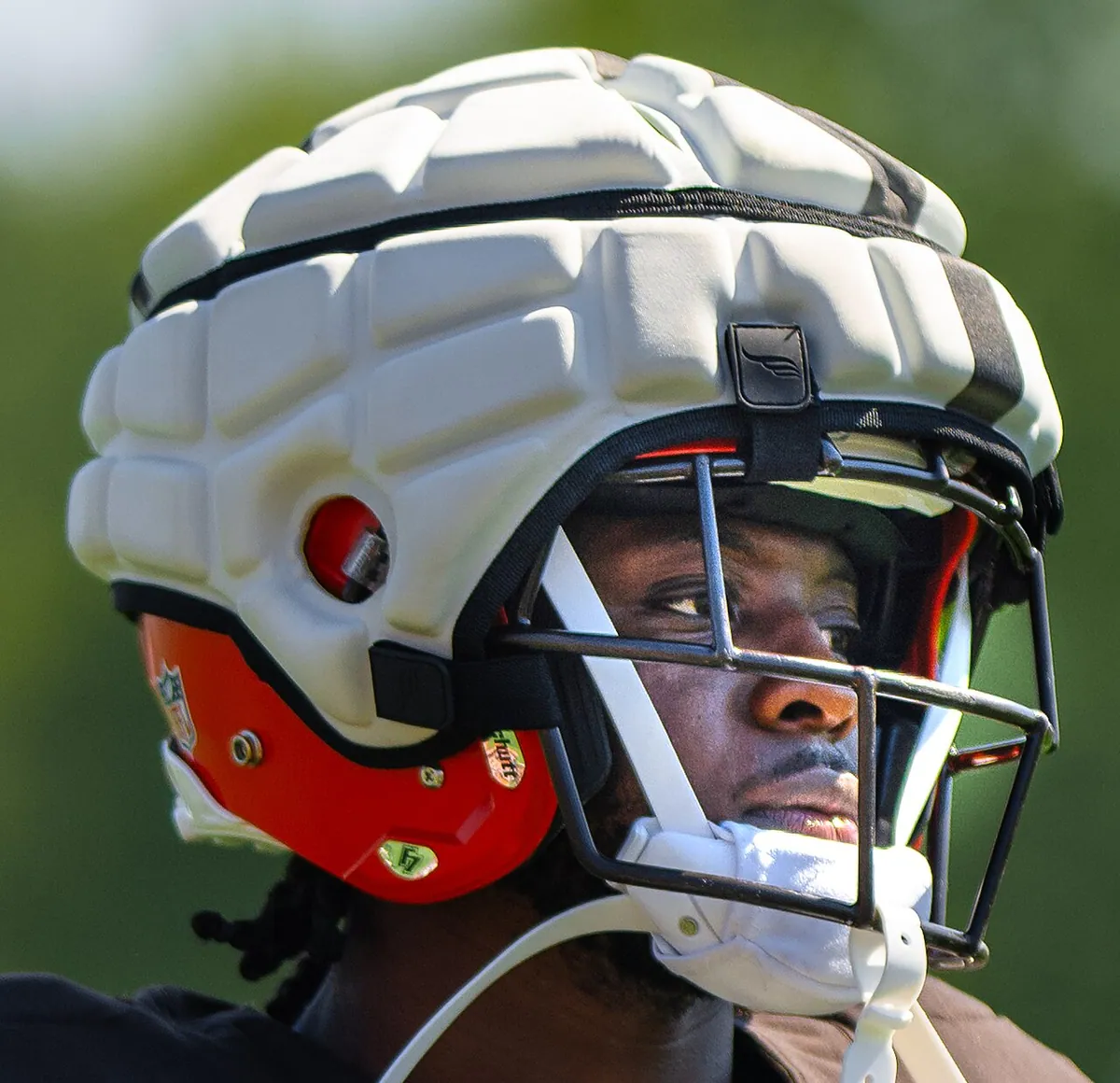
The Guardian Cap is a lightweight, soft-shell padding that straps over the crown and sides of a standard hard-shell football helmet using snaps and hook-and-loop fasteners. Each cap weighs less than one pound and does not require any drilling or permanent alteration to the helmet. The primary function is to add a compliant outer layer designed to spread the force of contact over a longer period, thereby reducing the initial severity of impacts transmitted to the helmet and the player's head. Guardian Sports states the caps can reduce radiant heat inside the helmet by 15 to 20 degrees Fahrenheit in hot conditions of 90 degrees Fahrenheit and higher. When used in games, the cap is covered by a team-colored wrap that displays logos and patterns to match teammates' helmets, ensuring a uniform appearance on the field.
History and Development
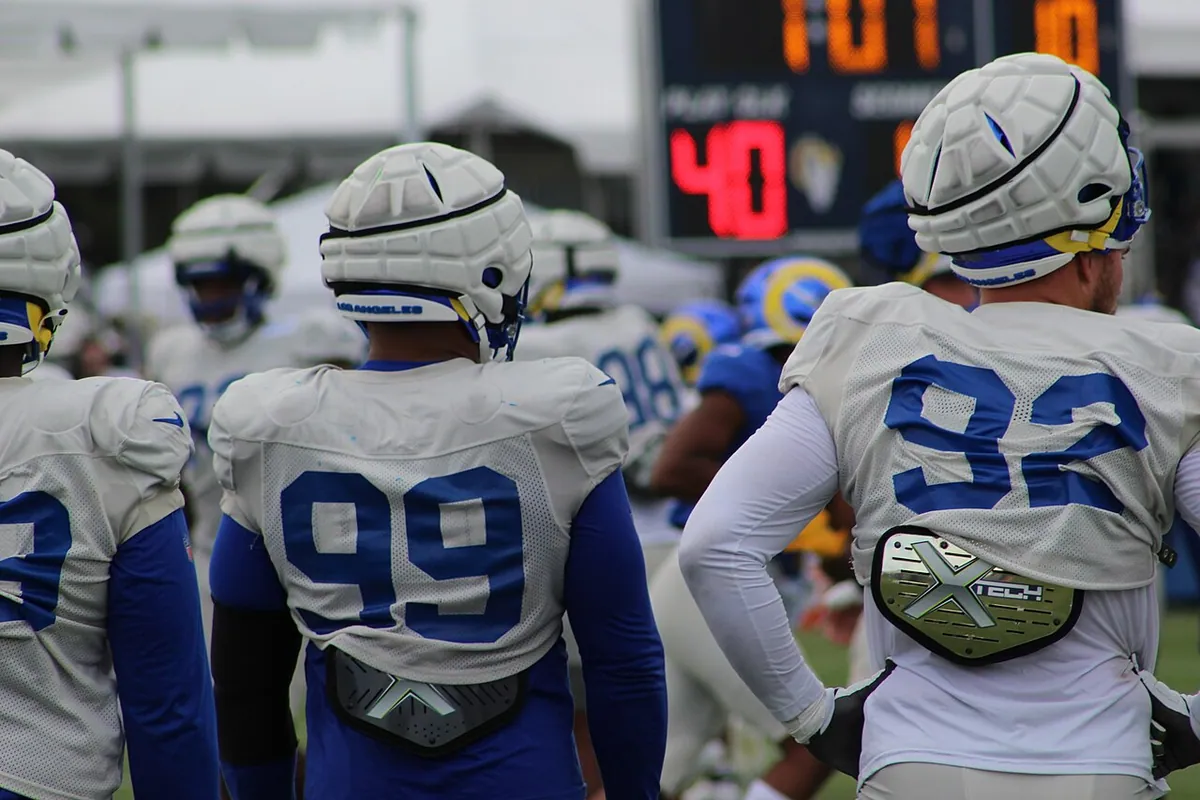
Guardian Sports was founded in 2010 by Erin and Lee Hanson, owners of a materials science company, who initially developed a fully soft-shelled football helmet. After that design failed to gain acceptance from players, fans, and coaches, they pivoted to creating an add-on soft-shell cover following a 2013 rule change by the National Operating Committee on Standards for Athletic Equipment that allowed third-party certification for such equipment. The company received an NFL grant in 2017 through the HeadHealthTECH Challenge to further develop the product. The Los Angeles Rams became early adopters of the caps in 2021 after their quarterback, Matthew Stafford, injured his hand on an uncapped helmet during training camp.
The NFL first mandated Guardian Caps in 2022, requiring offensive and defensive linemen, tight ends, and linebackers to wear them during preseason contact practices. In 2023, the mandate expanded to include running backs and fullbacks and was extended to all contact practices in the regular season and postseason. The NFL permitted optional in-game use starting in 2024, with Pittsburgh Steelers offensive lineman James Daniels becoming the first NFL player to wear one in a preseason game on August 9, 2024. Saskatchewan Roughriders running back Thomas Bertrand-Hudon was the first to wear one in a professional regular season game on August 16, 2024. Significant events in the adoption of Guardian Caps include.
- 2010: Guardian Sports is founded by Erin and Lee Hanson.
- 2015: Guardian Caps enter use in high school football.
- 2017: Guardian Sports receives an NFL HeadHealthTECH Challenge grant.
- 2021: The Los Angeles Rams adopt the caps after a quarterback injury.
- 2022: The NFL mandates caps for linemen, tight ends, and linebackers in preseason practices.
- 2023: The NFL expands the mandate to running backs, fullbacks, and all contact practices. The CFL adopts a mandate.
- 2024: The NFL allows optional in-game use. First NFL and CFL regular season appearances occur.
- 2026: The Guardian Cap NXT 2.0 is approved for the NFL season.
NFL Rules and Mandates
The NFL's Guardian Cap mandate has evolved significantly since its introduction. For the 2026 season, the rules require mandatory use during all contact practices in the preseason, regular season, and postseason for nearly all position groups. The mandate applies to offensive and defensive linemen, linebackers, running backs, fullbacks, wide receivers, and defensive backs. Only quarterbacks, kickers, and punters are not mandated to wear them during practices, though they are allowed to if they choose. Players can also be exempted from the mandate if they wear one of six new helmet models identified by the league and the NFL Players Association as providing equal or better protection. In-game use remains optional for all players.
The league's data, shared in 2023, states that if one player wears a Guardian Cap during a helmet hit, the cap absorbs 11 to 12 percent of the force. If both players involved in a helmet-to-helmet hit are wearing the caps, the impact force is reduced by around 20 percent. The NFL also reported a 52 percent decrease in concussions for players at mandated positions during training camps compared to the previous three years without the caps, though this study evaluated the caps alongside other protective measures. The 2026 mandate represents the broadest application, covering all contact practices for positions that frequently experience helmet contact. Position groups subject to the NFL's 2026 practice mandate.
- Offensive linemen
- Defensive linemen
- Linebackers
- Running backs
- Fullbacks
- Wide receivers
- Defensive backs
Use in College, High School, and Other Leagues
Guardian Caps are widely used beyond the NFL, with documented adoption in college football, high school programs, and youth leagues. College programs like the Auburn Tigers were noted using them in practices in 2023. The caps are offered in different models tailored for various levels of play. The Guardian Cap XT and XT 2.0 are designed for youth, high school, and college players. The Guardian Cap NXT and NXT 2.0 are heavier models intended for college, professional, and larger players and are only sold through sales representatives. The Canadian Football League mandated Guardian Caps for offensive and defensive linemen, running backs, and linebackers during training camp and padded practices starting in 2023. The equipment is also used in ice hockey and lacrosse, providing a soft-shell layer for impact reduction in those sports as well.
Player Reception and Aesthetics
Initial player reaction to Guardian Caps was often hesitant or critical, primarily focused on their bulky appearance. In 2022, Arizona Cardinals linebacker J.J. Watt joked that wearing one made him feel like a bobblehead, though he understood the safety rationale. Similar comments about the "bobblehead" look were made by CFL players like Calgary Stampeders defensive lineman Mike Rose, who stated they look goofy but help with brain protection. Sportswriter Mike Florio opined that the caps were big, bulky, and unattractive, comparing them to egg cartons. Ahead of the 2024 season, only two Indianapolis Colts players were publicly planning to use it. Some players cited issues with fit, noting the caps could slip.
Over time, acceptance has grown as the caps became normalized equipment. Los Angeles Rams equipment manager Brendan Burger noted in 2024 that players on his team had seen the data and accepted the caps as another standard piece of practice gear. USA Today's Nate Davis wrote that the adoption for in-game use represented something of a seismic shift that players had generally embraced. By the 2025 season, multiple NFL players chose to wear Guardian Caps in games. Notable advocates include Green Bay Packers wide receiver Romeo Doubs and New Orleans Saints wide receiver Chris Olave. Houston Texans safety Jalen Pitre and Doubs were named Guardian Sports' first Signature Athletes in endorsement deals in 2026.
Research on Effectiveness
Research on the efficacy of Guardian Caps presents a mixed picture, with NFL-sponsored studies showing benefits and independent research casting doubt. The NFL's on-field data claims the caps absorb 11 to 12 percent of impact force in single-player use and reduce force by around 20 percent in helmet-to-helmet collisions where both players wear them. The league also reported a 52 percent decrease in concussions at mandated positions during training camps from 2022 to 2023 compared to the prior three-year baseline. Guardian Sports cites laboratory studies from institutions like Virginia Tech and Stanford showing impact reduction. A Virginia Tech study found helmet shell add-ons like the Guardian Cap XT decreased STAR scores for the Riddell SpeedFlex helmet by 62 percent, indicating reduced acceleration. Stanford research reported the Guardian Cap XT reduced HARM values by an average of 25 percent at 3.5 m/s impact speeds.
Independent academic studies, however, have not confirmed substantial benefits. A 2017 study published in the Journal of Athletic Training concluded it could not determine that the Guardian Cap provided measurable impact mitigation. A 2023 study in the same journal suggested the caps may not be effective in reducing head impact magnitude for NCAA Division I football players. Critics have also raised concerns that the caps could create a false sense of safety, potentially leading to more dangerous play, though the NFL views them as part of a broader effort to reduce head injuries. Key findings from independent research studies.
Models and Specifications
Guardian Sports manufactures several models of the Guardian Cap, each designed for different levels of play and player sizes. The Guardian Cap XT is the original model tested and validated for use from youth to college levels and is also used for hockey and lacrosse. The Guardian Cap XT 2.0 uses the same core technology and materials but features a sleeker design that allows for more customization options and direct application of team decals and logos, also intended for youth through college. The Guardian Cap NXT 2.0 is the newest iteration, approved by the NFL for the 2026 season, featuring a sleeker surface for sticker application while maintaining the same impact-reduction science. All models function as an add-on layer, preserving the underlying helmet's certification and internal padding, and they are engineered to reduce the impact of repetitive head contact.
Additional Benefits and Considerations
Beyond potential head impact reduction, Guardian Caps offer several ancillary benefits noted by teams and coaches. The soft outer shell helps protect the helmet's hard shell and decals from scuffs and damage during practice, extending the equipment's lifespan and keeping team helmets cleaner. The padding can dampen the sound and vibration produced by helmet contact, which some players find preferable. The extra layer also provides incidental padding that can cushion blows to other body parts, such as knees, hands, and the midsection, during position drills and inside run sessions. It is crucial to note that Guardian Caps, like all protective gear, cannot eliminate the risk of concussion or other serious head injuries. Guardian Sports' own FAQs state that no helmet or headgear can prevent or eliminate concussion risk, and the caps must be used with properly fitted helmets and safe playing techniques, alongside other protective measures adopted by leagues.
Video
FAQ
Do any NFL players wear Guardian Caps?
Yes, NFL players wear Guardian Caps. Their use is mandated for most position groups during all contact practices in the preseason, regular season, and postseason as of the 2026 rules. Since 2024, players have also been allowed to wear them during games if they choose. The first NFL player to wear one in a game was Pittsburgh Steelers offensive lineman James Daniels in a 2024 preseason contest. During the 2025 season, multiple NFL players chose to wear them in games, including Green Bay Packers wide receiver Romeo Doubs and New Orleans Saints wide receiver Chris Olave.
Do Guardian Caps actually work?
Research on the effectiveness of Guardian Caps shows conflicting results. The NFL's data indicates the caps can absorb 11 to 12 percent of impact force when one player wears them and reduce force by about 20 percent in helmet-to-helmet hits where both players wear them. However, independent academic studies have not confirmed these benefits. Studies published in the Journal of Athletic Training in 2017 and 2023 found the caps may not provide measurable impact mitigation or reduce head impact magnitude for college football players.
Why do some NFL players not want to wear Guardian Caps?
Some NFL players have been hesitant or declined to wear Guardian Caps primarily due to aesthetic concerns and fit issues. Players like J.J. Watt have joked that the bulky design makes them look and feel like bobbleheads. Calgary Stampeders defensive lineman Mike Rose called them goofy-looking. Ahead of the 2024 season, many Indianapolis Colts players declined to wear them for appearance reasons. NFL executive Jeff Miller noted some early feedback centered on the caps slipping during use. While acceptance has grown, initial criticism focused on their unconventional look compared to traditional helmets.
What are the rules for Guardian Caps in the NFL?
For the 2026 NFL season, Guardian Caps are mandatory during all contact practices for offensive and defensive linemen, linebackers, running backs, fullbacks, wide receivers, and defensive backs. Only quarterbacks, kickers, and punters are not required to wear them during practices but may choose to do so. Players can also be exempt if they wear one of six specific new helmet models deemed to offer equal or better protection. Use during regular season and postseason games is entirely optional for all players. The mandate applies to practices from training camp through the playoffs, representing the league's broadest requirement to date.
Are Guardian Caps used in college and high school football?
Yes, Guardian Caps are used in college and high school football. College programs like the Auburn Tigers were noted using them in practices in 2023. The caps are offered in models tailored for different levels: the Guardian Cap XT and XT 2.0 are designed for youth, high school, and college players, while the heavier NXT and NXT 2.0 models are for college, professional, and larger athletes. The Canadian Football League also mandated their use for certain positions starting in 2023. Their adoption at these levels reflects a broader focus on reducing head impacts in practices across all levels of football.
What is a Guardian Cap and what is its purpose?
A Guardian Cap is a soft-shell padded cover that attaches to the outside of a standard football helmet. Its purpose is to add cushioning to help absorb contact and reduce the impact of hits to the helmet, with the objective of lowering the risk of concussions and other head injuries. The cap is designed as an add-on layer that does not replace the helmet's internal padding. It is used primarily during practices but has also been approved for optional use in live games.
Sources
- Guardian Cap (Wikipedia) Wikipedia
- Guardian Caps guardiansports.com
- Guardian Cap Helmets in the NFL, Explained nbc.com
- What Is a Guardian Cap in Football & What Does It Do? sportsunlimitedinc.com
- NFL expands rule against misuse of helmet. Guardian Caps required in regular season, postseason NFL