West Shore Home Field at Beaver Stadium is the home of the Penn State Nittany Lions football team. Located on the University Park campus of Pennsylvania State University, the stadium opened at its current site on September 17, 1960. It has been expanded numerous times, growing from an initial capacity of 46,284 to become one of the largest stadiums in the United States. The stadium is named for James A. Beaver, a former Pennsylvania governor and university trustee. A major $700 million revitalization project is underway and is scheduled for completion before the 2027 college football season. The venue set its all-time attendance record of 114,419 on October 10, 2026, during a game against USC.
Location and Construction
Beaver Stadium is situated on the east end of the Pennsylvania State University campus in University Park, Pennsylvania. The stadium's current location became the permanent home of Penn State football in 1960 following an innovative relocation project. After the 1959 season, the university's previous stadium, New Beaver Field, was dismantled and moved in 700 separate sections half a mile across campus. The old facility was reassembled and bolted onto a new upper grandstand at the new site. The cost of this move and initial construction was $1.6 million, which equates to approximately $17.4 million in 2025 dollars. The stadium was dedicated on September 17, 1960, with a 20-0 Penn State victory over Boston University. Halfback Eddie Caye scored the first touchdown in the new stadium at the 10:45 mark of the first quarter. The stadium is located within College Township and uses a University Park mailing address.
Capacity and Expansions
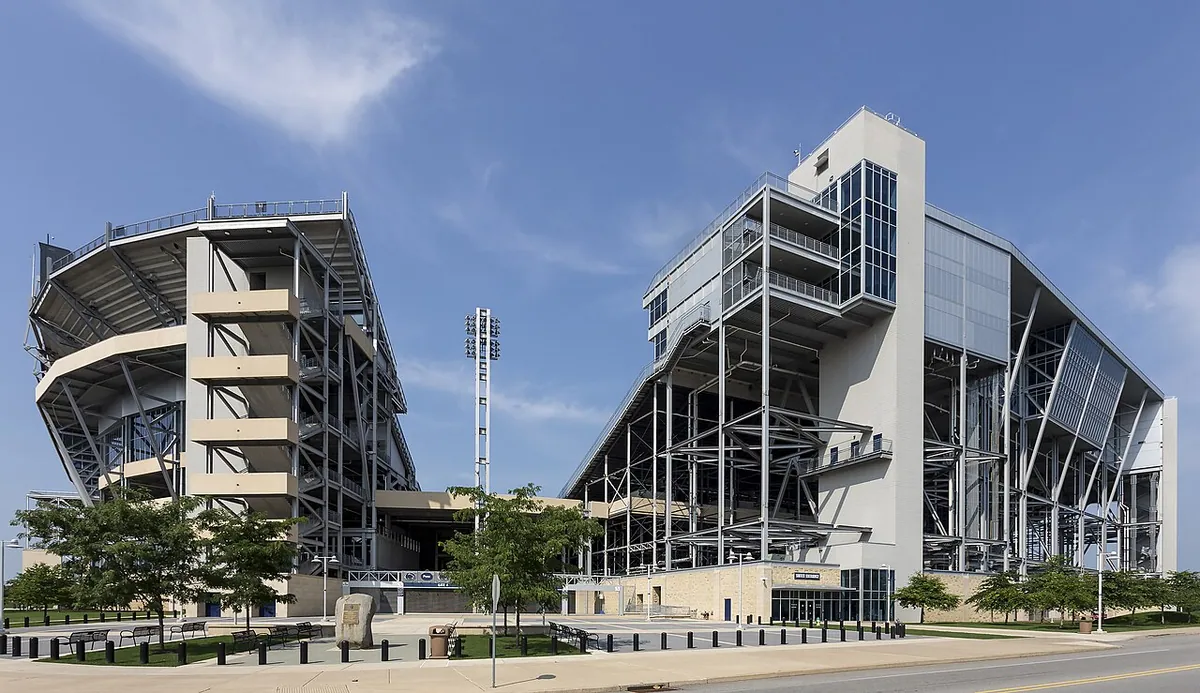
Beaver Stadium has undergone numerous expansions, more than doubling its size since 1960. The initial horseshoe configuration seated 46,284 spectators. The first major additions came in 1969 and 1972, adding over 2,000 and more than 9,000 seats respectively to bring capacity to 57,538. A 1976 expansion of bleachers in the south end zone raised capacity to 60,203. A uniquely engineered project in 1978 added over 16,000 seats by cutting the stadium into sections, raising it eight feet with hydraulic jacks, and inserting precast concrete seating forms where a running track had been. This brought capacity to 76,639. Further expansions in 1980 raised the official capacity to 83,770. After the addition of walkways and ramps in 1985, the count was adjusted to 83,370. A significant addition in 1991 placed a 10,033-seat upper deck over the north end zone, increasing capacity to 93,967. The most substantial expansion came in 2001 at a cost of $93 million. In 2011, capacity was reduced to 106,572 to comply with the Americans with Disabilities Act. As of the 2025 season, the official capacity is 106,304 due to ongoing renovations. The seating bowl is configured with 110 rows on its east side and 100 rows on the west side. The lower end zones each have 60 rows, while the north upper deck contains 35 rows and the south upper deck has 25 rows.
Football Tenants and Notable Events
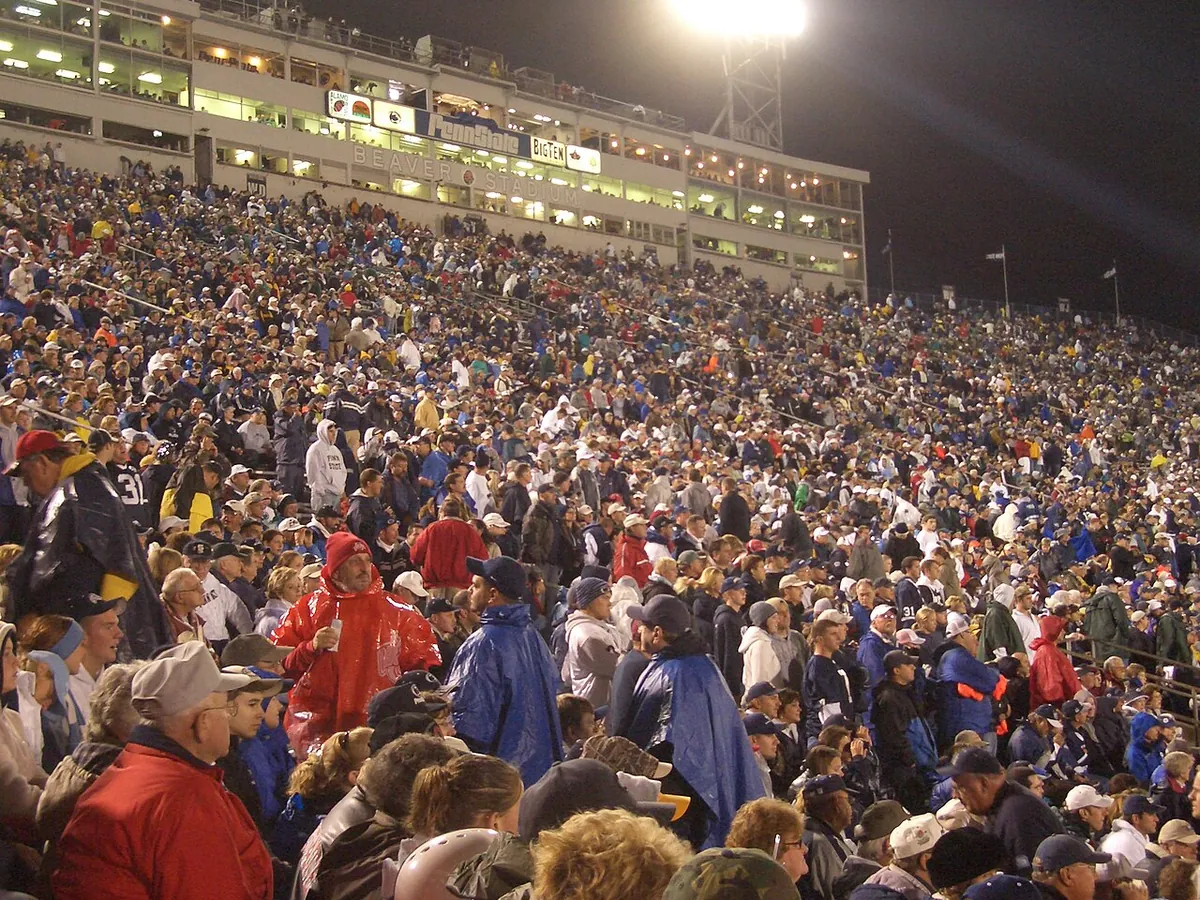
The stadium's sole football tenant is the Penn State Nittany Lions of the Big Ten Conference, who have played there since its opening in 1960. Its history is defined by regular-season college football contests, many of which have drawn record crowds. The stadium hosted its first night game on September 25, 1982, a 27-24 Penn State victory over Nebraska that was important to the program's first national championship season. Permanent lighting was installed in 1984. The annual White Out game, where fans all wear white, has become a nationally recognized tradition starting with a 2005 game against Ohio State. In 2002, Penn State set an NCAA record for total home attendance in a single season, drawing 857,911 fans over eight games for an average of 107,239. The stadium has also been the site of university commencements, which were held there until 1984. Penn State averaged 95,977 fans per game across all 13 games in the 2002 season, setting an NCAA full-season attendance record of 1,247,707 spectators. The top five largest crowds in stadium history are.
- 114,419, Penn State vs. USC, October 10, 2026
- 111,030, Penn State vs. Ohio State, November 2, 2024
- 111,019, Penn State vs. Oregon, September 27, 2025 (2OT)
- 110,889, Penn State vs. Ohio State, September 29, 2018
- 110,856, Penn State vs. Michigan, November 11, 2023
Renovations and Naming Rights
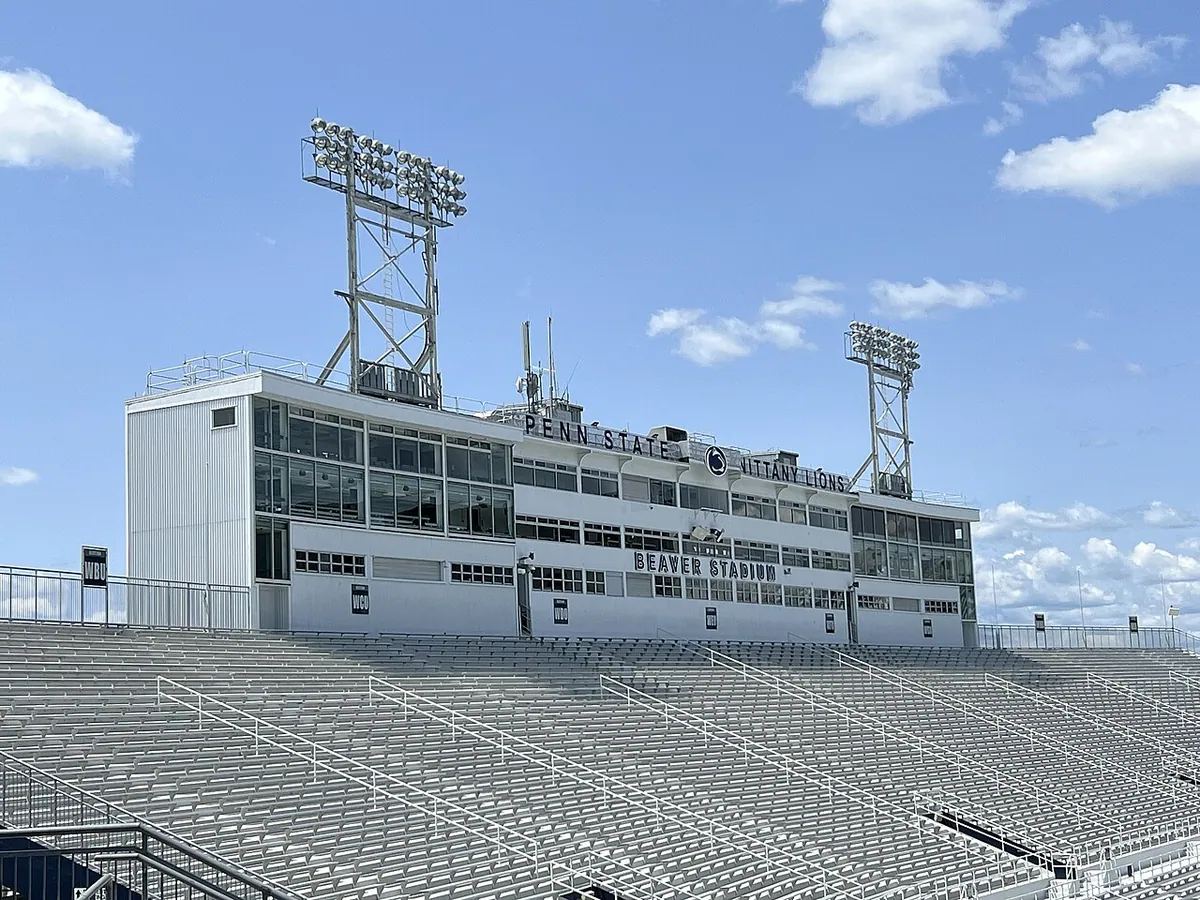
It is financed entirely by Penn State Intercollegiate Athletics. The renovation aims to enable year-round use of the stadium, enhance fan amenities, improve accessibility, and create modern gathering spaces. Key aspects include replacing the entire west side seating, adding suites and club spaces, and upgrading lighting and sound systems. The first stage of the project was approved in May 2023. A part of the renovation involving the scoreboards was completed before the 2024 season opener against Kent State. On January 4, 2025, the historic west end press box, which dated back to New Beaver Field and was moved in 1959, was demolished with controlled explosives. The project is expected to push the stadium's capacity over 109,000, potentially making it the largest in the United States. In March 2025, Penn State announced a 15-year naming rights agreement with West Shore Home, a home remodeling company based in Mechanicsburg, Pennsylvania, and owned by Penn State alumni. This deal officially renamed the venue West Shore Home Field at Beaver Stadium.
Stadium Features and Infrastructure
The playing surface at Beaver Stadium is natural grass, aligned northwest to southeast at an elevation of approximately 1,150 feet above sea level. The stadium features two large 4K UHD LED video boards, installed before the 2014 season at a cost of about $10 million. These boards replaced older models and provide a much larger area for game replays and video. An LED Nittany Lion logo on the back of each scoreboard is illuminated at night. Pyrotechnic displays are fired from the scoreboard tops as the Penn State team enters the field. The stadium contains 60 executive suites. The west-facing suites display large blue letters spelling "The Pennsylvania State University" and a list of the program's undefeated, national championship, and Big Ten championship years. The stadium's antiquated infrastructure, including outdated plumbing requiring winterization and narrow concourses, is a key driver of the current renovation. The venue was the first stadium to have its interior photographed for Google Street View.
Stadium Traditions and Culture
A key tradition is the "WE ARE. Call-and-response chant that echoes through the stands. The student section, known for its energy, has been voted the best in the country by ESPN and was recognized as student section of the year in 2019. Within it, the "S-Zone" is a section where students wear provided shirts to form a large blue and white "S". For Homecoming games in 2008, 2011, 2013, 2018, and 2023, the S-Zone used black and pink shirts to honor Penn State's original colors. Another tradition is Nittanyville, where students camp outside the stadium for days before big games to secure the best seats. Tailgating is extremely popular in the areas surrounding the stadium, with alcohol permitted in all outdoor areas and sold inside the stadium during games as of 2022. Penn State was ranked 15th nationally for tailgate culture by a magazine in August 2019. On September 8, 2021, Penn State dedicated a permanent Chair of Honor for POW/MIA service members in the stadium, which remains empty in perpetuity. The stadium's atmosphere is widely considered one of the toughest for opposing teams in college athletics.
Future Developments and Economic Impact
The ongoing $700 million revitalization represents the most significant change to Beaver Stadium since its 2001 expansion. Penn State Athletic Director Pat Kraft stated that the project aims to make Beaver Stadium the largest capacity venue in the United States, surpassing Michigan Stadium's 107,601 seats. The university's philosophy is to maximize seating to allow as many fans as possible to experience game day in Happy Valley. The project is managed by a consortium including Barton Malow, AECOM Hunt, and Alexander Building Construction Co. When completed, the revitalized stadium is intended to drive economic growth in the region and provide a modernized venue while preserving the traditional game-day atmosphere. The renovation is designed to grow revenue-generating opportunities and fuel funding for all 31 Penn State athletics programs. The project will transform fan experience through enhanced amenities, improved accessibility, and modern gathering spaces.
Historical Predecessors and Early History
Before Beaver Stadium, Penn State football had several earlier homes. Until 1893, games were played on the Old Main lawn. The first permanent stadium was Beaver Field, a 500-seat structure that opened with a 32-0 win over Western University of Pennsylvania on November 6, 1893. In 1909, New Beaver Field opened near Rec Hall with a capacity of 30,000, built originally of wood and reinforced with steel in 1936. That facility also contained fields for baseball, lacrosse, soccer, and track. New Beaver Field served as the home through the 1959 season. The decision to move and expand was driven by the team's growing popularity. The entire 30,000-seat structure was dismantled after the 1959 season to create the core of the current stadium. The name honors James A. Beaver, a Civil War brigadier general, Pennsylvania governor, and university board president who was instrumental in the school's development around the turn of the 20th century.
Video
FAQ
What is the seating capacity of Beaver Stadium?
The official seating capacity of Beaver Stadium as of the 2025 season is 106,304. This figure is part of an ongoing adjustment during a major renovation project. The stadium's all-time high capacity was 107,282 following the 2001 expansion. Before the current renovations, the capacity was 106,572 from 2011 to 2024. The renovation is expected to push the final capacity over 109,000 upon completion before the 2027 season, potentially making it the largest stadium in the United States. Athletic Director Pat Kraft stated in 2026 that the goal is to put a seat anywhere possible in the building.
Why is it called Beaver Stadium?
The stadium is named after James A. Beaver, a former governor of Pennsylvania from 1887 to 1891. Beaver was also a president of the Pennsylvania State University board of trustees and a native of nearby Millerstown. He served as a brigadier general in the Union Army during the Civil War and is credited with being an influential leader in the university's development at the turn of the 20th century. The name continues a tradition from the team's first permanent home, Beaver Field, which opened in 1893. James Beaver died in 1914.
What is the largest crowd ever at Beaver Stadium?
The largest crowd in Beaver Stadium history is 114,419, set on October 10, 2026, during a game where Penn State lost to USC 31-23. This record was achieved during the stadium's ongoing renovation, which included the addition of temporary seating. The previous record was 111,030, set on November 2, 2024, during a Penn State loss to Ohio State. The stadium has broken its attendance record multiple times throughout its history as expansions have increased its capacity.
What is happening to Beaver Stadium?
Beaver Stadium is undergoing a $700 million revitalization project scheduled for completion before the 2027 college football season. The multi-year project, approved in May 2024, involves replacing the entire west side seating, adding premium suites and club spaces, and improving amenities, lighting, and sound systems. The goal is to modernize the venue for year-round use while preserving its traditional atmosphere. The historic west end press box was demolished with controlled explosives in January 2025. Games have continued during construction, with temporary seating maintaining capacity over 106,000.
What is Beaver Stadium called now?
As of March 2025, the stadium's official name is West Shore Home Field at Beaver Stadium. This follows a naming rights deal with West Shore Home, a home remodeling company from Mechanicsburg, Pennsylvania. The company's owners are Penn State alumni. The agreement lasts for 15 years and adds the corporate sponsor's name while retaining the historic Beaver Stadium name. Prior to this, the venue was known simply as Beaver Stadium since its opening in 1960.
Does Penn State own Beaver Stadium?
Yes, Beaver Stadium is owned and operated by Pennsylvania State University. It is located on the university's University Park campus in College Township. The stadium is part of the Penn State Intercollegiate Athletics department. The ongoing $700 million renovation project is being financed and paid for entirely by Intercollegiate Athletics funds, not by student tuition or state appropriations. The Board of Trustees voted 26-2 to approve the renovation in May 2024.
Sources
- Beaver Stadium (Wikipedia) Wikipedia
- West Shore Home Field at Beaver Stadium, Penn State, Official Athletics Website gopsusports.com
- Beaver Stadium venuecoalition.com
- Beaver Stadium: A Visual History Through The Years onwardstate.com
- How Penn State football, Beaver Stadium, will have largest capacity Yahoo Sports
- Beaver Stadium: History, Capacity, Renovation & Future sportscapemagazine.com