The Cotton Bowl is an outdoor stadium located in Dallas, Texas, within the grounds of Fair Park, the site of the State Fair of Texas. Opened in 1930 as Fair Park Stadium, it was renamed the Cotton Bowl in 1936 and became famous as the longtime home of the Cotton Bowl Classic college football bowl game. The stadium has a current capacity of 92,100 and has hosted numerous professional and college football teams, including the Dallas Cowboys from 1960 to 1971. Its most famous annual event is the Red River Rivalry game between the Texas Longhorns and Oklahoma Sooners, which will remain at the venue through at least 2036. The stadium has undergone several major renovations, most recently a $140 million project announced in 2023, and it was designated a State Antiquities Landmark in 1984.
Construction, Opening and Early History
Ground was broken for the stadium in 1930 on the site of a previous wooden football stadium also known as Fair Park Football Stadium. The first game was played on October 26, 1930, between Dallas-area high schools. The original stadium seated 45,507 spectators and was built using a cut-and-fill method that lowered the playing surface 24 feet below ground level. The dirt removed was placed around the field, raising the back seats 15 feet above the street. The stadium hosted the 1934 Dixie Classic bowl game. In 1936, the stadium was renamed the Cotton Bowl, coinciding with its role in the Texas Centennial Exposition. That same year, President Franklin D. Roosevelt addressed a crowd of 40,000 people at the venue during the Cavalcade of History, an outdoor play with 250 actors.
Expansions and Renovations Timeline
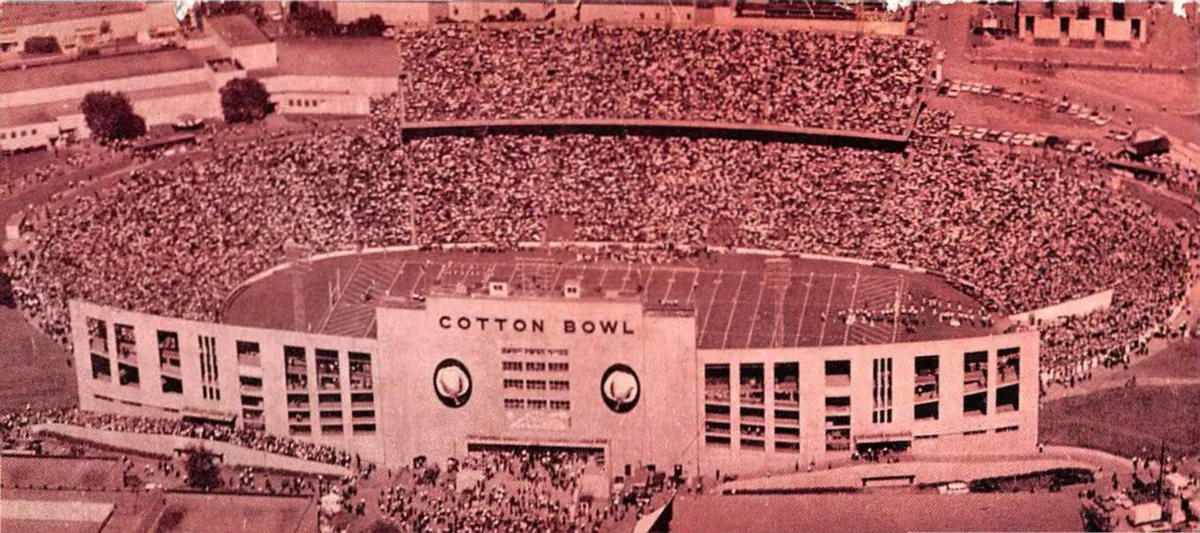
The stadium's capacity has been increased several times through major expansions and renovations. The first significant expansion came in 1948 when a second deck was added to the west side, raising capacity to 67,000. The east side was double-decked the following year in 1949, bringing total capacity to 75,504 and adding new team dressing rooms, a three-story press box, and an automatic lawn-sprinkler system. In 1968, chair-back seats were installed, which reduced capacity to 72,032. A major transformation occurred in 1993 in preparation for the 1994 FIFA World Cup, which involved widening the field, enlarging the press box, and reinstalling natural grass. The most comprehensive renovation was a $50 million project in 2008 that completely encircled the second deck, replaced all seats, and added new media and VIP facilities, a new scoreboard and video screen, and updated utilities. In December 2023, the city of Dallas announced a $140 million two-year renovation project for the stadium, scheduled for 2024 and 2025.
Stadium Capacity History and Record Attendance
The Cotton Bowl's seating capacity has fluctuated significantly throughout its history based on renovations and changes in seating configurations. It opened in 1930 with a capacity of 45,507. After the double-decking in 1948 and 1949, capacity peaked at 75,504. Following modifications for soccer and other events, capacity was reduced to 71,615 in 1994 and further to 68,252 in 1996. Temporary stands were erected in the end zones in the 2000s to increase seating for the Red River Rivalry to over 90,000. The comprehensive 2008 renovation returned the stadium to its current official capacity of 92,100 seats. The record attendance for a football game at the Cotton Bowl is 96,009, set during the 2009 Red River Rivalry game between Texas and Oklahoma. The stadium was filled to its then-capacity of 75,504 for both the 1966 NFL Championship and the preceding Cotton Bowl Classic in 1966.
Professional Football Tenants and Key Games
The Cotton Bowl has been home to three different professional football franchises. The first was the NFL's Dallas Texans in 1952, a team that played only four games at the stadium before financial failure forced the league to operate it as a traveling team based in Hershey, Pennsylvania. In 1960, both the NFL's Dallas Cowboys and the AFL's Dallas Texans began play at the Cotton Bowl. The AFL Texans, owned by Lamar Hunt, played there for three seasons before moving to Kansas City and becoming the Chiefs after winning the 1962 AFL championship. The Dallas Cowboys called the Cotton Bowl home for their first 12 seasons, from their formation in 1960 through 1971. The Cowboys played the 1966 NFL Championship Game at the Cotton Bowl on January 1, 1967, losing to the Green Bay Packers 34-27. The team moved to Texas Stadium in Irving during the 1971 season, playing their first two home games that year at the Cotton Bowl before the new stadium opened.
Primary College Football Tenants
The stadium's primary college tenant for decades was the SMU Mustangs. SMU began playing games there in 1932 and moved permanently to the Cotton Bowl in 1948, drawn by the immense popularity of running back Doak Walker, which earned the stadium the nickname The House That Doak Built. SMU played there until 1978, when they moved to Texas Stadium. The Mustangs returned to the Cotton Bowl for a period in the 1990s after serving the NCAA death penalty, using it before moving to their new on-campus stadium. They left for good when Gerald J. Ford Stadium was completed in 2000. The Cotton Bowl also served as a temporary home for the First Responder Bowl from 2011 until 2018, after which that game moved to SMU's campus. The stadium has no primary college or professional tenant as of 2026, though it hosts major annual events.
Annual College Football Games and Events
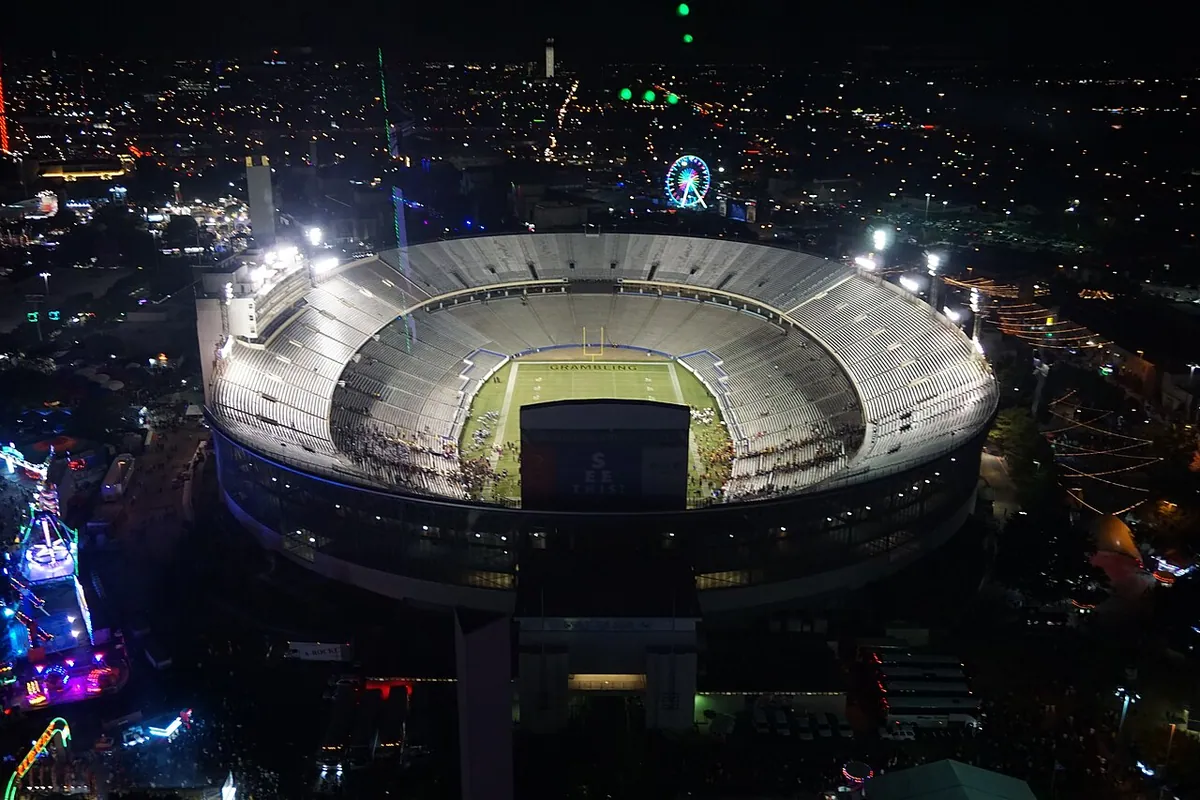
The stadium's most famous annual event is the Red River Rivalry between the University of Texas Longhorns and the University of Oklahoma Sooners. The game is played during the State Fair of Texas with tickets split evenly between the two schools and fans divided at the 50-yard line. As of the 2024 game, Texas leads the series 64-51-5. In December 2023, it was announced the rivalry would stay in the Cotton Bowl through 2036. Another annual college game is the State Fair Classic, featuring Grambling State University and Prairie View A&M University, which is the largest FCS football game in Texas and is known for its halftime Battle of the Bands. From 2018 to 2019, the stadium also hosted the Texas State Fair Classic Showdown, featuring Texas Southern University and Southern University. The stadium has a long history of hosting Texas high school football playoff and championship games, including record crowds in 1945 and 1967. Key historic college football events hosted at the Cotton Bowl include.
- The Cotton Bowl Classic (1937 to 2009): Hosted the first 73 editions of this major bowl game. The first game on January 1, 1937, saw TCU beat Marquette 16-6 before 17,000 fans.
- The First Responder Bowl (2011 to 2018): An annual bowl game previously known as the Heart of Dallas Bowl and TicketCity Bowl. The inaugural 2011 game saw Texas Tech defeat Northwestern 45-38.
- High school football championships and playoff games, including the North Texas Football Classic in 2011 and 2012.
The Cotton Bowl Classic Era and Move
The stadium is named for the Cotton Bowl Classic, the annual postseason college football game it hosted from its inception on New Year's Day 1937 through the January 2009 game. The game was the idea of Dallas oilman J. Curtis Sanford, who lost $6,000 on the first game. By 1940, it was being called Sanford's Folly after he lost $20,000 with only 12,000 paid customers. In 1941, a partnership with the Southwest Conference was arranged, and the game between Texas A&M and Fordham sold out the 45,507 seats, beginning a streak of sellouts. The game was not suspended during World War II, and in 1944 it featured a team from Randolph Field against the University of Texas, resulting in the Classic's first tie. The Classic moved to AT&T Stadium in Arlington starting with the January 2010 game, a move influenced by Dallas's cold January weather and the modern amenities of the domed stadium. The Cotton Bowl stadium itself has never hosted a Super Bowl.
Other Notable Sporting and Entertainment Events
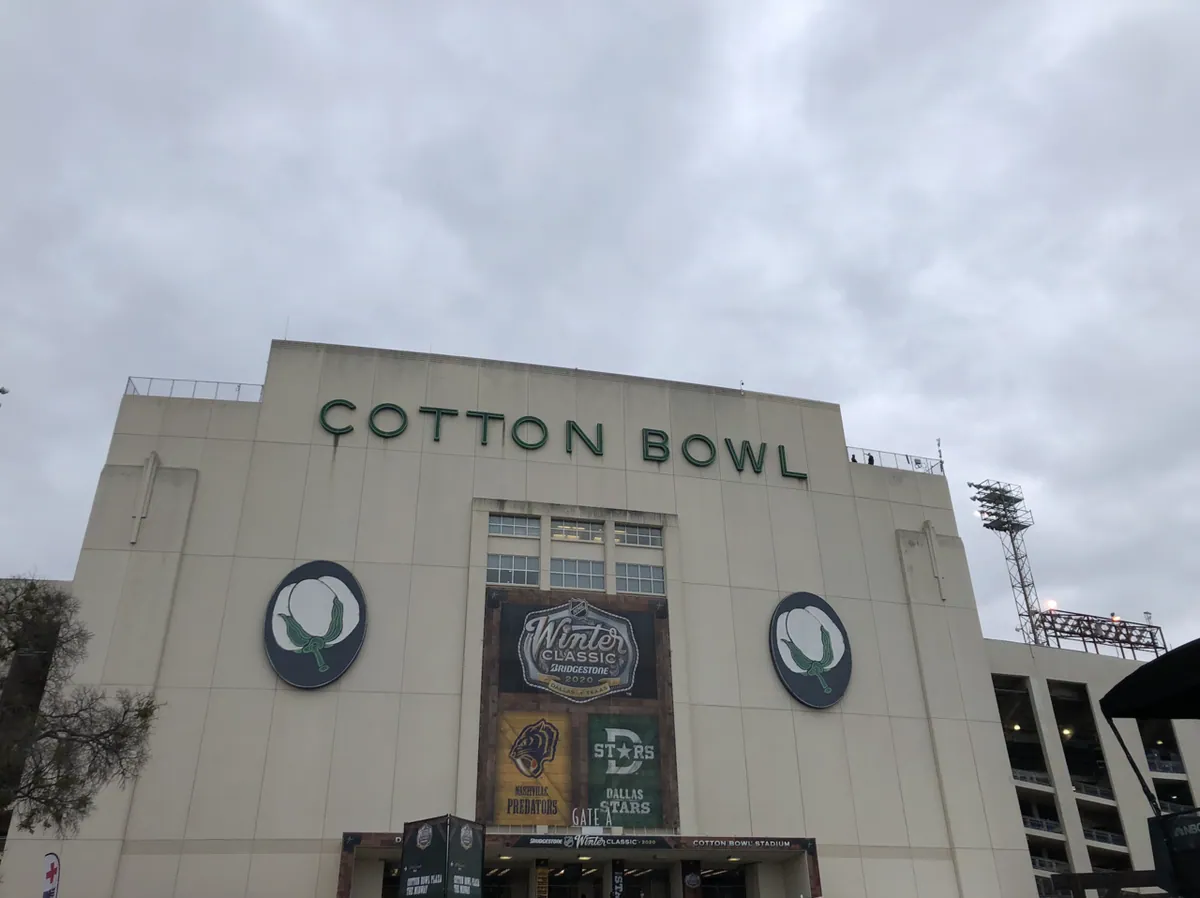
Beyond football, the Cotton Bowl has hosted a wide variety of other events. It was the site of a famous Texas League minor league baseball game on April 11, 1950, between the Dallas Eagles and Tulsa, which drew 54,151 fans, a record for the league that still stands. The stadium hosted six matches during the 1994 FIFA World Cup, including a Group C match between Germany and South Korea before 63,998 fans and a quarterfinal between Brazil and the Netherlands before 63,500. It also hosted CONCACAF Gold Cup matches in 1993 and 2021, including a 2021 match where Mexico defeated El Salvador before 45,792 spectators. On January 1, 2020, the NHL Winter Classic was held at the Cotton Bowl, with over 85,000 fans attending the game between the Dallas Stars and Nashville Predators. The stadium has also been used for major concerts, including the inaugural Texxas Jam. It hosted an International Champions Cup soccer match between Real Madrid and A.S. Roma in 2014, which Roma won 1-0.
Field Surface and Stadium Characteristics
The playing surface at the Cotton Bowl has changed twice in its history. The stadium originally featured natural grass from its opening in 1930 until 1969. In 1970, an AstroTurf artificial surface was installed to meet modern demands and remained for 23 years. In preparation for the 1994 FIFA World Cup, the artificial turf was removed and natural grass was reinstalled in 1993. The playing surface has remained natural grass ever since. The elevation of the field is approximately 450 feet above sea level. The structural engineers for the 1948 to 1949 expansion were Chappell, Stokes & Brenneke.
Naming Rights, Ownership and Historic Designations
Its name derives from the Cotton Bowl Classic game it hosted for 73 years. It was originally called Fair Park Stadium from its opening in 1930 until 1936, when it was renamed the Cotton Bowl. The stadium is owned by the City of Dallas. It holds several historic designations that recognize its architectural and cultural significance. It was designated a State Antiquities Landmark by Texas in 1984. It was designated as a Certified Property as part of the Texas Centennial Exposition Buildings district on September 24, 1986. The City of Dallas also designated it as a historic landmark on March 4, 1987.
Video
FAQ
What is the capacity of the Cotton Bowl stadium?
The Cotton Bowl stadium currently has an official seating capacity of 92,100. This figure was established after a major renovation project in 2008 that encircled the upper deck. The stadium's capacity has changed numerous times, starting at 45,507 when it opened in 1930. It grew to 75,504 after expansions in 1948 and 1949, was reduced to 68,252 in 1996, and finally reached its present size with the 2008 upgrades.
Did the Dallas Cowboys ever play at the Cotton Bowl?
Yes, the Dallas Cowboys used the Cotton Bowl as their home stadium for their first 12 seasons. The team played there from its inaugural season in 1960 through the 1971 season. Their first game at the venue was on September 24, 1960. The Cowboys also hosted the 1966 NFL Championship Game there on January 1, 1967, losing to the Green Bay Packers. The team relocated to Texas Stadium in Irving partway through the 1971 season.
What is the Red River Rivalry game at the Cotton Bowl?
The Red River Rivalry is the annual neutral-site college football game between the University of Texas Longhorns and the University of Oklahoma Sooners, played at the Cotton Bowl during the State Fair of Texas. Ticket sales are divided equally between the two universities, and their fan bases are split along the 50-yard line. The rivalry has been held at the stadium for decades, and a 2023 agreement extended its stay there through at least the 2036 season. Texas holds a series lead of 64 wins, 51 losses, and 5 ties as of the 2024 contest.
Has the Cotton Bowl stadium been renovated recently?
The Cotton Bowl stadium has undergone several renovations, with the most recent major project announced in December 2023. The city of Dallas committed an estimated $140 million for a two-year renovation scheduled for 2024 and 2025. This follows a previous $50 million renovation in 2008 that expanded capacity and modernized facilities. Other significant renovations occurred in 1993 for the FIFA World Cup and in the late 1940s when second decks were added.
What other major events have been held at the Cotton Bowl?
The Cotton Bowl has hosted a diverse array of major events beyond football. It was a venue for six matches during the 1994 FIFA World Cup. The stadium hosted the NHL Winter Classic on January 1, 2020, where over 85,000 spectators watched the Dallas Stars play the Nashville Predators. It has also staged CONCACAF Gold Cup soccer matches, a famous 1950 Texas League baseball game, and large music concerts like the Texxas Jam. The stadium was also used for the Cavalcade of History during the 1936 Texas Centennial Exposition.
What was the original name of the Cotton Bowl stadium when it opened?
The stadium originally opened as Fair Park Stadium in 1930. It was constructed on the site of the State Fair of Texas, known as Fair Park, and its first game was played between Dallas-area high schools in October of that year. The name was officially changed to the Cotton Bowl in 1936. The original structure seated 45,507 spectators and was built at a cost of $328,200.
Sources
- Cotton Bowl (stadium) (Wikipedia) Wikipedia
- Goodyear Cotton Bowl Classic, Official Website cottonbowl.com
- The Cotton Bowl Stadium texastimetravel.com
- The History and Significance of the Cotton Bowl Stadium tshaonline.org
- Cotton Bowl, History, Photos & More of the former NFL stadium of the Dallas Cowboys Stadiums of Pro Football