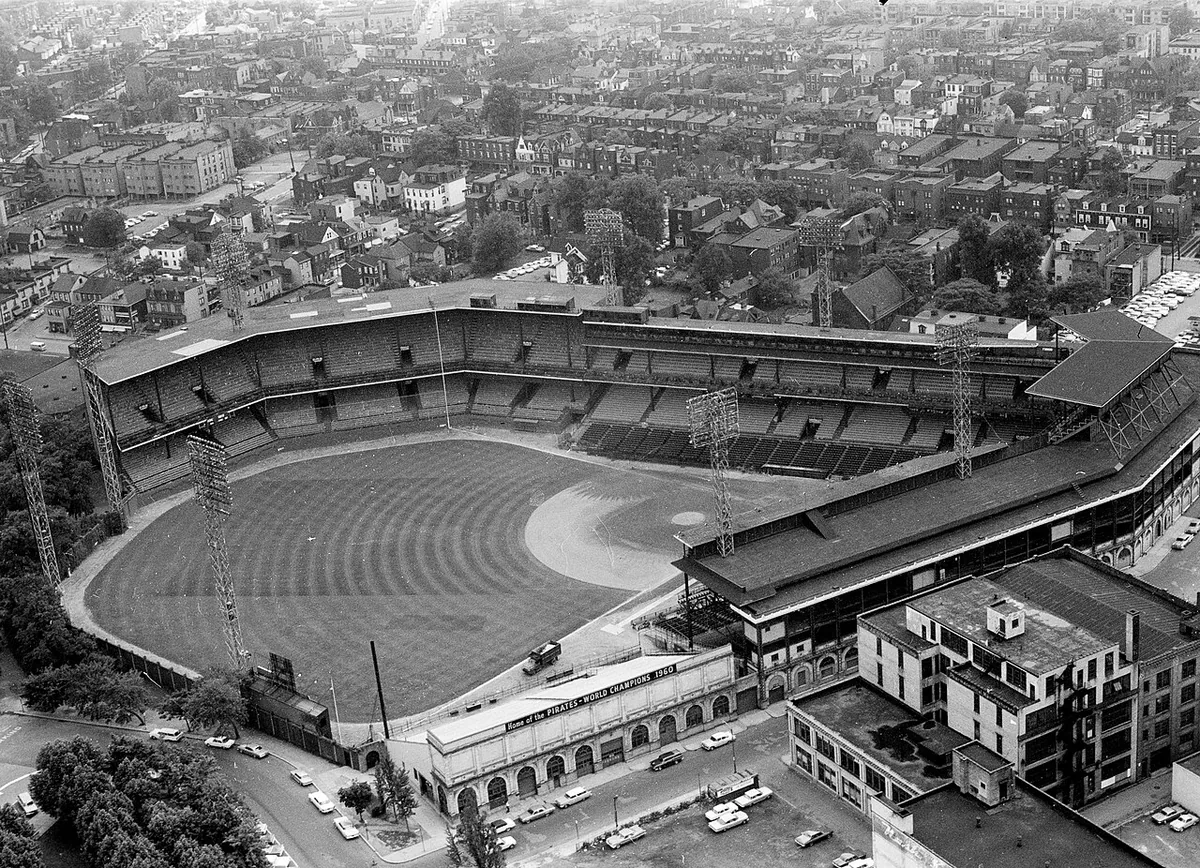
Forbes Field was a baseball park located in the Oakland neighborhood of Pittsburgh, Pennsylvania. It operated from 1909 until its closure in 1970 and was the first home of the Pittsburgh Steelers of the National Football League. The University of Pittsburgh Panthers football team also called the stadium home from 1909 to 1924. Constructed primarily of steel and concrete, Forbes Field was originally built for baseball but became a significant venue for early professional and college football in Western Pennsylvania before its demolition in 1971.
American Football at Forbes Field
Forbes Field hosted football for both professional and college teams. The University of Pittsburgh Panthers moved their home games to the new stadium upon its opening in 1909. The Pittsburgh Steelers, originally named the Pittsburgh Pirates, began playing at Forbes Field with their NFL debut in 1933. The stadium also hosted the combined Philadelphia-Pittsburgh "Steagles" team in 1943 and the merged Chicago Cardinals-Pittsburgh "Card-Pitt" team in 1944. The grass surface was used for all football games played at the venue.
The Pittsburgh Panthers enjoyed tremendous success during their tenure at Forbes Field. Their first game there was a victory over Bucknell University on October 16, 1909. Under coaches like Glenn "Pop" Warner and Jock Sutherland, the Panthers compiled five undefeated seasons and were awarded national championships in 1910, 1915, 1916, 1917, and 1918. The 1910 season was particularly dominant, as the team did not allow a single point. This period established Pitt as a national football power, with Forbes Field serving as the home for these historic teams before they moved to Pitt Stadium in 1924.
The Pittsburgh Steelers' history at Forbes Field was marked by early struggles and later memorable moments. The franchise's inaugural game on September 20, 1933, was a 23-2 loss to the New York Giants before a crowd of 25,000. A week later, the Steelers earned their first-ever win at Forbes Field by defeating the Chicago Cardinals. For much of their early decades, the Steelers posted losing records, achieving their first winning season in 1942. One of the most notable games occurred on November 30, 1952, when the Steelers set a team record by scoring nine touchdowns in a 63-7 rout of the New York Giants. The victory prompted the crowd of 15,140 to storm the field and tear down the goalposts.
- Pitt Panthers' first Forbes Field game: October 16, 1909 (win vs. Bucknell).
- Pitt's undefeated, unscored-upon season: 1910.
- Pittsburgh Steelers' first NFL game: September 20, 1933 (loss to N.Y. Giants).
- Steelers' first franchise victory: September 1933 (vs. Chicago Cardinals).
- Steelers' record 63-point game: November 30, 1952 (vs. N.Y. Giants).
- Final Steelers game at Forbes Field: December 1, 1963.
Construction, Opening, and Cost
Forbes Field was conceived by Pittsburgh Pirates owner Barney Dreyfuss as a modern replacement for the wooden and flood-prone Exposition Park. With assistance from industrialist Andrew Carnegie, Dreyfuss purchased seven acres of land adjacent to Schenley Park in Oakland. Ground was officially broken on March 1, 1909, and the Nicola Building Company completed construction in just 122 days. The stadium opened on June 30, 1909, with a Pirates game against the Chicago Cubs. The project was noted for its use of steel and concrete, a pioneering design for longevity that made it one of the first such stadiums in Major League Baseball.
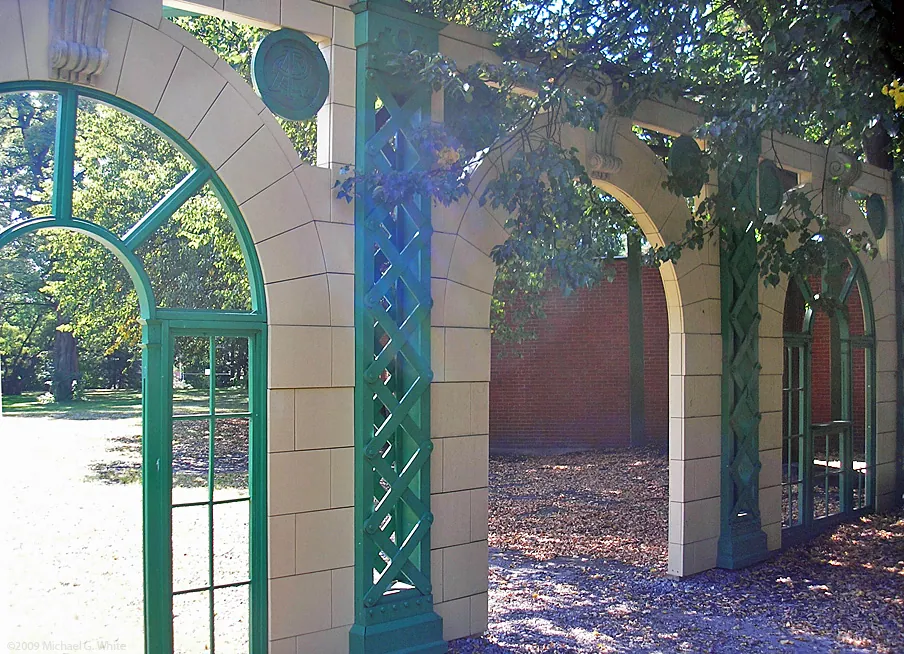
The cost of construction and site acquisition was officially recorded at $1 million, though some contemporary estimates placed the total closer to $2 million. Architect Charles Leavitt Jr. designed the three-tiered grandstand with fan-friendly innovations like ramps and elevators. Dreyfuss chose to name the stadium after General John Forbes, a British military leader in the French and Indian War, rather than naming it after himself. The exterior featured a buff-colored terra cotta facade with light green steelwork and a red slate roof, creating a distinctive and grand appearance for its time.
Stadium Capacity and Configuration
The seating capacity at Forbes Field changed multiple times throughout its history due to expansions and modifications. Upon opening in 1909, the stadium had a capacity of 25,000. A major expansion in 1925 increased the capacity to 41,000. By the time the stadium closed in 1970, the capacity was 35,000. The largest crowd for a Steelers game at Forbes Field was 40,916 for a contest against the New York Giants on September 30, 1962. For baseball, the largest recorded crowd was 44,932 for a game against the Brooklyn Dodgers on September 23, 1956.
The original design included obstructed views due to support pillars, a common feature of early steel-and-concrete ballparks. On days of overflow attendance, fans were permitted to sit on the grass in the outfield, provided they agreed to allow a player to catch any ball hit in the area. The lowest season of attendance came in 1914, when 139,620 people attended games. The highest season attendance at the stadium came in 1960, when 1,705,828 people watched the Pirates play. The smallest crowd to attend a Pirates game was believed to be 200 people on June 10, 1938, though other records list 1,034.
Field Surface and Notable Features
Forbes Field had a natural grass playing surface throughout its existence, with sod originally grown in Crestline, Ohio. The field was known for its hard infield dirt, which could create unpredictable hops, as famously evidenced during the 1960 World Series. The outfield dimensions were exceptionally deep for most of the park's life, making it one of the most difficult stadiums in baseball to hit an over-the-fence home run. The original 1909 dimensions were 360 feet to left field, 462 feet to center, and 376 feet to right field.
Several unique physical features defined the ballpark. A hand-operated scoreboard with a Longines clock was located on the left-field wall. In May 1930, a 28-foot-high screen was erected atop the right-field wall. In 1946, the left and center field fence was replaced by a brick wall. Ivy was planted at the base of the new wall. Three light towers stood in the outfield, and their surrounding cages were in play, with balls hitting them or landing inside them ruled as home runs. For many years, the batting cage was stored in fair territory in deep left-center field, creating an unusual obstacle for fielders.
Tenants and Major Events
Forbes Field was primarily the home of the Pittsburgh Pirates baseball team from 1909 to 1970. Its football tenants were the University of Pittsburgh Panthers (1909 to 1924) and the Pittsburgh Steelers (1933 to 1963). While no Super Bowls were played at Forbes Field, the venue hosted significant football games during the early NFL and college football eras. The stadium was the site of numerous historic baseball events, including Babe Ruth's final three home runs on May 25, 1935, with the last one clearing the right-field roof. The final game of the 1960 World Series, won by Bill Mazeroski's walk-off home run, is one of the most famous moments in baseball history. The first night game at Forbes Field was played on June 4, 1940. The final event was a baseball doubleheader between the Pirates and Chicago Cubs on June 28, 1970.
| Tenant | Years at Forbes Field |
|---|---|
| Pittsburgh Pirates (MLB) | 1909 to 1970 |
| Pitt Panthers (NCAA) | 1909 to 1924 |
| Pittsburgh Steelers (NFL) | 1933 to 1963 |
| Steagles | 1943 |
| Card-Pitt | 1944 |
Renovations, Closure, and Demolition
The most significant renovation to Forbes Field occurred in 1925 at a cost of $750,000. This project extended the grandstand down the right-field line, increasing seating capacity and changing the right-field foul distance from 376 feet to 300 feet. Other modifications included the addition of a press box known as the "Crow's Nest" on the roof behind home plate in 1938. In 1947, the bullpens were moved to the base of the scoreboard in left field, cutting 30 feet from the left field area to create "Greenberg Gardens," later called "Kiner's Korner. This configuration was restored in 1954.
By the late 1950s, the stadium was showing its age and lacked modern amenities and adequate parking. In a significant move, the University of Pittsburgh purchased the stadium and its land in November 1958 for $2 million, with an agreement to lease it back to the Pirates until a replacement was built. This led to the construction of Three Rivers Stadium. The Pirates played their final game at Forbes Field on June 28, 1970, winning both games of a doubleheader against the Cubs. After closure, the stadium was damaged by two fires. Demolition took place in July 1971, with relics like stadium seats sold to the public. Home plate was ceremoniously relocated by helicopter to the new Three Rivers Stadium.
Legacy and Remnants
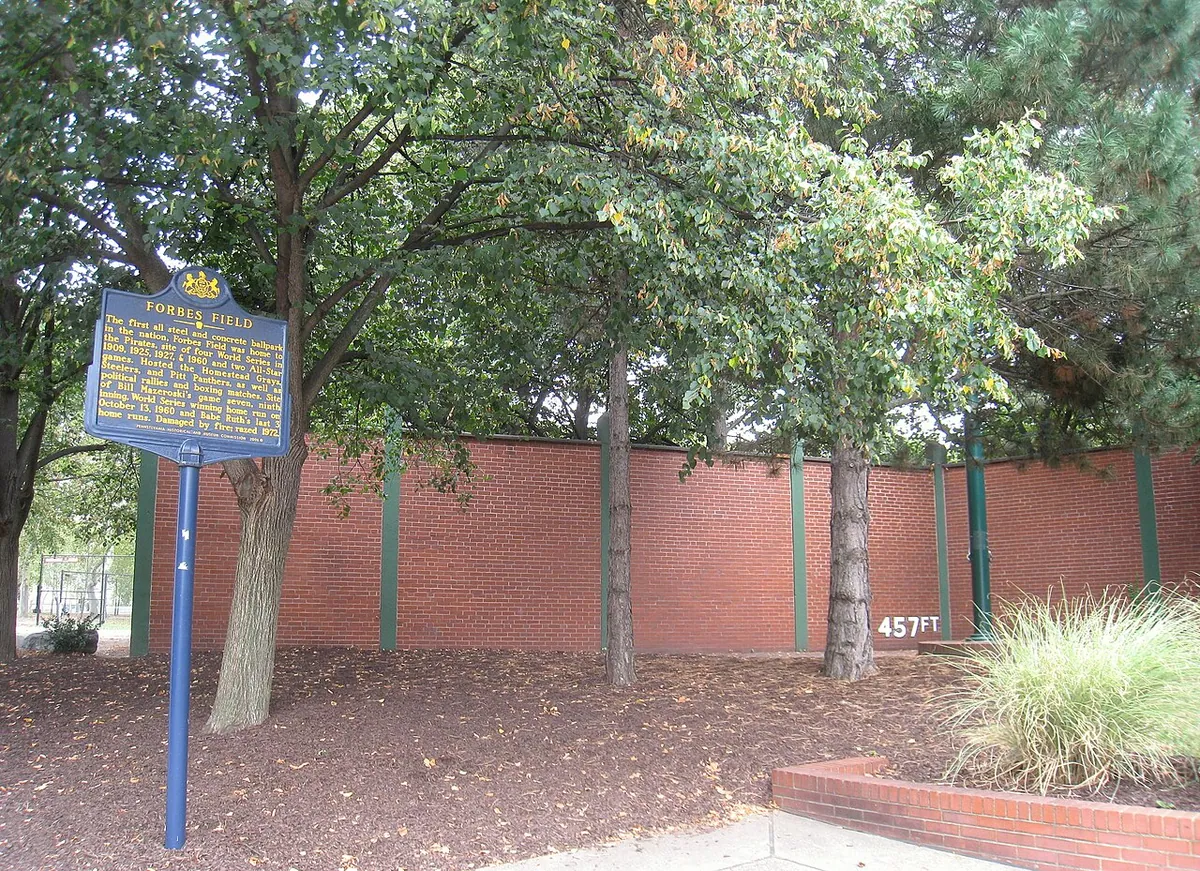
Although Forbes Field was demolished, several remnants of the ballpark were preserved on the site, which is now part of the University of Pittsburgh campus. A section of the original outfield brick wall, including a length of the ivy-covered left-field wall, still stands. The location of home plate is preserved under glass in a university hallway. A plaque marks the spot where Bill Mazeroski's 1960 World Series-winning home run cleared the wall. These physical remnants serve as a memorial to the stadium's 61-year history.
The legacy of Forbes Field extends beyond its physical remains. It was a pioneering stadium in terms of construction and design, influencing future ballpark development. For football fans, it represents the foundational home of the Pittsburgh Steelers and a golden era of Pitt Panthers football. Annual gatherings still take place at the wall on the anniversary of Mazeroski's home run, demonstrating the enduring affection for the venue. Forbes Field's history is integral to the story of professional sports in Pittsburgh, bridging the era of wooden parks to the age of modern multi-purpose stadiums.
Video
FAQ
What was the capacity of Forbes Field for football games?
Forbes Field's seating capacity changed over time. After a major expansion in 1925, the stadium's capacity was 41,000. By the time it closed in 1970, the capacity was 35,000. The largest crowd for a Steelers game at Forbes Field was 40,916 for a 1962 contest against the New York Giants. The configuration for football utilized the existing baseball grandstand, and on days of high attendance, fans were sometimes permitted to sit on the grass in the outfield.
When was Forbes Field demolished?
Forbes Field was demolished in July 1971. The stadium hosted its final event, a Pittsburgh Pirates doubleheader, on June 28, 1970. After sitting vacant, it was damaged by two fires. The demolition process then cleared the site, which was owned by the University of Pittsburgh. Some artifacts, including stadium seats, were sold to the public. Key remnants, like a section of the outfield wall, were preserved and remain on the university campus today.
Where was Forbes Field located?
Forbes Field was located at 230 South Bouquet Street in the Oakland neighborhood of Pittsburgh, Pennsylvania. The site was adjacent to Schenley Park and near the campus of the University of Pittsburgh. When built, the location was about a 10-minute trolley ride from downtown Pittsburgh and was initially criticized for being too far from the city center. The area later developed into a major academic and cultural district.
What is left of Forbes Field today?
Several remnants of Forbes Field are preserved on the University of Pittsburgh campus. A large section of the original outfield brick wall, complete with ivy, still stands. The location of home plate is marked under glass in a hallway on campus. A memorial plaque indicates the spot where Bill Mazeroski's 1960 World Series-winning home run cleared the wall. These preserved elements serve as a historical park and a gathering place for fans, especially on the anniversary of the famous home run.
What was the original cost to build Forbes Field?
The original cost to build Forbes Field was an estimated US$1 to $2 million. Official Pittsburgh Pirates records state the site acquisition and construction cost $1 million, which is equivalent to about $35.8 million in 2025 dollars. Some contemporary estimates, however, placed the total cost at twice that amount. Owner Barney Dreyfuss selected low-priced land so he could allocate more funds toward constructing a pioneering stadium made of steel and concrete.
What were some notable features and innovations at Forbes Field when it opened?
When it opened in 1909, Forbes Field featured several notable innovations for its time. It was one of the first steel-and-concrete ballparks in Major League Baseball, built for durability. The stadium included ramps and elevators to assist fan movement, a novelty in ballparks. It also had a room for umpires and a visiting team clubhouse similar to the Pirates' facilities. The grandstand was three-tiered, and the exterior featured buff-colored terra cotta and light green steelwork with a red slate roof.
Sources
- Forbes Field (Wikipedia) Wikipedia
- Forbes Field football.ballparks.com
- Forbes Field, history, photos and more of the Pittsburgh Pirates former ballpark ballparksofbaseball.com