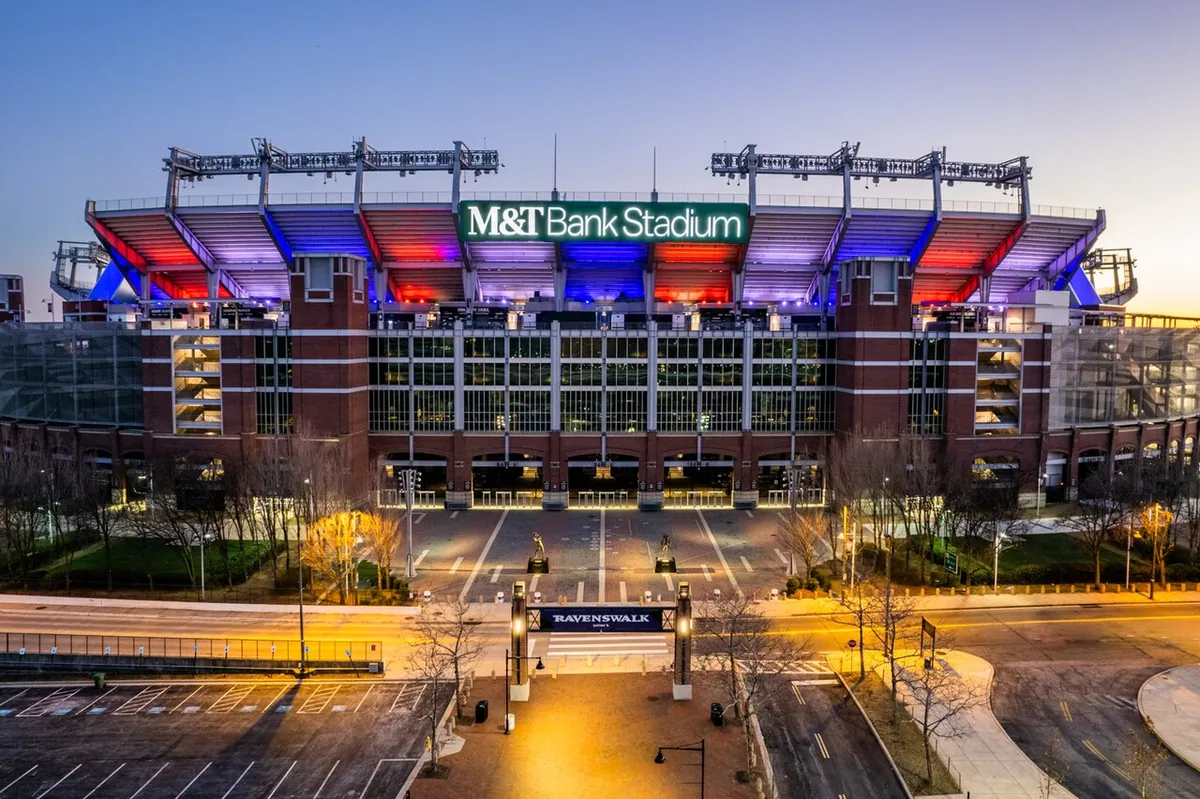
M&T Bank Stadium is a multi-purpose outdoor stadium located at 1101 Russell Street in Baltimore, Maryland. It has been the home stadium of the Baltimore Ravens of the National Football League since its opening on August 8, 1998. The stadium was constructed at a cost of $220 million, is owned by the Maryland Stadium Authority, and operated by the Ravens. The venue is immediately adjacent to Oriole Park at Camden Yards and hosts a wide variety of events including NFL games, concerts, and international soccer matches.
Location and Construction History
M&T Bank Stadium is located at 1101 Russell Street in Baltimore, Maryland, immediately adjacent to Oriole Park at Camden Yards. Knabe & Co. piano factory, which closed during the Great Depression. Ground was broken for the stadium on July 23, 1996, following the announcement by Art Modell in November 1995 that he would relocate his NFL franchise to Baltimore. The stadium was designed by HOK Sport, the same firm that designed the neighboring baseball park. Construction was completed in less than two years, with the venue opening on August 8, 1998. The total construction cost was $220 million, funded through a combination of proceeds from tax-exempt revenue bond sales, debt service paid by lottery proceeds, and financial support from the Baltimore Ravens. The general contractors for the project were a joint venture of The Whiting-Turner Contracting Company and Barton Malow.
Stadium Design and Architectural Features
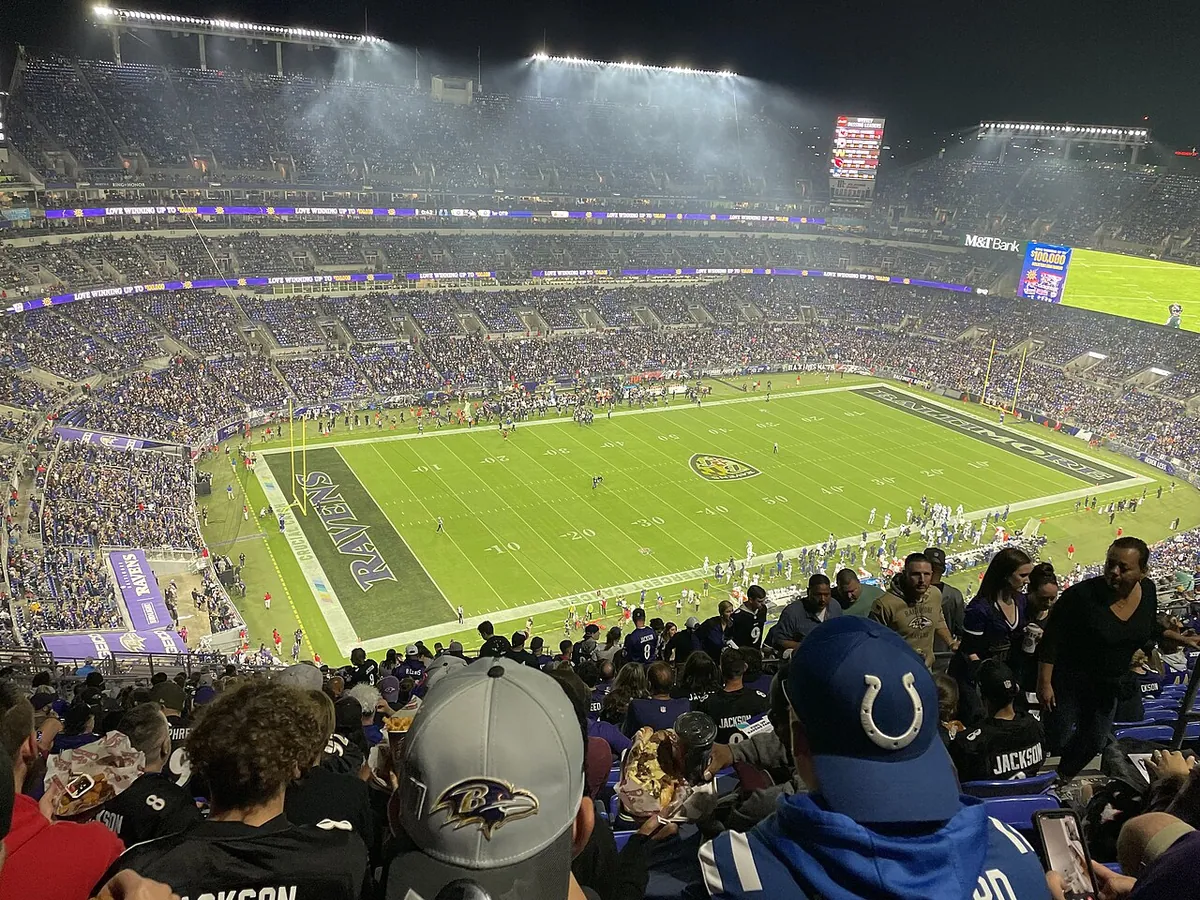
M&T Bank Stadium is an open-air facility with five distinct seating levels: the lower bowl, club level, suites levels, and the upper bowl. The lower bowl contains 42 rows of seats, split into two sections with rows numbered 1 to 18 below the tunnel entrances and 19 to 42 above them. In the upper bowl, sideline seats are labeled 1 to 32, while end zone rows range from 1 to 26. Seat widths vary from 19 to 21 inches in the lower and upper bowls due to the curved design, while padded club seats range from 21 to 23 inches. The stadium features suites and club seats. The venue is served by the Stadium/Federal Hill station of the Baltimore Light Rail, as well as MTA Maryland bus routes 69, 70, 73, and 75.
Technology, Sustainability, and Renovations
The stadium is equipped with advanced technological facilities, including the RavensVision high-definition video display. In November 2013, the Baltimore Ravens and the Maryland Stadium Authority earned a LEED Gold certification for the stadium from the U.S. Green Building Council. A $489 million joint venture renovation project between the Ravens and the Maryland Stadium Authority was completed in 2026. This project, designed by Gensler and implemented in three phases, added a new team store, an entertainment venue, bars, field-level seats, premium suites, and a completely revamped North Plaza.
Seating Capacity Evolution
The listed capacity was 69,084 from 1999 to 2004, 70,107 from 2005 to 2006, and 71,008 from 2007 to 2020. The current listed capacity is 70,745 as of 2021. The largest crowd in stadium history was 71,547 for an NFL Divisional Playoff game between the Baltimore Ravens and Houston Texans on January 15, 2012. Previous regular season records include 71,502 for a game against the Pittsburgh Steelers on December 14, 2008, and 71,438 for a game against the Washington Redskins on December 7, 2008. The stadium's design draws from Baltimore's architectural style and is praised for its fan amenities, ease of access, and concessions.
Playing Surface History
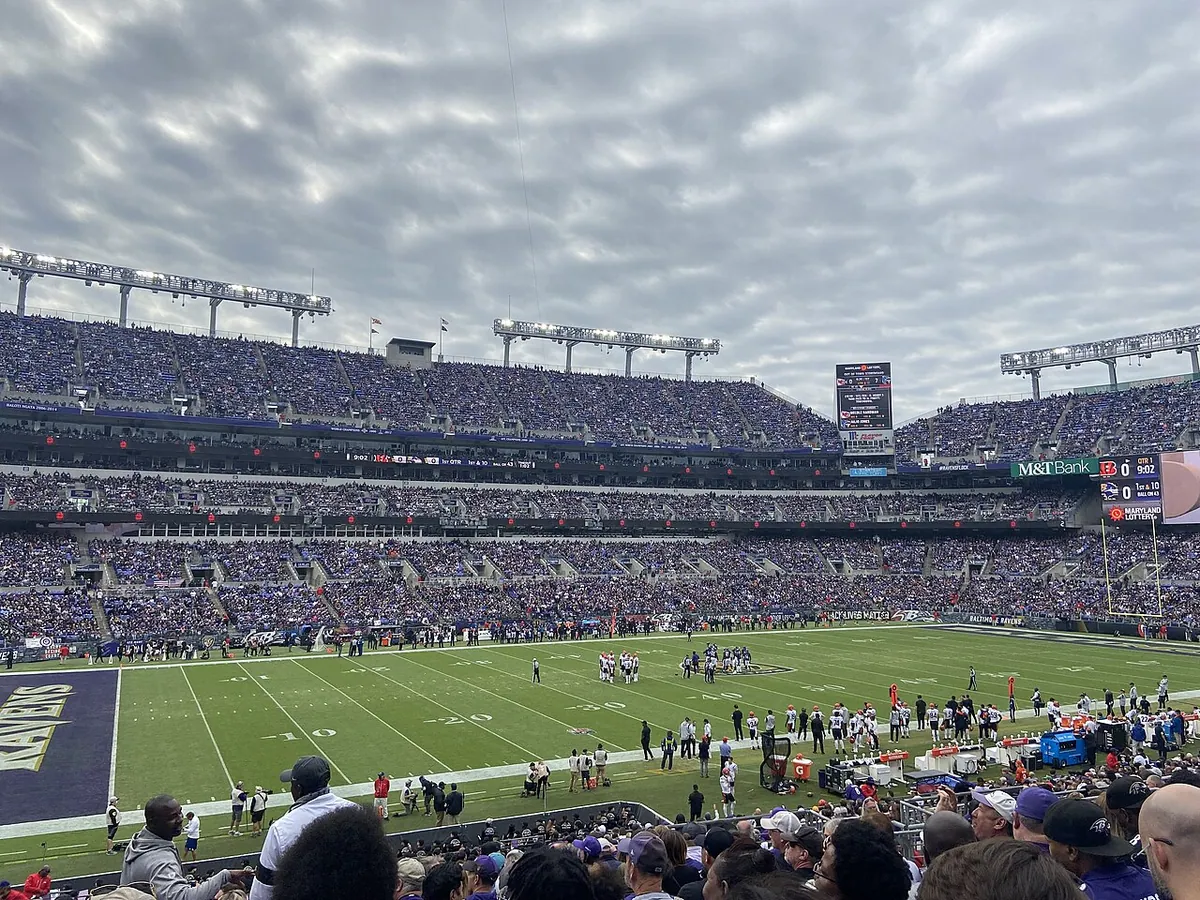
The playing surface at M&T Bank Stadium has undergone several changes. The stadium featured GN-1 Bermuda Grass from 1998 to 2002. An artificial surface, Shaw Sports Turf Momentum, was installed for the 2003 season. This synthetic turf was replaced by a new-generation product, Shaw Sports Turf Momentum 51, in 2010. In December 2015, the Ravens announced a return to natural grass. Since the 2016 season, the playing field has been Tifway 419 Bermuda Grass. This surface is maintained for the primary tenant, the Baltimore Ravens, and for the various other football and sporting events the stadium hosts.
NFL Football and the Baltimore Ravens Tenancy
M&T Bank Stadium has been the home of the Baltimore Ravens since its opening. From the 1999 season through November 27, 2026, the stadium has hosted 234 NFL games, comprising 224 regular season contests and 10 playoff games. The venue has been known by three names during the Ravens' tenancy: PSINet Stadium (25 games), Ravens Stadium (8 games), and M&T Bank Stadium (201 games). The stadium hosted a conference championship game in the 2023 season on January 28, 2024, when the Kansas City Chiefs defeated the Ravens 17-10. The highest-scoring NFL game at the stadium from 1999 to 2026 was a 44-41 overtime victory by the Ravens over the Seattle Seahawks on November 23, 2003, combining for 85 total points. The plaza in front of the stadium features statues of Baltimore Colts legend Johnny Unitas and Ravens icon Ray Lewis. The letters MO in the Baltimore Ravens end zones are painted gold or white in honor of Baltimore sports fan Mo Gaba.
- November 23, 2003: Highest combined score game (Ravens 44, Seahawks 41, 85 total points).
- January 15, 2012: Record attendance of 71,547 for a Divisional Playoff game.
- December 14, 2008: Regular season record crowd of 71,502 for a game against the Steelers.
College Football Events
The stadium is a periodic host for the Army, Navy Game, having held the rivalry in 2000, 2007, 2014, 2016, and 2025. It has also hosted several notable neutral-site games involving major programs, including the Crab Bowl Classic between Maryland and Navy. The two teams played at the stadium in 2005 for the first time in 40 years and again on September 6, 2010, with Maryland winning 17-14. Other major matchups have included Notre Dame versus Navy in 2006 and 2022, Ohio State versus Navy in 2014, Maryland versus West Virginia in 2013, and Maryland versus Penn State in 2015.
| Date | Matchup | Result |
|---|---|---|
| October 28, 2006 | Notre Dame vs. Navy | Notre Dame 38, Navy 14 |
| September 6, 2010 | Maryland vs. Navy | Maryland 17, Navy 14 |
| 2014 | Ohio State vs. Navy | Ohio State 34, Navy 17 |
| October 24, 2015 | Maryland vs. Penn State | Penn State 31, Maryland 30 |
| 2022 | Notre Dame vs. Navy | Notre Dame 35, Navy 32 |
Naming Rights History and Financial Deals
PSINet acquired the naming rights in 1999, renaming it PSINet Stadium. After PSINet filed for bankruptcy in 2002, the name reverted to Ravens Stadium. On May 6, 2003, M&T Bank secured a 15-year, $75 million naming rights deal, brokered by Team Services, LLC, and the venue became M&T Bank Stadium. This partnership was renewed in 2023, extending the naming rights through the 2037 season. Following the death of Johnny Unitas in September 2002, there was public sentiment to name the sponsorless stadium after him. The plaza in front of the main entrance was named Unitas Plaza and features a bronze statue of the Hall of Fame quarterback.
- 1998: Opened as Ravens Stadium at Camden Yards.
- 1999: Naming rights sold to PSINet, becoming PSINet Stadium.
- May 6, 2003: M&T Bank signed a 15-year, $75 million naming rights deal.
- 2002: Public sentiment leaned toward renaming the stadium after Johnny Unitas.
Other Major Sporting Events and Concerts
The largest concert in its history was the U2 360° Tour on June 22, 2011, which drew 74,557 fans and generated $6,832,510 in revenue. The fastest-selling concert was the On the Run Tour featuring Beyoncé and Jay-Z on July 7, 2014. The stadium has hosted major international soccer matches, including games during the 2013 and 2015 CONCACAF Gold Cup. A quarterfinal doubleheader during the 2013 Gold Cup drew 70,540 spectators. An MLS match between Inter Miami CF and D.C. United on March 7, 2026, drew a crowd of 72,026. On September 12, 2026, the stadium hosted a rugby union test between South Africa and New Zealand as part of the Rugby's Greatest Rivalry tour, attracting 68,173 spectators, the largest-ever crowd to watch a rugby match in the USA. The venue has also hosted the NCAA Division I Men's Lacrosse Championship semifinals and finals on six occasions: 2003, 2004, 2007, 2010, 2011, and 2014.
- June 22, 2011: U2's 360° Tour, the largest concert (74,557 attendees).
- September 12, 2026: Rugby test (South Africa vs. New Zealand) with 68,173 fans.
- 2013 & 2015: Hosted CONCACAF Gold Cup quarterfinal matches.
- 2003 to 2014: Hosted the NCAA Men's Lacrosse Championship six times.
- July 24, 2009: Hosted Chelsea vs. AC Milan in the World Football Challenge.
Recent games
| Date | Game | Week |
|---|---|---|
| Jan 10, 2027 | Pittsburgh Steelers at Baltimore Ravens | Week 18 |
| Dec 27, 2026 | Cleveland Browns at Baltimore Ravens | Week 16 |
| Dec 13, 2026 | Tampa Bay Buccaneers at Baltimore Ravens | Week 14 |
| Nov 16, 2026 | Los Angeles Chargers 23 at Baltimore Ravens 20 | Week 10 |
| Nov 5, 2026 | Jacksonville Jaguars 33 at Baltimore Ravens 10 | Week 9 |
| Oct 25, 2026 | Cincinnati Bengals 35 at Baltimore Ravens 13 | Week 7 |
| Oct 4, 2026 | Tennessee Titans 18 at Baltimore Ravens 24 | Week 4 |
| Sep 20, 2026 | New Orleans Saints 24 at Baltimore Ravens 17 | Week 2 |
| Dec 21, 2025 | New England Patriots 28 at Baltimore Ravens 24 | Week 16 |
| Dec 7, 2025 | Pittsburgh Steelers 27 at Baltimore Ravens 22 | Week 14 |
| Nov 27, 2025 | Cincinnati Bengals 32 at Baltimore Ravens 14 | Week 13 |
| Nov 23, 2025 | New York Jets 10 at Baltimore Ravens 23 | Week 12 |
Video
FAQ
What is the capacity of M&T Bank Stadium?
The listed capacity of M&T Bank Stadium is 70,745 as of 2021. When the stadium opened in 1998, it held 68,400 spectators. The listed capacity was 69,084 from 1999 to 2004, 70,107 from 2005 to 2006, and 71,008 from 2007 to 2020. The largest crowd ever recorded at the stadium was 71,547 for an NFL playoff game on January 15, 2012.
When did M&T Bank Stadium open and who designed it?
M&T Bank Stadium opened to the public on August 8, 1998. The architectural design was handled by the firm HOK Sport, which is now known as Populous. Construction began with a groundbreaking ceremony on July 23, 1996, and the entire project was finished in less than two years. The Baltimore Ravens played their first official NFL game at the stadium on September 6, 1998.
Is M&T Bank Stadium a covered or dome stadium?
M&T Bank Stadium is not a covered or domed facility. It is an open-air, outdoor stadium with no roof structure. Official records classify it as an outdoor venue. The playing field is natural grass, specifically Tifway 419 Bermuda Grass, which replaced an artificial turf system prior to the 2016 season.
What NFL team plays at M&T Bank Stadium and what are its attendance records?
M&T Bank Stadium is the permanent home field of the Baltimore Ravens. The team has played its home games there since the stadium opened in 1998, hosting a total of 234 NFL games from the 1999 season through November 27, 2026. The stadium's all-time attendance record is 71,547, set during a playoff victory over the Houston Texans on January 15, 2012. Other significant crowds include 71,502 for a regular season game against the Pittsburgh Steelers in December 2008.
What was M&T Bank Stadium called before and how did it get its current name?
The stadium originally opened under the name Ravens Stadium at Camden Yards in 1998. In 1999, the naming rights were sold to the company PSINet, and it became known as PSINet Stadium. After PSINet declared bankruptcy in 2002, the name temporarily reverted to Ravens Stadium. The current name took effect in 2003 when M&T Bank purchased the naming rights through a 15-year, $75 million agreement. This deal was later renewed, extending the M&T Bank Stadium name through the 2037 season.
What is the address and location of M&T Bank Stadium?
M&T Bank Stadium is located at 1101 Russell Street in Baltimore, Maryland, United States, with the zip code 21230. The stadium sits in the Camden Yards sports complex, immediately adjacent to Oriole Park at Camden Yards. Its specific coordinates are 39.27806°N latitude and 76.62278°W longitude. This location places it near major highways and public transit, including the Stadium/Federal Hill station on the Baltimore Light Rail.
Sources
- M&T Bank Stadium (Wikipedia) Wikipedia
- M&T Bank Stadium | Baltimore Ravens, baltimoreravens.com baltimoreravens.com
- M&T Bank Stadium baike.baidu.com
- M&T Bank Stadium Attendance History tickettimeline.com
- Buffalo Bills Introduce M&T Bank Lounge, the Premier 365-Day.. buffalobills.com
- nflverse game, roster and draft data nflverse (CC BY 4.0)