The Pontiac Silverdome was a multi-purpose domed stadium located at 1200 Featherstone Road in Pontiac, Michigan. It opened on August 23, 1975, and served as the home of the Detroit Lions of the National Football League from 1975 through the 2001 season. With an original seating capacity of 80,311 for football, it was the largest stadium in the NFL until the year 2000. The venue was notable for its 430,000-square-foot air-supported Teflon-coated fiberglass roof, the first of its kind in a major athletic facility. It hosted major events including Super Bowl XVI, WrestleMania III, and matches from the 1994 FIFA World Cup. The stadium was demolished between December 4, 2017, and March 2018.
Conception and Construction
The idea for the Pontiac Silverdome originated with Pontiac native C. Don Davidson, an architect and urban planner. Davidson returned to Pontiac in 1965 and made a new stadium a key component of his vision for the city's renewal. He contacted Detroit Lions owner William Clay Ford and promoted the project through a weekly newspaper he started called The Pontiac Times. After controversy and consideration of other sites like the Michigan Fairgrounds, Walled Lake, and the Detroit Riverfront, Pontiac was chosen as the location. The architectural firm of O'Dell, Hewlett and Luckenbach was hired, with Davidson serving as chief project designer. Initial designs included a dual stadium complex for football and baseball, but this was scrapped due to high costs. Groundbreaking occurred on September 19, 1973, and the stadium was built in 23 months by general contractor Barton Malow at a cost of $55.7 million. The stadium opened on August 23, 1975, initially named Pontiac Metropolitan Stadium.
Stadium Design and Capacity
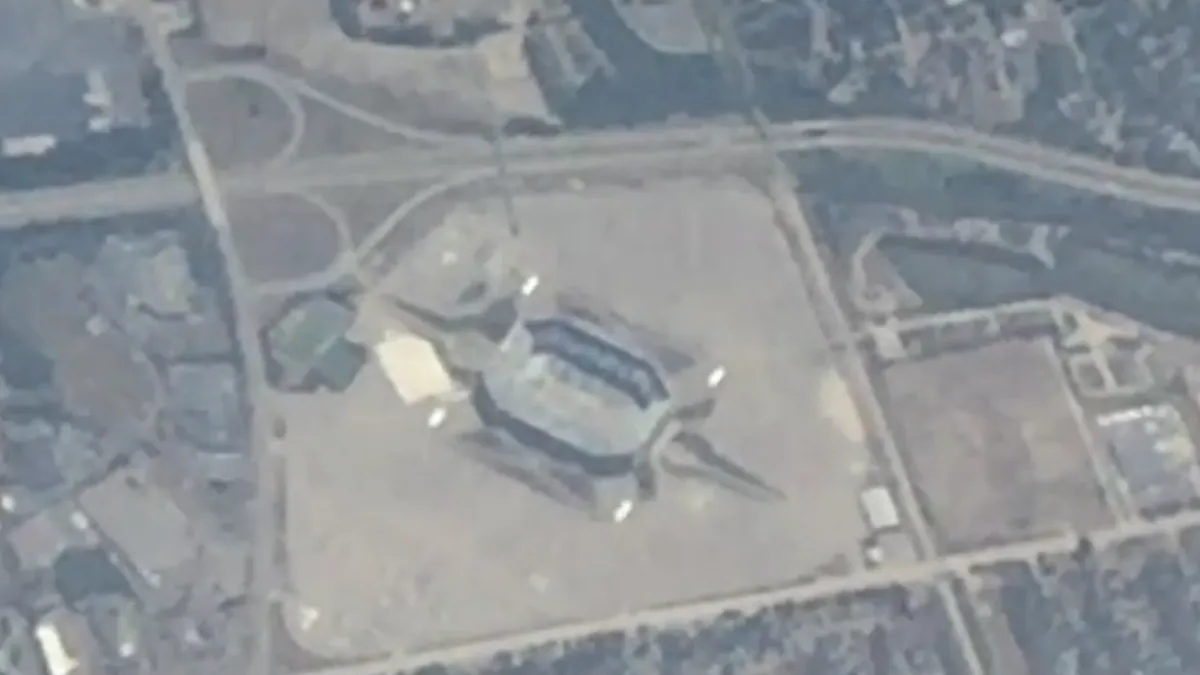
The Pontiac Silverdome's most innovative feature was its roof, a 430,000-square-foot structure made of Teflon-coated fiberglass panels held up by interior air pressure. This was the first use of such an air-supported roof in a major athletic facility. The white roof produced a silver-like reflection in sunlight, leading to the nickname Silverdome, which became the official name in 1977. The interior featured three tiers of blue seats that completely encircled the AstroTurf playing field. For football, the official capacity was 80,311, making it the largest stadium in the National Football League upon its opening. This title was held until the year 2000. The facility included 102 luxury suites and 7,384 club seats. The stadium's amenities also included a club restaurant.
Detroit Lions Tenancy and NFL Games
The Detroit Lions were the primary tenant for 27 seasons, from 1975 through 2001. The Lions played their first game at the venue on October 6, 1975, against the Kansas City Chiefs. From 1975 to 2001, the Lions played 212 regular season and playoff games at the Silverdome. In the period from the 1999 season through the 2001 season, the stadium hosted 24 NFL regular season games, all with the Detroit Lions as the home team. A notable high-scoring game from that era was the Detroit Lions' 31-27 victory over the St. Louis Rams on November 7, 1999, which featured a combined 58 points. The Lions' final game at the Silverdome was played on January 6, 2002, with players like defensive end Robert Porcher criticizing the stadium's artificial turf. Dissatisfaction with the stadium's lack of modern amenities compared to newer venues was a key factor in the team's relocation to Ford Field in downtown Detroit, which opened in August 2002.
Other Football Tenants and Events
Beyond the NFL, the Silverdome hosted football at multiple levels. The Michigan Panthers of the United States Football League played their home games at the stadium during the 1983 and 1984 seasons. In college football, the stadium hosted the Cherry Bowl postseason game in 1984 and 1985. It later became the home of the Motor City Bowl from 1997 through 2001. The Michigan High School Athletic Association held its football state finals at the Silverdome from 1976 to 2004. The stadium's most significant professional football event was Super Bowl XVI, played on January 24, 1982. This game between the San Francisco 49ers and Cincinnati Bengals was the first Super Bowl held in a northern city. The venue also served as a practice facility for the Pittsburgh Steelers in the lead-up to Super Bowl XL in 2006, during which the NFL installed FieldTurf that was later donated to a local high school.
| Football Event | Years | Details |
|---|---|---|
| Detroit Lions (NFL) | 1975 to 2001 | 212 total games |
| Michigan Panthers (USFL) | 1983 to 1984 | United States Football League |
| Cherry Bowl | 1984, 1985 | College postseason |
| Motor City Bowl | 1997 to 2001 | College postseason |
| MHSAA State Finals | 1976 to 2004 | High school championships |
Roof Collapse and Major Renovations
The stadium's innovative roof faced significant challenges. On March 4, 1985, a heavy, wet snowstorm caused the fabric roof to depress onto a steel lighting catwalk, tearing a hole. The loss of air pressure caused the dome to deflate slowly, with no injuries reported. The collapsing snow damaged more roof panels, collapsed precast risers in the southwest upper deck, and dislodged numerous seats. Repair operations began immediately but were delayed by high winds that damaged nearly all 100 remaining roof panels. The decision was made to replace the entire roof with improved, original-style Teflon-coated fiberglass material incorporating snow-melting and waterproofing upgrades. The repairs cost just under $8 million and were completed on May 28, 1985, when the dome was successfully re-inflated. This repaired roof remained intact for almost 28 years, until January 2, 2013. The playing surface was changed from the original AstroTurf to FieldTurf.
Record Attendance and Major Non-Football Events
The Pontiac Silverdome set numerous attendance records for indoor events. The largest crowd ever was 93,682 for a Catholic Mass with Pope John Paul II on September 18, 1987. Just months earlier, on March 29, 1987, WrestleMania III drew a reported 93,173 fans, setting a North American record for a live indoor sporting event that stood until 2010. The Detroit Pistons, who played at the Silverdome from 1978 to 1988, set NBA attendance records, including 61,983 for a regular season game against Boston on January 29, 1988. The venue hosted the 1979 NBA All-Star Game. It was also a major concert venue, with Led Zeppelin setting a world record for a solo indoor attraction with 76,229 fans on April 30, 1977. The Silverdome hosted first-round games for the 1994 FIFA World Cup, the first World Cup matches ever played indoors. A special natural grass surface grown on wooden pallets was installed over the AstroTurf by a team from Michigan State University for these games.
Decline and Post-Lions Usage
After the Lions' departure in 2002, activity at the Silverdome dropped drastically. The city of Pontiac faced serious financial problems and struggled with the high maintenance costs of the vacant structure. The upper concourse was used as a 0.4 to 0.5-mile inline skating track. A three-screen drive-in theater operated in the parking lot between 2003 and 2006, reopening briefly in 2010. The city attempted to sell the stadium, receiving a bid of $18 million in 2008 from a group wanting to create an entertainment complex, but no deal was finalized. In October 2009, the city announced an auction with no minimum bid to spark development. Greek-Canadian real estate developer Andreas Apostolopoulos, through Triple Properties Inc., submitted the winning bid of $550,000, which with fees totaled $583,000. This sale price, a fraction of the original $55.7 million cost, was seen as a symbol of the Detroit area's real estate collapse.
Brief Reopening and Final Collapse
The new owner invested millions to revive the stadium, which reopened on April 17, 2010, with a monster truck event. Subsequent events included an exhibition soccer match between A.C. Milan and Panathinaikos on August 6, 2010, and a WBO light welterweight title boxing match between Timothy Bradley and Devon Alexander on January 29, 2011, which drew about 7,000 attendees. The owners pursued a Major League Soccer expansion team and considered renovations for that purpose. However, in early 2013, a winter storm caused the roof to tear and deflate, rendering the stadium unusable. Unable to find a company to make the repairs and with the city unable to fund necessary services, the Silverdome was closed permanently in January 2013. Following the roof failure, the abandoned stadium was used as a location for a 2015 Red Bull video featuring BMX rider Tyler Fernengel performing tricks inside the empty structure.
Demolition and Site Redevelopment
In 2014, the owners auctioned off the stadium's contents, including seats and fixtures. The building was condemned and cleared for demolition in 2017. The Detroit-based Adamo Group was contracted to handle the demolition. The first implosion attempt on December 3, 2017, failed when faulty wiring prevented eight explosive charges from detonating. A second attempt soon after successfully brought down the upper ring of the stadium. Demolition work continued through March 2018. Prior to demolition, the parking lot had been used for storage of hundreds of Volkswagen diesel cars involved in the 2015 emissions scandal. After the site was cleared, Amazon unveiled a $250 million plan for a delivery and distribution center on the former Silverdome property in September 2019. This development marked the final chapter for the site that once housed the Silverdome.
Recent games
| Date | Game | Week |
|---|---|---|
| Jan 6, 2002 | Dallas Cowboys 10 at Detroit Lions 15 | Week 17 |
| Dec 30, 2001 | Chicago Bears 24 at Detroit Lions 0 | Week 16 |
| Dec 16, 2001 | Minnesota Vikings 24 at Detroit Lions 27 | Week 14 |
| Nov 22, 2001 | Green Bay Packers 29 at Detroit Lions 27 | Week 11 |
| Nov 11, 2001 | Tampa Bay Buccaneers 20 at Detroit Lions 17 | Week 9 |
| Oct 28, 2001 | Cincinnati Bengals 31 at Detroit Lions 27 | Week 7 |
| Oct 21, 2001 | Tennessee Titans 27 at Detroit Lions 24 | Week 6 |
| Oct 8, 2001 | St. Louis Rams 35 at Detroit Lions 0 | Week 4 |
| Dec 24, 2000 | Chicago Bears 23 at Detroit Lions 20 | Week 17 |
| Nov 23, 2000 | New England Patriots 9 at Detroit Lions 34 | Week 13 |
| Nov 12, 2000 | Atlanta Falcons 10 at Detroit Lions 13 | Week 11 |
| Nov 5, 2000 | Miami Dolphins 23 at Detroit Lions 8 | Week 10 |
Video
FAQ
What was the Pontiac Silverdome and when was it built?
The Pontiac Silverdome was a multi-purpose domed stadium in Pontiac, Michigan. Construction began on September 19, 1973, and the stadium opened on August 23, 1975, at a cost of $55.7 million. It was originally named Pontiac Metropolitan Stadium but was renamed the Silverdome in 1977 due to the silver reflection of its white roof. The stadium was built as a home for the Detroit Lions and featured the first air-supported Teflon-coated fiberglass roof used in a major athletic facility.
What was the seating capacity of the Pontiac Silverdome for football games?
For football games, the Pontiac Silverdome had a seating capacity of 80,311. This made it the largest stadium in the National Football League from its opening in 1975 until the year 2000. Some sources list the capacity at over 82,600. The interior featured three tiers of blue seats and included 102 luxury suites and 7,384 club seats. The record attendance for any event was 93,682, set in 1987 for a Mass with Pope John Paul II.
Which teams called the Pontiac Silverdome home?
The primary tenant was the Detroit Lions of the NFL, who played there from 1975 through the 2001 season. The Detroit Pistons of the NBA also called the Silverdome home from 1978 to 1988. Other professional tenants included the Detroit Express of the North American Soccer League (1978 to 1980) and the Michigan Panthers of the United States Football League (1983 to 1984). The stadium also hosted the Detroit Mechanix of the American Ultimate Disc League in 2012.
What major events were held at the Pontiac Silverdome besides football?
The Silverdome hosted a wide array of major events. It was the site of Super Bowl XVI in 1982 and WrestleMania III in 1987, which drew 93,173 fans. It hosted four first-round matches of the 1994 FIFA World Cup, the first World Cup games played indoors. The venue held the 1979 NBA All-Star Game and NCAA Men's Basketball Tournament Midwest Regionals in 1988 and 1991. It also set concert records, with Led Zeppelin playing to 76,229 people in 1977.
What was the address of the Pontiac Silverdome?
The Pontiac Silverdome was located at 1200 Featherstone Road in Pontiac, Michigan. This address was the site of the multi-purpose stadium from its opening in 1975 until its demolition decades later. The stadium sat on a large 199-acre parcel of land. This location in Pontiac was chosen after consideration of several other potential sites in the Detroit metropolitan area.
Who designed and engineered the Pontiac Silverdome?
The Pontiac Silverdome was designed by the architectural firm of O'Dell, Hewlett and Luckenbach, with C. Don Davidson serving as the chief project designer. The structural engineer for the project was Geiger Berger Associates. The general contractor was Barton Malow. The stadium's original design concept was part of Davidson's master plan for urban renewal in Pontiac, though an initial dual-stadium complex for football and baseball was scrapped due to high costs.
Sources
- Pontiac Silverdome (Wikipedia) Wikipedia
- Silverdome, History, Photos & More of the former NFL stadium of the Detroit Lions Stadiums of Pro Football
- What Happened to the Pontiac Silverdome, the NFL's Biggest Stadium givemesport.com
- Pontiac Silverdome detroithistorical.org
- nflverse game, roster and draft data nflverse (CC BY 4.0)