Tottenham Hotspur Stadium is a multi-purpose stadium located in Tottenham, North London, England. It is the home of Premier League club Tottenham Hotspur and serves as a European venue for the NFL International Series. The stadium opened on April 3, 2019, after a construction period that began in 2015/2016, with a total cost of approximately £1 billion. With a seating capacity of 62,850, it is the largest club stadium in London and features the world's first dividing, retractable pitch system to accommodate both soccer and American football. The venue has hosted NFL games annually since 2019 and is designed with specific facilities for American football, including dedicated locker rooms and an artificial playing surface. The wider Northumberland Development Project aims to regenerate the local area over a 20-year period.
American Football at the Stadium
Tottenham Hotspur Stadium has hosted NFL International Series games annually since 2019, with at least two regular season games each year. From the 2019 season through November 27, 2026, a total of 12 NFL games have been played at the venue, all regular season contests. The first NFL game held there was on October 6, 2019, when the Oakland Raiders defeated the Chicago Bears 24-21. The stadium has seen a variety of NFL franchises compete, with the Jacksonville Jaguars appearing in three games from 2021 to 2024. The highest-scoring NFL game at the stadium occurred on October 13, 2019, when the Carolina Panthers beat the Tampa Bay Buccaneers 37-26 for a combined 63 points.
The venue is specifically designed to host American football, featuring purpose-built NFL locker rooms, media facilities, and player amenities. The playing surface for NFL games is an artificial field called Turf Nation, which is revealed by the stadium's unique retractable pitch system. This design allows for a transition from the natural grass soccer pitch to the artificial surface required for NFL games and concerts. The stadium's partnership with the NFL is a 10-year agreement initiated in 2019, guaranteeing a minimum of two games per season. No NFL playoff games, Super Bowls, or college football bowl games have been held at the venue as of November 2026.

Construction and Development History
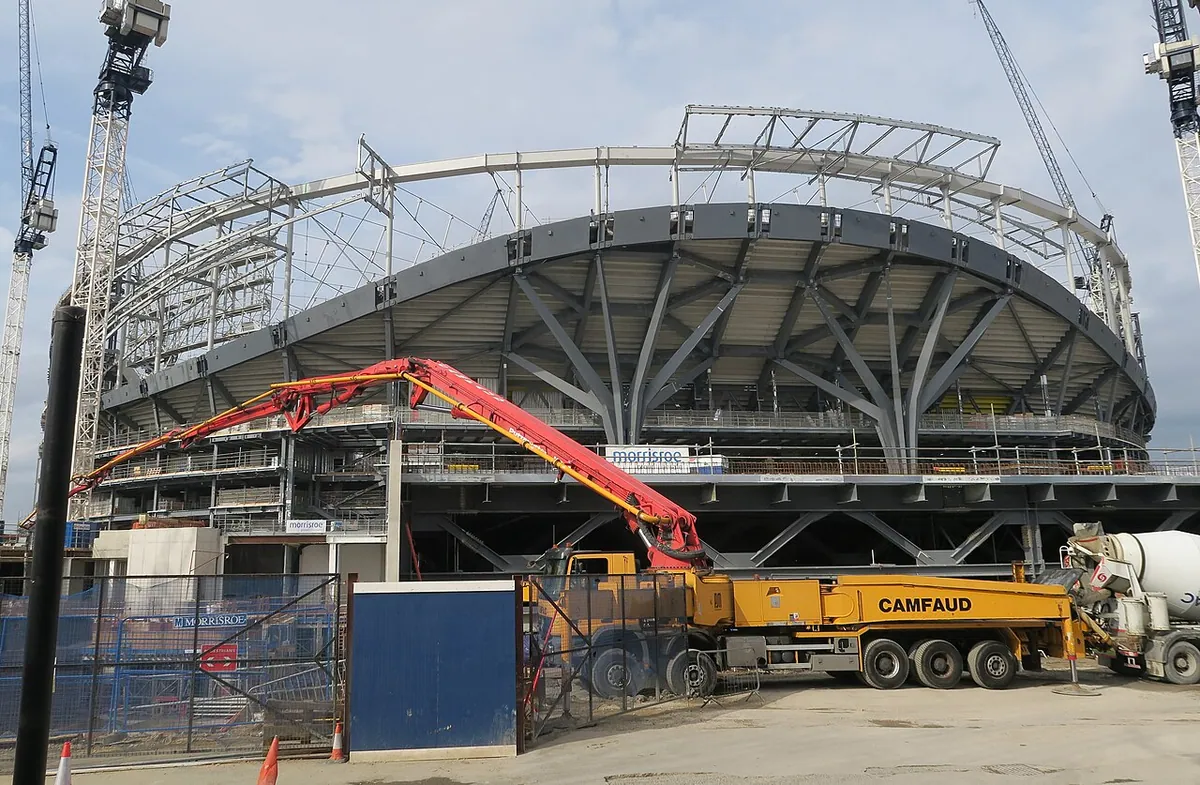
The stadium was built as the centerpiece of the Northumberland Development Project, a 20-year regeneration plan for the Tottenham area announced in October 2008. Planning began in 2007, but the project faced significant delays, including a compulsory purchase order dispute with a local business that was not resolved until July 2014. Construction of the stadium structure itself commenced in 2016, following the demolition of the club's historic former ground, White Hart Lane. The build was executed in two main phases to allow Tottenham Hotspur to continue playing at White Hart Lane during the 2016-17 season. The final cost of the project reached approximately £1 billion, and the general contractor was Mace.
The original opening was planned for the beginning of the 2012-13 season under early plans, but was repeatedly revised and ultimately scheduled for September 2018. Critical safety system issues related to electrical wiring caused major delays, forcing a postponement. This forced Tottenham Hotspur to extend its temporary tenancy at Wembley Stadium for the 2018-19 season and relocate the first scheduled NFL game in October 2018 to Wembley. The stadium finally opened on April 3, 2019, with a Premier League match against Crystal Palace. Four test events were held in March 2019 to secure the safety certificate, including an under-18s match attended by 28,987 fans and a legends game with 41,244 spectators.
The innovative retractable pitch system and other complex technical features were key factors in the construction timeline and the stadium's ultimate capabilities. The project covers the site of the demolished White Hart Lane and adjacent areas, with a total area of 43,000 square meters, nearly double the size of the old ground. Elements of the old stadium were incorporated into the new build, including crushed aggregate from its foundation used in new concrete and bricks from the East Stand used in the Shelf Bar. The exterior was finished with decorative tiles, perforated metal panels, and glass panels.
Architectural Design and Key Features
Designed by the architectural firm Populous, the stadium is an asymmetric bowl standing 48 meters high and approximately 250 meters long. Its most distinctive feature is the world's first dividing, retractable natural grass pitch, which slides in three sections under the South Stand in about 25 minutes to reveal a synthetic Turf Nation surface underneath for NFL games and concerts. Each of the three pitch segments weighs over 3,000 tons. The seating bowl is designed for intimacy, with the stands angled at up to 35 degrees, the steepest permissible in UK guidelines, bringing fans close to the action. The closest seat is just 4.99 meters from the pitch in the South Stand, increasing to 7.97 meters on other sides.
The 17,500-seat single-tier South Stand is the largest of its kind in the United Kingdom and is designed to generate a powerful 'wall of sound' from home supporters. The stadium incorporates over 8,000 premium seats and 70 private boxes across its nine floors in the northern section. Acoustic design was a priority, with Populous consulting U2's sound engineers to optimize reverberation times and amplify crowd noise. The roof is a 720-meter circumference cable net structure held by a compression ring and clad in standing seam aluminum panels. Lighting is provided by 324 LED floodlights.
- World's first dividing, retractable pitch system in three sections.
- 17,500-seat single-tier South Stand, the largest in the UK.
- Stands at a steep 35-degree angle for an intimate spectator experience.
- Acoustics optimized in collaboration with U2's sound engineers.
- Over 8,000 premium seats and 70 private boxes.
- Purpose-built NFL locker rooms and facilities with a lowered field for better sightlines.
- Extensive accessibility features including over 250 wheelchair positions and a sensory suite.
- External 'veil' made of perforated metal panels that can be lit with LEDs.
Capacity and Attendance Records
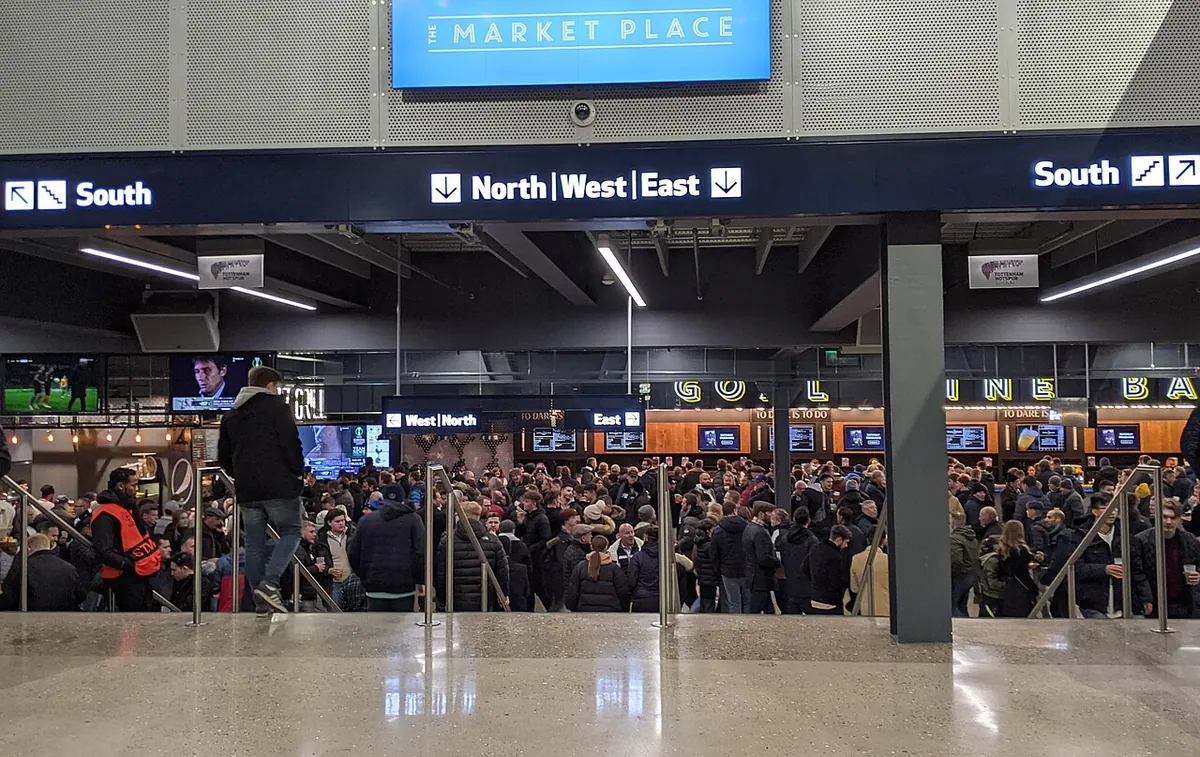
The stadium has a total seating capacity of 62,850, making it the third-largest football stadium in England and the largest club ground in London. This capacity is spread across nine floors in the northern horseshoe-shaped section and five floors in the south. The record attendance for an association football match is 62,027, set during the Premier League North London derby between Tottenham Hotspur and Arsenal on May 12, 2022. For American football, the record attendance is 61,273, achieved during the NFL game between the Jacksonville Jaguars and Buffalo Bills on October 8, 2023. The venue has also hosted major concerts, with a record concert attendance of 65,000 for a BTS performance as part of their Arirang World Tour in July 2026. The stadium's design as a bowl with enclosed corners and stands close to the pitch is intended to cultivate an extraordinary atmosphere. The facility attracts around two million visitors per year through matches, tours, and events, contributing significantly to the local economy.
NFL Game History and Tenants
The Jacksonville Jaguars have been the most frequent NFL tenant, playing three games at the stadium in 2021, 2023, and 2024. Other teams with multiple appearances include the Chicago Bears, Minnesota Vikings, and New York Jets, each with two games. All contests to date have been neutral-site regular season fixtures, with no playoff games hosted. The stadium's design incorporates a lowered playing field for NFL games, which improves the view for spectators in the first rows by allowing them to see over players and staff on the sidelines. The NFL agreement was first revealed in July 2015, with the stadium conceived as a multi-use venue capable of hosting American football from as early as October 2013.
| Date | Game (Winner listed first) | Venue Name in Records |
|---|---|---|
| October 6, 2019 | Oakland Raiders 24, Chicago Bears 21 | Tottenham Stadium |
| October 13, 2019 | Carolina Panthers 37, Tampa Bay Buccaneers 26 | Tottenham Stadium |
| October 10, 2021 | Atlanta Falcons 27, New York Jets 20 | Tottenham Stadium |
| October 17, 2021 | Jacksonville Jaguars 23, Miami Dolphins 20 | Tottenham Stadium |
| October 2, 2022 | Minnesota Vikings 28, New Orleans Saints 25 | Tottenham Stadium |
| October 9, 2022 | New York Giants 27, Green Bay Packers 22 | Tottenham Stadium |
| October 8, 2023 | Jacksonville Jaguars 25, Buffalo Bills 20 | Tottenham Hotspur Stadium |
| October 15, 2023 | Baltimore Ravens 24, Tennessee Titans 16 | Tottenham Hotspur Stadium |
| October 6, 2024 | Minnesota Vikings 23, New York Jets 17 | Tottenham Stadium |
| October 13, 2024 | Chicago Bears 35, Jacksonville Jaguars 16 | Tottenham Stadium |
Naming Rights and Multi-Use Events
The name 'Tottenham Hotspur Stadium' was initially intended to be temporary, with the club planning to sell naming rights to a sponsor. As of November 2026, no naming rights deal has been finalized, and the original name remains in use. The stadium is sometimes informally referred to as New White Hart Lane by fans and media. Beyond soccer and NFL, the stadium is a major venue for concerts and other sports, designed to host world-class entertainment year-round. It has hosted world heavyweight boxing, including the Anthony Joshua vs. Oleksandr Usyk fight in 2022, and major concert tours by artists like Beyoncé, who played five sellout shows in 2023.
Upcoming events include concerts by Fall Out Boy and Stray Kids in 2027, and a rugby union match dubbed 'The Showdown 7' between Saracens and Harlequins. The stadium complex also includes the Tottenham Experience visitor center, an F1 Drive karting experience with 180 meters of track beneath the South Stand, and the Dare Skywalk rooftop adventure. The wider development project is projected to create 3,500 jobs and inject £293 million annually into the local economy. The stadium has been included as a candidate host venue in the UK's bid for the FIFA Women's World Cup in 2035.
Location, Access, and the Wider Project
The stadium is located at 782 High Road in the Tottenham district of North London. It is built on the site of the former White Hart Lane ground and adjacent land as part of the Northumberland Development Project. The area is well-served by public transport, with multiple railway stations providing access. The nearest London Overground stations are White Hart Lane and Northumberland Park, while the London Underground is accessible via Seven Sisters station on the Victoria line. National Rail services also stop at Tottenham Hale station. A 9.5-meter wide pavement was created in front of the stadium on High Road to improve crowd flow on match days.
Dedicated entrances exist for different users, with a main glazed entrance on the West Stand facing High Road and a dedicated NFL event entrance on Worcester Avenue to the east. A large public square the size of Trafalgar Square serves as the main access point for home fans on the south podium. The wider Northumberland Development Project encompasses not just the stadium but also a club museum, new homes, shops, a gym, a supermarket, and a sixth-form school. The project's goal is to act as a catalyst for the 20-year regeneration program planned by Haringey Council, revitalizing an area affected by deprivation and riots in 2011.
Historical Context and Predecessor
Tottenham Hotspur Football Club was formed in 1882 and played early matches on Tottenham Marshes before moving to enclosed grounds. The club's immediate predecessor was White Hart Lane, which opened in 1899 on land behind the White Hart pub. That stadium was designed in part by renowned architect Archibald Leitch and saw its capacity grow to nearly 80,000 by 1934. Following the Taylor Report and conversion to an all-seater stadium, its capacity was reduced to 36,284 by 1998.
The decision to stay in Tottenham and redevelop the existing site was influenced by Haringey Council's desire to keep the club in the community as an economic anchor. The council issued planning permission in September 2011 and later waived community infrastructure payments to facilitate the project. The new stadium's design intentionally references the old ground's character, aiming to be noisier and more atmospheric. The Shelf Bar in the new stadium incorporates bricks from the old East Stand, and heritage plaques mark points of the old ground, such as its center spot. The stadium's opening in 2019 marked the start of a new chapter, with the club winning the 2024-25 Europa League.
Recent games
| Date | Game | Week |
|---|---|---|
| Oct 4, 2026 | Indianapolis Colts 30 at Washington Commanders 13 | Week 4 |
| Oct 13, 2024 | Jacksonville Jaguars 16 at Chicago Bears 35 | Week 6 |
| Oct 6, 2024 | New York Jets 17 at Minnesota Vikings 23 | Week 5 |
| Oct 15, 2023 | Baltimore Ravens 24 at Tennessee Titans 16 | Week 6 |
| Oct 8, 2023 | Jacksonville Jaguars 25 at Buffalo Bills 20 | Week 5 |
| Oct 9, 2022 | New York Giants 27 at Green Bay Packers 22 | Week 5 |
| Oct 2, 2022 | Minnesota Vikings 28 at New Orleans Saints 25 | Week 4 |
| Oct 17, 2021 | Miami Dolphins 20 at Jacksonville Jaguars 23 | Week 6 |
| Oct 10, 2021 | New York Jets 20 at Atlanta Falcons 27 | Week 5 |
| Oct 13, 2019 | Carolina Panthers 37 at Tampa Bay Buccaneers 26 | Week 6 |
| Oct 6, 2019 | Chicago Bears 21 at Oakland Raiders 24 | Week 5 |
Video
FAQ
What is the capacity of Tottenham Hotspur Stadium?
Tottenham Hotspur Stadium can hold 62,850 spectators for events. This figure makes it the biggest stadium owned by a single club in London and the third largest football stadium in England. The largest single section is the South Stand, which alone accommodates 17,500 fans in one continuous tier. The highest recorded crowd for an American football game there was 61,273 people during a 2023 NFL contest.
How many NFL games are played at Tottenham Hotspur Stadium?
The venue hosts a minimum of two NFL regular season games every year under a ten-year agreement that started in 2019. From the 2019 season through late November 2026, official records show 12 NFL games have taken place at the stadium. All these matches have been part of the regular season schedule, with no postseason games held so far. Teams like the Jacksonville Jaguars have played there multiple times during this period.
When did Tottenham Hotspur Stadium open?
The stadium officially opened on April 3, 2019, with a Premier League soccer match. Construction work on the main structure began in 2016 after years of planning and legal delays. Problems with critical safety systems pushed back the original planned opening from September 2018. The first NFL game occurred on October 6, 2019, after the initially scheduled 2018 game was moved to a different London stadium.
What is special about the pitch at Tottenham Hotspur Stadium?
The stadium features the world's first dividing, retractable natural grass playing surface. This pitch moves in three large sections weighing over 3,000 tons each, storing them beneath the South Stand in approximately 25 minutes. This process uncovers a permanent artificial Turf Nation surface used for NFL games and concerts. The system allows the venue to switch between soccer and other events without damaging the primary grass field.
Where is Tottenham Hotspur Stadium located?
The stadium's address is 782 High Road in the Tottenham area of North London, England. It occupies the land where the club's old White Hart Lane ground once stood. Several public transport stations serve the location, including White Hart Lane and Northumberland Park on the Overground, Seven Sisters on the Underground's Victoria line, and Tottenham Hale for mainline trains. A specific entrance for NFL events is situated on Worcester Avenue to the east.
How was the stadium designed for American football sightlines?
The stadium's design improves viewing for American football by positioning the playing surface lower than the first row of spectator seats. This architectural choice lets fans see the action over the players and coaching staff standing on the sidelines. The arrangement is part of the purpose-built NFL facilities that include dedicated locker rooms. The retractable pitch system also ensures the artificial surface is at the correct level and quality for NFL games.
Sources
- Tottenham Hotspur Stadium (Wikipedia) Wikipedia
- Tottenham Hotspur Stadium tottenhamhotspurstadium.com
- The New Tottenham Hotspur Stadium populous.com
- Tottenham Guide: Capacity, Seating & Bags stadiumseeker.com
- Tottenham Hotspur Stadium, StadiumDB.com stadiumdb.com
- nflverse game, roster and draft data nflverse (CC BY 4.0)