Gary
Kubiak
Head coaching record
Biography
Gary Wayne Kubiak is a former American football quarterback and coach in the National Football League. He played his entire nine-year career as a backup for the Denver Broncos from 1983 to 1991. Kubiak later became a head coach, leading the Houston Texans from 2006 to 2013 and the Denver Broncos from 2015 to 2016. He won Super Bowl 50 as the Broncos' head coach, adding to three previous Super Bowl victories as an assistant coach and player. Kubiak retired from coaching in 2021 after serving as the offensive coordinator for the Minnesota Vikings. His career head coaching record is 82 wins and 75 losses in the regular season, with a 5-2 playoff record.
Early Life and High School Career
Gary Kubiak was born on August 15, 1961, in Houston, Texas. He attended St. Pius X High School in Houston, where he excelled as a multi-sport athlete. As a quarterback, he set a then-state record by passing for 6,190 yards during his high school career. Kubiak was named to all-state teams in football, basketball, baseball, and track on two separate occasions. His early connection to professional football began when Houston Oilers head coach Bum Phillips hired him as a ball boy. In recognition of his high school achievements, Kubiak was inducted into the Texas High School Football Hall of Fame in 1999. His alma mater further honored him in November 2017 by naming its stadium Kubiak Stadium.
College and NFL Playing Career
Kubiak played college football at Texas A&M University under coaches Tom Wilson and Jackie Sherrill. He set a Southwest Conference record by throwing six touchdown passes in a single game against Rice. In his senior 1982 season, he led the conference with 1,948 passing yards and 19 touchdowns, earning All-Southwest Conference honors. He finished his collegiate career with 4,078 passing yards, 31 touchdowns, and 27 interceptions. The Denver Broncos selected Kubiak in the eighth round with the 197th overall pick of the 1983 NFL Draft, the same year the team acquired John Elway. Kubiak spent his entire nine-year NFL career as Elway's backup. He appeared in 119 regular-season games, starting five, and compiled a record of 3-2 as a starter. His career passing statistics include 173 completions on 298 attempts for 1,920 yards, with 14 touchdowns and 16 interceptions, resulting in a 70.6 passer rating. He was a member of three AFC Championship teams and played in Super Bowl XXI and Super Bowl XXIV, entering both games in relief of Elway.
Assistant Coaching Career (1992 to 2005)
Kubiak began his coaching career in 1992 as the running backs coach at Texas A&M, his alma mater. He worked with All-American running back Greg Hill, who became a first-round NFL draft pick in 1994. In 1994, Kubiak moved to the NFL, joining the San Francisco 49ers as their quarterbacks coach. That season, he coached Steve Young to an NFL MVP season and a Super Bowl XXIX victory, where Young threw a record six touchdown passes. Kubiak returned to the Denver Broncos in 1995 when Mike Shanahan, his former 49ers offensive coordinator, became head coach. He served as the Broncos' offensive coordinator and quarterbacks coach for the next 11 seasons. During this span from 1995 to 2005, the Broncos' offense accumulated 66,501 total yards and scored 465 touchdowns, which led the NFL over that period. He coached 14 different Broncos to Pro Bowl selections, including Hall of Famers such as John Elway, Terrell Davis, and Shannon Sharpe. Kubiak was part of the coaching staff for the Broncos' back-to-back Super Bowl victories in the 1997 and 1998 seasons.
Houston Texans Head Coach (2006 to 2013)
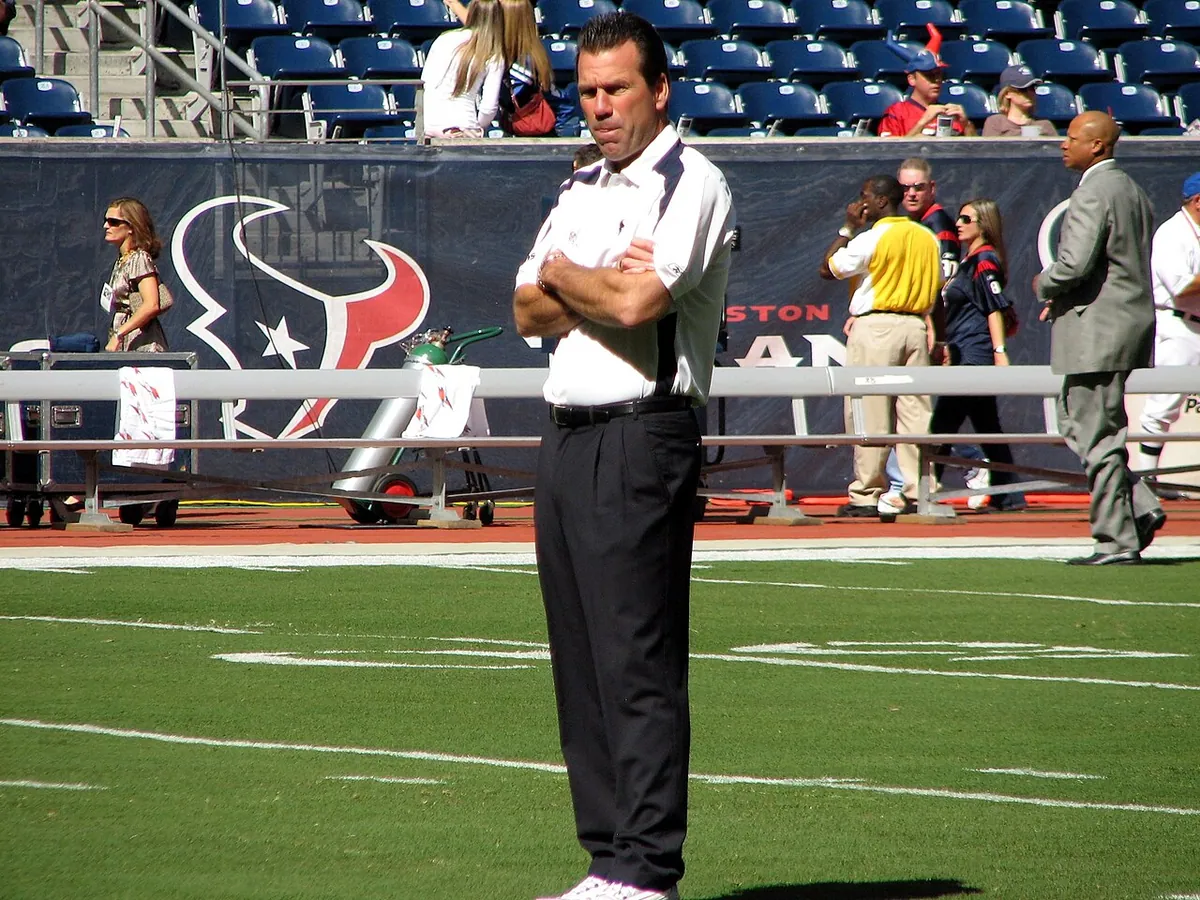
Gary Kubiak was hired as the second head coach in Houston Texans history on January 26, 2006, replacing Dom Capers. His tenure with the Texans spanned eight seasons, from 2006 to 2013. The team's record improved gradually under his leadership, achieving its first non-losing seasons in 2007 and 2008 with 8-8 records. The 2009 season marked the franchise's first winning record at 9-7, though they missed the playoffs on a tiebreaker. After a 6-10 season in 2010, Kubiak made significant defensive staff changes, hiring longtime friend Wade Phillips as defensive coordinator. The 2011 season was a breakthrough, as the Texans finished 10-6, won the AFC South, and secured the first playoff berth and victory in franchise history. Kubiak was named AFC Coach of the Year for the 2011 season and received a contract extension. The team followed with a franchise-best 12-4 record in 2012 and another playoff win before losing in the divisional round. The 2013 season was marred by a health incident and poor performance. On November 3, 2013, Kubiak suffered a transient ischemic attack (TIA) and collapsed at halftime of a game against the Indianapolis Colts. He was fired on December 6, 2013, with three games remaining, after the team started 2-11. His overall record with the Texans was 61-64 in the regular season and 2-2 in the playoffs.
| Season | Record |
|---|---|
| 2006 | 6-10 |
| 2007 | 8-8 |
| 2008 | 8-8 |
| 2009 | 9-7 |
| 2010 | 6-10 |
| 2011 | 10-6 |
| 2012 | 12-4 |
| 2013 | 2-11 |
Baltimore Ravens and Super Bowl 50 Victory
After being fired by the Texans, Kubiak served as the offensive coordinator for the Baltimore Ravens in 2014 under head coach John Harbaugh. He installed a West Coast offense with a zone-blocking scheme, helping quarterback Joe Flacco and running back Justin Forsett achieve career single-season highs. The Ravens returned to the playoffs that season, and Kubiak's success made him a sought-after head coaching candidate. On January 18, 2015, Kubiak returned to the Denver Broncos as head coach, signing a four-year deal after being recruited by general manager John Elway. He brought Wade Phillips with him as defensive coordinator. The 2015 Broncos, led by a top-ranked defense, finished the regular season 12-4 despite offensive struggles. Quarterback Peyton Manning battled injuries and was benched midseason for Brock Osweiler, though Manning returned to start the playoffs. They then beat the Carolina Panthers 24-10 in Super Bowl 50, giving Kubiak his first Super Bowl win as a head coach. He is the only person to play in a Super Bowl for a team and later win it as that team's head coach. The 2015 team recorded three comeback wins of at least 14 points against playoff teams.
Final Broncos Season and Health Scares
The 2016 season presented challenges for Kubiak and the Broncos, including the departure of both Peyton Manning to retirement and Brock Osweiler to free agency. The team integrated new quarterbacks Trevor Siemian and Paxton Lynch. During the season, Kubiak experienced another health scare. After a Week 5 loss, he was hospitalized with flu-like symptoms and extreme fatigue, diagnosed with a complex migraine condition. Special teams coordinator Joe DeCamillis served as interim head coach for one game while Kubiak rested. Despite these setbacks, Kubiak led the Broncos to a 9-7 record, though the team missed the playoffs. Following a season-ending victory on January 1, 2017, Kubiak announced he was stepping down as head coach, citing health reasons. His two-year record with the Broncos was 21-11 in the regular season and 3-0 in the playoffs, giving him a 24-11 overall record with the franchise.
Vikings Tenure and Retirement
After a two-year hiatus from coaching, which included a front-office role with the Broncos, Kubiak returned to the NFL in 2019. He joined the Minnesota Vikings as assistant head coach and offensive advisor under Mike Zimmer. He was promoted to offensive coordinator for the 2020 season following the departure of Kevin Stefanski. His final game as an NFL coach was a 37-35 win over the Detroit Lions on January 3, 2021. On January 21, 2021, Kubiak announced his retirement from coaching after 29 years in the profession. In his retirement statement, he expressed gratitude to the fans and organizations he worked for and stated his intention to spend more time with family.
Coaching Philosophy and Notable Scheme
Gary Kubiak's offensive philosophy was a direct descendant of the West Coast offense, which he learned under Mike Shanahan. His system combined a precise, timing-based passing game with an outside zone-blocking scheme for the running game. This approach heavily utilized play-action passes to create explosive plays downfield. As a coordinator and head coach, his offenses were known for their efficiency and balance. In Baltimore in 2014, his scheme revitalized the Ravens' offense, helping it achieve significant success. In Denver, he adapted his system to blend with Peyton Manning's preferences while maintaining the core zone-running principles. Defensively, when paired with coordinator Wade Phillips, his teams employed an aggressive 3-4 scheme that emphasized pressuring the quarterback, which was central to the Broncos' Super Bowl 50 victory.
FAQ
What does Gary Kubiak do now?
Gary Kubiak is fully retired from professional football. He announced his retirement from coaching on January 21, 2021, following his role as the offensive coordinator for the Minnesota Vikings during the 2020 season. He announced his retirement from coaching in January 2021. In his retirement statement, he expressed a desire to step away from the game and enjoy more time with his family and friends.
Why did Gary Kubiak stop coaching?
Gary Kubiak's departure from head coaching in 2017 was directly linked to health concerns. He experienced a complex migraine condition during the 2016 season that required hospitalization and caused him to miss a game. Following that season, he stepped down as Broncos head coach, citing the need to prioritize his health. He later retired from coaching altogether in 2021 after his stint with the Vikings, concluding a 29-year career, stating a desire to spend more time with family.
Are John Elway and Gary Kubiak friends?
John Elway and Gary Kubiak share a decades-long professional and personal relationship. Kubiak served as Elway's backup quarterback for nine seasons with the Denver Broncos. Later, when Elway was the quarterback, Kubiak was his position coach and offensive coordinator during the team's back-to-back Super Bowl wins in the late 1990s. When Elway became the Broncos' general manager, he personally recruited Kubiak to return as head coach in 2015, describing the opportunity as Kubiak's dream job.
How many Super Bowl rings does Gary Kubiak have?
Gary Kubiak was part of four Super Bowl championship teams. He earned his first ring as the quarterbacks coach for the San Francisco 49ers when they won Super Bowl XXIX in the 1994 season. He added two more rings as the offensive coordinator for the Denver Broncos when they won Super Bowls XXXII and XXXIII in the 1997 and 1998 seasons. His fourth and final ring came as the head coach of the Denver Broncos when they defeated the Carolina Panthers in Super Bowl 50.
What was Gary Kubiak's record as a head coach?
Since the 1999 season, Gary Kubiak compiled a career head coaching record of 82 wins and 75 losses during the regular season. His postseason record stands at 5 wins and 2 losses. With the Houston Texans from 2006 to 2013, his regular season record was 61-64 with a 2-2 playoff mark. With the Denver Broncos from 2015 to 2016, he achieved a 21-11 regular season record and a perfect 3-0 playoff record, culminating in a Super Bowl 50 victory.
Which coaches are part of Gary Kubiak's coaching tree?
The coaching tree of Gary Kubiak includes several prominent NFL head coaches. This group consists of Mike McDaniel of the Miami Dolphins, Kyle Shanahan of the San Francisco 49ers, and Robert Saleh of the New York Jets. It also includes Matt LaFleur of the Green Bay Packers, Vance Joseph of the Arizona Cardinals, Brian Callahan of the Tennessee Titans, and Klint Kubiak of the Las Vegas Raiders. Collectively, these coaches have led their teams to a combined regular season record of 248-237-1 in their head coaching roles.
Sources
- Gary Kubiak (Wikipedia) Wikipedia
- Klint Kubiak reflects on father Gary Kubiak after being the first father-son.. NFL
- Gary Kubiak pro-football-history.com
- Kubiak, Gary tshof.org
- Super Bowl-winning Broncos head coach Gary Kubiak retires from NFL denverbroncos.com
- nflverse game, roster and draft data nflverse (CC BY 4.0)