Protective equipment worn by players in tackle football primarily consists of shoulder pads, a helmet, and leg padding. This gear is designed to absorb the shock of impacts and distribute force to reduce the risk of injury during the physical play of the sport. Basic mandatory equipment includes a helmet, shoulder pads, gloves, shoes, thigh and knee pads, a mouthguard, and an athletic supporter. The equipment is constructed from synthetic materials like molded plastic, foam rubbers, and elastics, and its assignment and maintenance are the responsibility of the team equipment manager.
The Football Helmet
A professional football helmet is a complex piece of safety equipment consisting of a hard plastic shell, interior foam and inflatable padding, a face mask, and a chin strap. The interior is lined with padding and sometimes inflatable bladders designed to absorb impact and create a snug, customized fit for the player's head. Face masks come in at least 15 different styles, with players at different positions selecting masks that balance protection with visibility, such as quarterbacks often choosing more open designs. A visor or eye shield, first popularized by former Chicago Bears quarterback Jim McMahon, can be added for eye protection or glare reduction, with the NFL requiring medical clearance for tinted versions.
The helmet fitting process begins with measuring the player's head with calipers to select an appropriately sized shell. Padding, including both foam and inflatable air pads, is then added to ensure a secure fit, with inflator bulbs used to adjust bladders on the helmet's exterior. Jaw pads are fitted to snug the lower part of the helmet against the player's face. Modern NFL helmets are remarkably light and, when properly fitted, do not shift on the player's head during activity. Technological advancements have integrated features like shock-absorbing Energy Wedges into faceguards to reduce impact force. The helmet evolved from simple leather designs to today's highly engineered equipment, with a significant milestone in 1995 when a rule change allowed quarterbacks to have radio transmitters installed in their helmets.
Shoulder Pads and Upper Body Protection
Shoulder pads are a foundational piece of football equipment, providing the sport's characteristic broad-shouldered silhouette. Their structure includes a hard plastic outer shell with shock-absorbing foam padding underneath, covering the shoulders, chest, and rib area. These pads are secured with snaps and buckles and are sometimes worn over a foam rubber cushion on a cotton half-tee for added comfort. The primary functions of shoulder pads are to absorb shock through deformation upon impact and to distribute that force over a larger area to help regulate body temperature and prevent injury.
To achieve a proper fit, equipment managers measure across the player's back from shoulder blade to shoulder blade and add half an inch. Shoulder pad design varies by player position to balance protection with mobility. Lightweight, low-profile models are marketed for skill players like quarterbacks, running backs, and wide receivers to maximize movement. More robust models are available for linemen and linebackers who engage in frequent, high-impact contact. Brands like Riddell offer position-specific pads, with some custom power models such as the 'Power CPK LB/FB' priced as high as $699.99. Shoulder pads are a required piece of equipment in tackle football, and players not wearing them are not permitted onto the playing field in the NFL and may be subject to fines.
- Constructed with a hard plastic shell and foam padding.
- Lightweight designs prioritize mobility for skill positions.
- Heavier, protective models are used by linemen and linebackers.
- Riddell offers custom power pads costing up to $699.99.
- Shoulder pads are mandatory for play in the NFL.
Leg Padding and Lower Body Gear
Protection for the lower body includes thigh pads, knee pads, hip pads, and tailbone pads, all typically made of plastic and inserted into designated pockets inside the football pants. Hip pads, which date to the 1890s, are among the earliest known pieces of protective football gear. Today, hip and tailbone pads protect the hips, pelvis, and coccyx and are worn in a girdle under the football pants. Thigh and knee pads are also inserted into the pant pockets before the player dresses. The pants themselves are usually made of nylon and spandex for a tight fit during games, featuring a traditional lace-up fly and a belt for security. The interior has four individual pockets specifically designed to hold the two thigh pads and two knee pads.
Football cleats are essential footwear designed for traction on grass, with removable cleat studs that can be changed based on field conditions. Longer cleats offer better grip on wet fields, while shorter cleats can provide greater speed on dry surfaces. For games played on artificial turf, players often wear flat-bottomed shoes called turf shoes. An athletic supporter, or jockstrap, is another basic piece of equipment, originally invented in 1874 as the bicycle jockey strap. It features an elastic waistband and a support pouch that may contain a pocket for a protective cup. While youth leagues like Pop Warner often require a protective cup, its use is less common but still recommended at the high school, college, and pee-wee levels.
Gloves, Jerseys, and Additional Gear
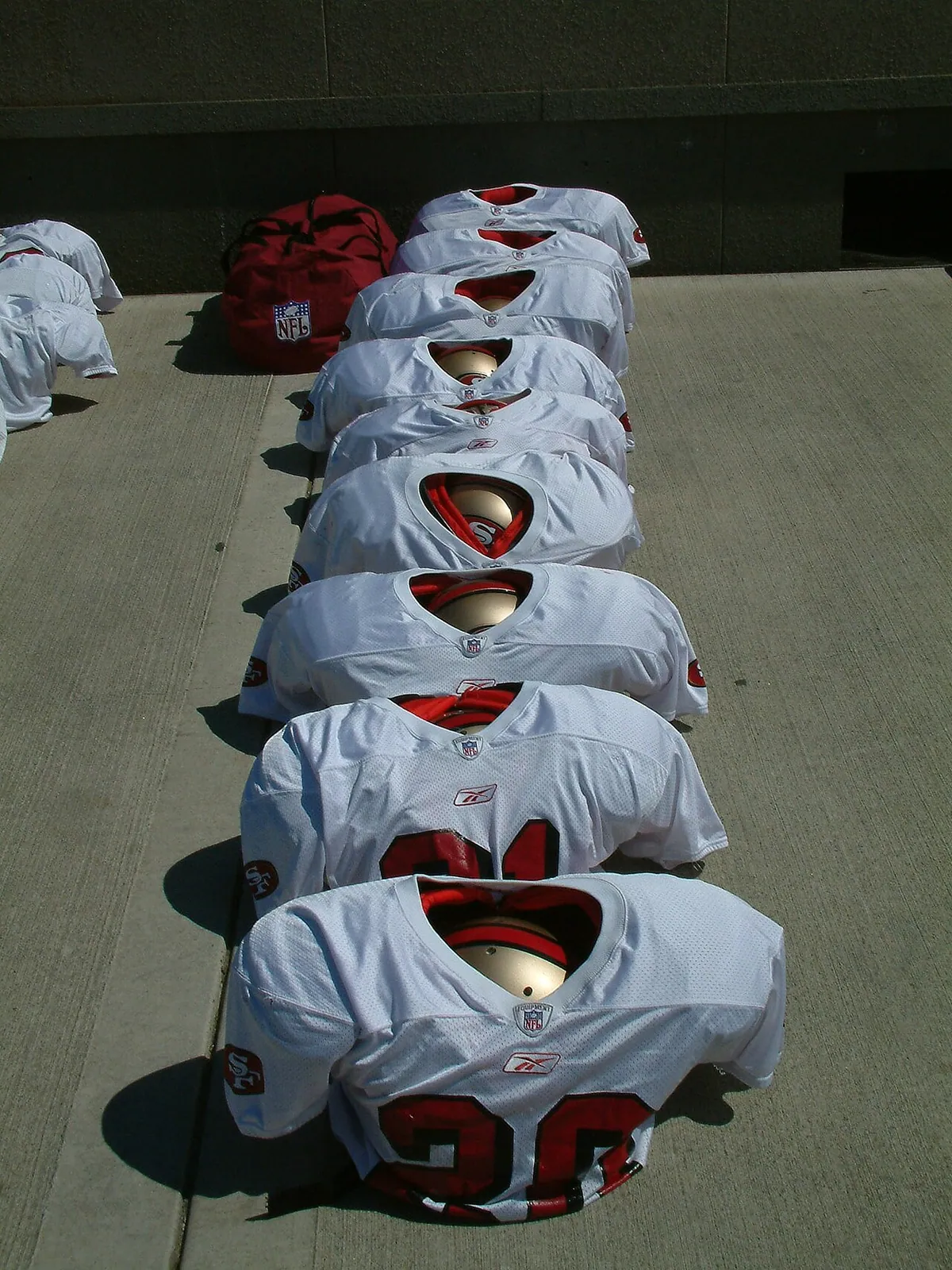
Many football players wear gloves to improve grip and protect their hands. Receivers often use gloves with sticky rubber palms, known as tack gloves, which became a standard after spray-on sticky substances were banned in the 1980s. Linemen wear gloves with thick padding to protect their fingers and hands from getting caught in face masks or stepped on. Players are not permitted to apply additional gels or adhesives to their gloves. The jersey and pants serve primarily to identify the player by name, number, and team colors. Jerseys are usually made of nylon with spandex side panels to keep them taut and difficult for opponents to grab. Features like a bottom wrap, Velcro strips to attach to pants, and two-sided carpet tape on shoulder pads help keep the jersey securely in place.
Each professional player typically has a set of practice jerseys and four game jerseys, often changing at halftime during rainy conditions. Jerseys may feature patches such as the American flag or team logos. Game-used jerseys and pants are considered sports collectibles, with those from celebrity athletes commanding high prices. Other optional protective equipment includes neck rolls, elbow pads, and rib pads. Before the widespread adoption of helmets, players sometimes wore nose guards or nose armor, an invention credited to Harvard's Arthur Cumnock in 1889 to protect a teammate's weak nose. This device, made of fine rubber, gained popularity in the early 1890s for protecting the nose and teeth during play.
- Receivers use tack gloves with sticky palms after stick 'em was banned in the 1980s.
- Linemen wear thickly padded gloves for hand protection.
- Jerseys use spandex panels and attachment features to prevent grabbing.
- NFL players usually have four game jerseys and change at halftime in rain.
- Game-used jerseys and pants are valuable sports collectibles.
- Nose guards made of rubber were used for facial protection in the 1890s.
Communication Technology in Helmets
In-helmet radio communication represents a significant technological advancement in football equipment. John Campbell and George Sarles created the first radio transmitter for a helmet in 1956, testing it with Cleveland Browns quarterback George Ratterman. The experiment resulted in game-time interference and was outlawed by the NFL after only three preseason games. This system uses a small speaker in each ear hole, allowing coaches to call plays directly. NFL rules mandate that helmets with a headset must have a visible green dot on the back to identify the authorized user, which is typically the quarterback on offense.
In 2008, the NFL expanded the rule to allow one defensive player, usually a linebacker or defensive back, to also wear a radio helmet with a green dot. The NCAA updated its rules in 2024 to similarly allow one offensive and one defensive player to use radio helmets, with the signal cutting off when 15 seconds remain on the play clock or when the ball is snapped, whichever comes first. The radio is not re-enabled until the play ends. While this technology aids communication in noisy environments like the Super Bowl, it also adds expense and requires additional maintenance. The system also led to rule adjustments after instances in 2006 where holders on field goal attempts received last-second audible commands, which the league viewed as potentially creating an unfair advantage.
- First tested in 1956 by the Cleveland Browns but banned for causing interference.
- NFL approved active radio systems for quarterback helmets in 1995.
- Helmets with radios are marked with a green dot on the back.
- Defensive players were allowed radio helmets starting in 2008.
- NCAA rules adopted in 2024 allow one offensive and one defensive player to use them.
- NCAA radios cut off at 15 seconds on the play clock or the snap.
Equipment for Flag Football vs. Tackle Football
Flag football requires significantly less protective equipment than tackle football, contributing to its lower cost and accessibility. In tackle football, players are required to wear a full suite of protective gear including a helmet, shoulder pads, girdle with hip and tail pads, thigh and knee pads, a mouthguard, and cleats. Flag football eliminates the need for most of this heavy equipment due to its non-tackle nature. The NFL FLAG equipment checklist specifies that players need only a flag football belt and flags, a team jersey, shorts without pockets, a mouthguard, and cleats (with metal cleats prohibited). Football gloves are optional. Some high school or 7-on-7 flag programs may require soft-shell helmets, but standard NFL FLAG leagues do not.
The flag football belt and flag system is central to the game. NFL FLAG provides belts with flags attached via a plastic pop socket that emits a popping noise when detached, clearly signaling the end of a play. Other leagues may use different mechanisms, such as Velcro or Triple Threat belts where the entire belt falls off. The absence of heavy pads makes flag football generally less expensive for families, with estimates that tackle football leagues can cost up to $300 more per season due to equipment. The mouthguard remains the sole mandatory protective gear in flag football, highlighting the sport's focus on reducing contact-related injuries.
Fitting, Maintenance, and Equipment Management
Properly fitting equipment is critical for player safety and performance, reducing the risk of equipment-related injuries and allowing for full freedom of movement. The fitting process for a helmet involves precise head measurements and the customization of interior padding. Shoulder pads are fitted based on back measurements, and all pads should sit securely without restricting motion or riding up. Cleats must fit comfortably to prevent blisters and provide appropriate traction for the playing surface. Well-fitted gear improves agility, speed, and overall performance while ensuring maximum protection. Companies such as Riddell and XTech X2 provide various sizing choices to meet the needs of players from youth to adult levels.
The equipment manager handles two main functions for a football team: custom-fitting each player with protective gear and managing the logistics of equipment maintenance, repair, inventory, and transportation for road games. Proper maintenance extends the lifespan of equipment and includes regular cleaning, inspection, and storage. Jerseys may be changed at halftime in adverse weather, and players often have multiple sets. The NFL mandates that teams provide at least 24 official footballs, prepared by the equipment manager, to officials 135 minutes before kickoff. Investing in the right gear and ensuring it is correctly fitted and maintained are key components of player safety at all levels of the sport.
Evolution and Standards of Football Equipment
Football protective equipment has evolved from minimal gear in the sport's early days to the highly engineered systems used today. Shoulder pads and hip pads emerged in the 1890s. The helmet itself transformed from simple leather designs to complex plastic shells with advanced padding by the mid-1980s. Modern designs continue to focus on improving impact absorption, with features like integrated shock-absorbing faceguards.
Safety standards and league rules govern equipment use. The NFL requires players to wear certified equipment, including helmets that meet NOCSAE (National Operating Committee on Standards for Athletic Equipment) standards, shoulder pads, hip pads, knee pads, thigh guards, mouthguards, pants, and jerseys. The league's 64 uniform inspectors enforce rules such as tucked-in jerseys, banned bandannas, and specific stocking colors. Equipment like Guardian caps are part of ongoing efforts to reduce head impacts. The NFL and NFLPA work with medical experts to inform equipment policies and protocols, emphasizing that mandatory gear is non-negotiable for on-field participation.
Video
FAQ
What are the different types of football pads?
The main types of football pads are shoulder pads, leg pads (thigh and knee pads), hip and tailbone pads, and the helmet. Shoulder pads protect the upper body, chest, and collarbone and come in position-specific designs. Leg pads are inserted into pockets in the football pants to protect the thighs and knees. Hip and tailbone pads, worn in a girdle, safeguard the pelvis and coccyx. The helmet is the most complex pad, protecting the head and featuring components like a face mask, chin strap, and optional visor. Additional padding can include elbow pads, rib pads, and neck rolls.
What equipment is needed for flag football?
Flag football requires much less equipment than tackle football. The essential items are a flag football belt and set of flags, a team jersey, shorts without pockets, a mouthguard, and cleats that are not metal. Football gloves are an optional accessory for better grip. Unlike tackle football, helmets, shoulder pads, and extensive leg padding are not required in standard NFL FLAG leagues, though some high school or 7-on-7 programs may mandate soft-shell helmets. The flag belt system, where opponents pull a flag to stop play, replaces the tackling aspect, significantly reducing the need for protective gear.
How do you properly fit football shoulder pads?
Properly fitting shoulder pads involves measuring the player's back from shoulder blade to shoulder blade with a soft cloth tape measure. To this measurement, add half an inch to determine the correct pad size. When worn, the pads should sit securely over the shoulders without restricting arm movement or riding up. The hard plastic shell should cover the chest and rib area, with the shock-absorbing foam padding underneath making full contact. Many players wear a foam rubber cushion over a cotton half-tee underneath for added comfort. Well-fitted pads absorb and distribute impact effectively while allowing the player full mobility.
How much does football protective equipment weigh?
The combined weight of football protective equipment is substantial but designed for performance. On average, a football helmet weighs between 4 and 6 pounds. Shoulder pads add another 4 to 5 pounds. Additional gear like thigh pads, knee pads, hip pads, and a girdle contribute several more pounds. Cleats, gloves, and other accessories add minimal weight. Modern equipment focuses on using lightweight, durable materials to minimize this load while maximizing protection and mobility for the athlete.
What is the role of an equipment manager in football?
The equipment manager is responsible for two primary functions: fitting each player with customized protective gear that offers maximum injury prevention, and handling the logistics of all team equipment. This includes maintaining, repairing, and stocking gear, as well as organizing its transportation for road games. The manager ensures that equipment like helmets and shoulder pads meet safety standards and are properly fitted. On game days, duties can include preparing the official footballs for inspection, providing backup jerseys, and managing equipment changes due to weather. This role is crucial for team operations, player safety, and compliance with league equipment rules.
How are football helmets fitted to a player's head?
The helmet fitting process begins by measuring the player's head with calipers to determine the appropriate shell size and style. Padding, consisting of both foam rubber pads and inflatable air pads, is then added to ensure a secure fit. Inflatable bladders in the top and side padding are customized using an inflator bulb applied to points on the helmet's exterior. Jaw pads are fitted to make the lower part of the helmet snug against the player's face. This meticulous process ensures there is no movement or shifting of the helmet on the player's head during play, which is crucial for safety and comfort.
Further reading
- Athletic equipment standards National Operating Committee on Standards for Athletic Equipment (NOCSAE). The independent body that writes the performance standards football helmets and other protective gear must meet.