American football terms are the vocabulary used to describe the rules, positions, strategies, and actions of the sport at all levels from youth to the NFL. This glossary covers basic terminology like down, touchdown, and interception, as well as advanced strategic concepts such as defensive formations, offensive philosophies, and specific play types. Understanding these terms is essential for players, coaches, officials, and fans to communicate effectively about the game. The language ranges from simple concepts like the line of scrimmage to complex schemes like the Air Raid offense.
Basic Gameplay and Scoring Terms
The foundational language of football describes the structure of the game and how points are scored. A down is the period of action that begins when the ball is put into play and ends when it is ruled dead. The offense has four of these downs to advance the ball 10 yards to earn a new first down and retain possession. A touchdown, worth six points, is scored when a player has possession of the ball within the opponent's end zone. A field goal, worth three points, is scored by kicking the ball above the crossbar and between the uprights of the goalpost. A safety, worth two points, occurs when a defender tackles the ball carrier in his own end zone, after which the defending team gains possession via a free kick. The extra point is a one-point kick attempted after a touchdown, while a two-point conversion is an alternative play from the two-yard line.
The line of scrimmage is the imaginary line extending from where the ball is placed to both sidelines, which neither team may cross before the snap. The backfield is the area behind the offensive line where the quarterback and running backs line up. A drive refers to the series of consecutive plays run by an offense, typically ending with a score, a punt, or a turnover. The red zone is the area from the opponent's 20-yard line to the goal line, a critical scoring area. A turnover occurs when possession of the ball changes from one team to the other, most commonly via a fumble or an interception. An interception is a forward pass caught by a defensive player, resulting in an immediate change of possession.
Offensive Positions and Player Roles
The offensive unit consists of players tasked with advancing the ball. The quarterback is the leader who takes the snap from the center and directs the offense by handing off, passing, or running. The center snaps the football between his legs to start each play and informs his fellow linemen of blocking assignments. Running backs, including tailbacks and fullbacks, are positioned in the backfield and are primarily responsible for carrying the ball on rushing plays. A fullback is often a running back specifically skilled at blocking for other ball carriers. Wide receivers line up near the sidelines and are primary targets for forward passes. Tight ends are hybrid players who line up on the offensive line and function as both blockers and receivers. The offensive line consists of the center, two guards, and two tackles, whose main job is to block defensive players to protect the quarterback and create running lanes.
- Quarterback: Takes the snap, directs offense, passes or runs.
- Center: Snaps the ball, makes blocking calls for the line.
- Running Back/Tailback: Primary ball carrier on rushing plays.
- Fullback: Often a blocking back in the backfield.
- Wide Receiver: Primary pass-catching target, lines up wide.
- Tight End: Hybrid player who blocks and catches passes.
- Offensive Line: Five interior linemen who block.
Eligible receivers are the offensive players allowed by rule to catch a forward pass, which includes all backs and players on the ends of the line. The term backfield can also refer collectively to the offensive players who begin plays behind the line, such as the quarterback and running backs. A ball carrier is any player currently in possession of the football during a live play. A carry is a statistic counting a rushing player's attempt to advance the ball. A checkdown is a short pass, often to a running back or tight end, used by a quarterback as a last-resort option in their progression of reads.
Defensive Positions and Formations
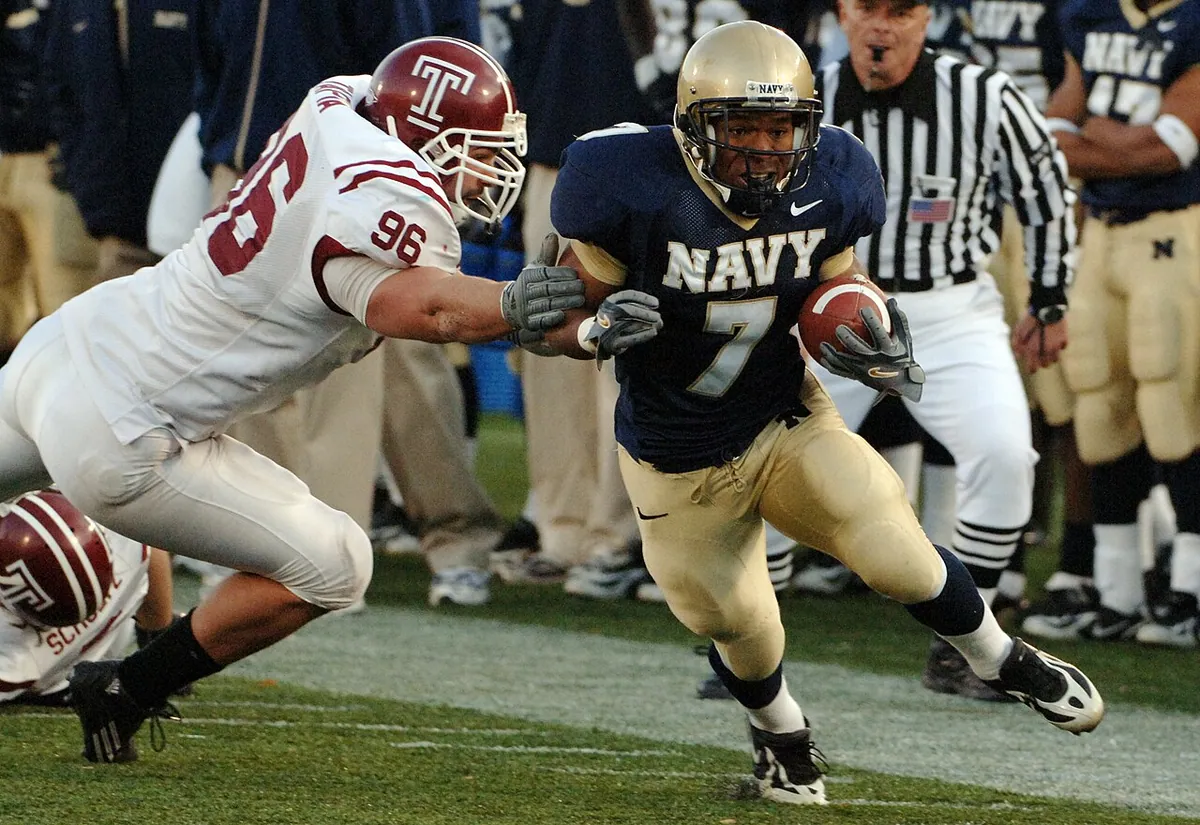
The defensive team aims to prevent the offense from scoring. Defensive linemen line up directly opposite the offensive line. Defensive ends line up at the outer edges of the defensive line and aim to pressure the quarterback or contain running plays. Defensive tackles line up on the interior of the defensive line, with a nose tackle often positioned directly across from the center. Linebackers play behind the defensive line and are responsible for stopping runs, covering receivers, and blitzing. In a standard 4-3 defense, there are four defensive linemen and three linebackers. Defensive backs, or the secondary, cover receivers and defend against passes. Cornerbacks typically line up across from wide receivers, while safeties play deeper to provide help on long passes. The strong safety lines up on the side of the offensive tight end, while the free safety plays a more central, roaming role.
Specific defensive formations are named for the number of defensive backs on the field. The base defense typically uses four defensive backs. A nickel defense brings in a fifth defensive back, replacing a linebacker, to better defend against passes. A dime defense uses a sixth defensive back for extreme pass-prevention situations. Coverage schemes define how defenders guard receivers. Man-to-man coverage assigns each defender to a specific eligible receiver. Zone coverage assigns defenders to specific areas of the field. A blitz is a play where the defense rushes more players than usual to try to tackle the quarterback behind the line. Tackling the quarterback behind the line of scrimmage results in a loss of yardage and is called a sack.
Special Teams and Kicking Game Terms
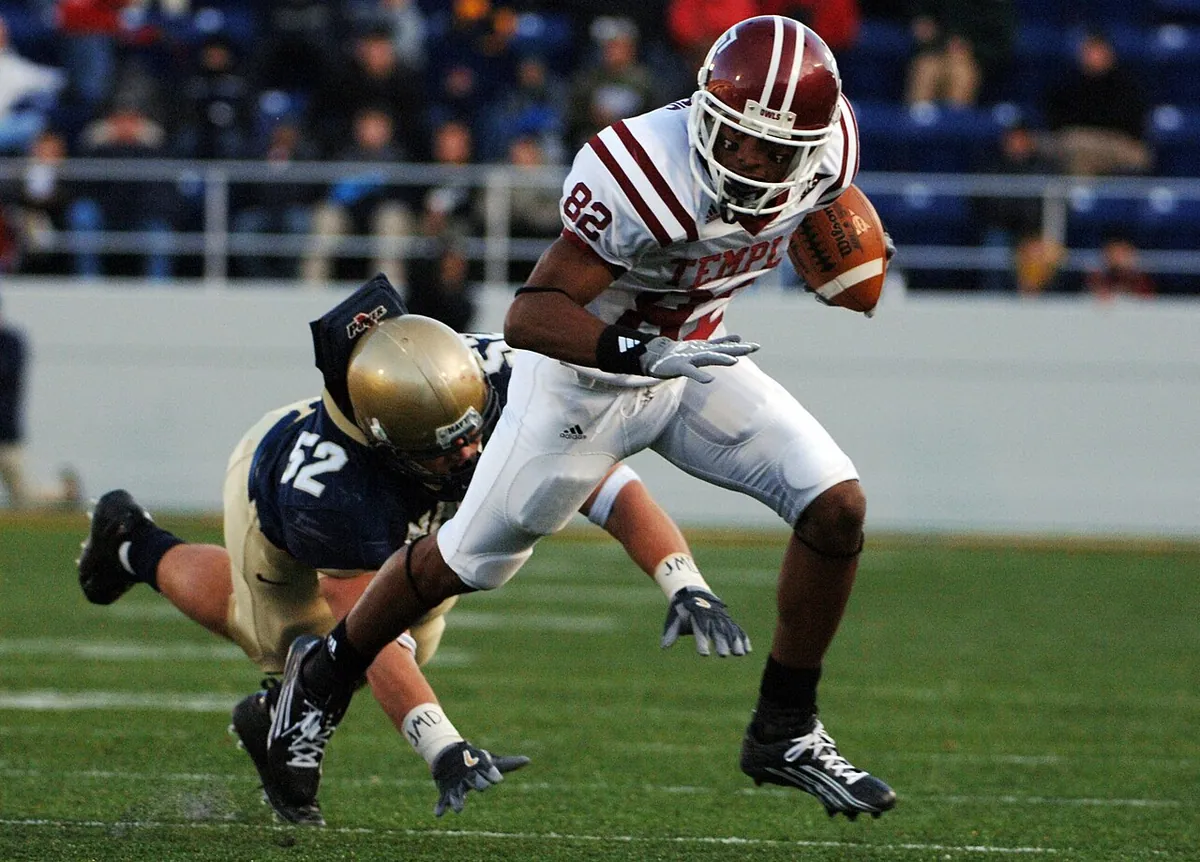
Special teams are the units on the field during kicking plays. The kickoff is a free kick that starts the game, the second half, and play after a score. A fair catch is a signal by a player receiving a punt, waving one arm above the head, which allows them to catch the ball without being tackled but not to advance it. A punt is a kick made when a player drops the ball and kicks it before it hits the ground, usually on fourth down to surrender possession while pinning the opponent deep. An onside kick is a short, bouncing kickoff intended for the kicking team to recover, which according to 2026 NFL rules can be declared at any time. The chain crew are the eight home-team employees who use the 10-yard chain and down marker to help officials measure for first downs. A drop kick is an extremely rare type of kick where the ball is dropped and kicked as it hits the ground, which can score a field goal. The coffin corner refers to the area near the intersection of the sideline and the goal line, where punters aim to kick the ball out of bounds to trap the receiving team deep.
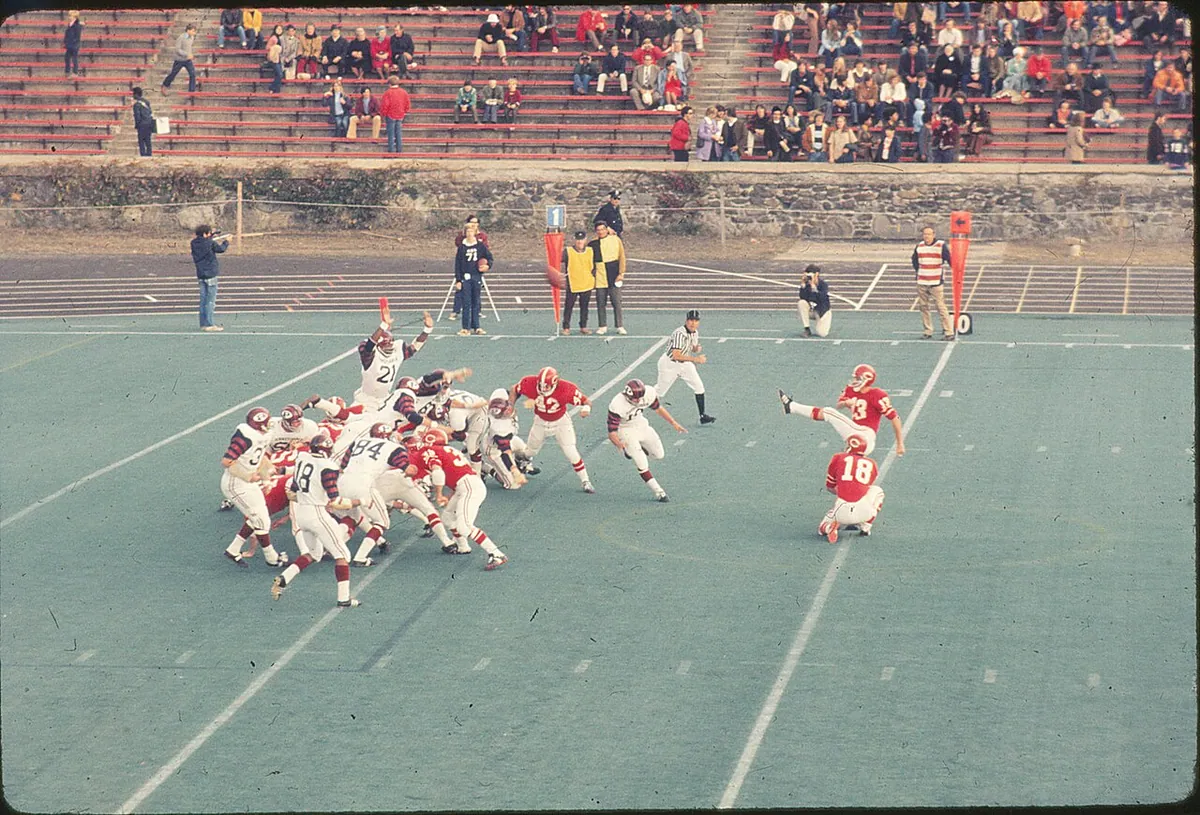
The holder is the player who positions the ball for a placekick on field goals and extra points. The long snapper is a specialized center for punt and field goal formations. A gimme is slang for a very short field goal, usually 25 yards or less, that is almost certain to be successful. A touchback occurs when the ball is downed in the end zone on a kickoff or punt, resulting in the receiving team starting its drive at its own yard line. Special teams also involve players who field kicks and attempt to gain yardage, and players who sprint downfield to tackle the returner. The play clock is the timer the offense must obey. In the NFL, teams have 40 seconds from the end of the previous play to snap the ball or risk a delay of game penalty.
Common Penalties and Rule Violations
Penalties are called for rule infractions and result in a loss of yardage. A false start is a five-yard penalty against the offense for moving before the snap. Offside is a five-yard penalty against the defense for being across the line of scrimmage when the ball is snapped. Encroachment is a foul where a defensive player contacts an opponent before the snap. Holding is a 10-yard penalty for illegally grabbing an opponent to impede their movement. Pass interference is a penalty for illegally impeding an eligible receiver's chance to catch a pass, resulting in an automatic first down. An automatic first down is awarded for several defensive fouls like pass interference and personal fouls, even if the penalty yardage is less than needed for the first down. Under high school (NFHS) rules, only roughing the snapper, holder, kicker, and passer carry an automatic first down.
Personal fouls are 15-yard penalties for dangerous play. Roughing the passer is called for a late or unnecessarily violent hit on the quarterback. A face mask foul, grabbing the helmet's grill, is a 15-yard penalty. Clipping is an illegal 15-yard block from behind at or below the waist. A chop block is an illegal combination block where one player blocks high and another blocks low. Intentional grounding is a penalty against a quarterback who throws an incomplete pass without a realistic receiver to avoid a sack. Delay of game is a five-yard foul for not snapping the ball before the play clock expires. A dead ball foul occurs between the end of one play and the snap of the next. A red flag is a coach's challenge flag thrown to request a video review, while a yellow flag is the penalty flag thrown by an official.
Strategic and Advanced Terminology
Advanced football terminology describes complex strategies and play designs. A quarterback may change the play at the line of scrimmage by calling out a new one, an action known as an audible. A bootleg is a misdirection play where the quarterback fakes a handoff and runs or rolls out in the opposite direction. On a draw play, the quarterback initially drops back as if to pass before handing the ball to a running back. A screen pass is a short toss to a receiver behind the line of scrimmage, with blockers set up in front. A bubble screen is a specific screen pass to a receiver moving toward the sideline. A reverse is a trick play where the ball is handed off to a receiver moving into the backfield, who then runs around the opposite end. A double reverse involves two hand-offs behind the line, reversing direction twice.
Offensive philosophies define a team's strategic identity. The Air Raid offense, derived from the West Coast offense but run from the shotgun, de-emphasizes the run in favor of quick, medium, and screen passes. Defensive strategy includes the box, the area directly opposite the offensive line about five yards deep. Putting eight men in the box means bringing a safety forward to stop the run. A bridge quarterback is a veteran signed to a short-term deal while a team develops a long-term solution. A bust refers to a highly drafted player who fails to meet expectations. Clock management is the strategic use of rules to control the game clock, especially near the end of a half or game. A Hail Mary is a long, high-risk pass thrown in a desperate situation where even an interception would result in field position similar to a punt. A three-and-out is when an offense fails to get a first down and must punt after three plays.
Statistics and Measurement Terms
Football uses a wide array of statistics to measure performance. All-purpose yardage is the sum of all yards gained by a player via rushing, receiving, and returns. Completion percentage is the percentage of passes completed from passes attempted. Adjusted yards per passing attempt (AY/A) is a formula that credits touchdowns and penalizes interceptions: (Passing Yards + 20*(Passing TD) - 45*(Interceptions)) / Passing Attempts. Net yards per passing attempt (NY/A) expands this formula to include sack yards. Approximate Value (AV), created by Doug Drinen, is a metric that attempts to assign a single number to a player's seasonal value since 1960. A catch, as defined by the NFL, requires a player to secure control of the ball inbounds, get two feet or another body part down, and perform a football act like tucking the ball.
| Statistic | Description |
|---|---|
| All-Purpose Yards | Rushing + Receiving + Return yards |
| Completion Percentage | Completions divided by Pass Attempts |
| Adjusted Yards/Attempt (AY/A) | (Pass Yds + 20*TD - 45*INT) / Att |
| Net Yards/Attempt (NY/A) | Adds sack yards to AY/A formula |
| Approximate Value (AV) | Single-number player value metric (since 1960) |
| Carry | One rushing attempt by a ball carrier |
The chain gang operates the 10-yard chain that measures for a first down. The down marker indicates the current down (first, second, third, or fourth). The hash marks are the lines running down the middle of the field. The ball is always spotted on or between them. A dead ball is a ball that is no longer in play. A player is ruled down when he touches the ground with any part of his body besides his hands or feet due to contact from an opponent. In professional football, a player must be down by contact for play to stop. Falling without being touched does not end the play. The gridiron is another term for the football field itself.
Historical and Obsolete Formations
Football strategy has evolved, leaving behind some historical formations. The 7-2-2 defense or seven-box was invented by Amos Alonzo Stagg in 1890 and featured seven defensive linemen, two linebackers, and two defensive backs. Coaches Knute Rockne at Notre Dame and Mike Donahue at Auburn employed this formation as their base defense. The 7-1-2-1 defense or seven-diamond was invented by Henry L. Williams in 1903, using seven linemen, one linebacker, and three defensive backs. By the mid-1930s, this formation was considered almost obsolete due to its vulnerability against the forward pass. The double wing formation used two tight ends and two wingbacks, with the snap tossed between the legs. The Notre Dame Box was a variation where the center handed the ball to the quarterback. The single wing formation used a direct snap to a back rather than the quarterback. These formations were foundational to the early run-oriented game before the rise of the forward pass and modern spread offenses.
The A-11 offense, a brief modern anomaly, was an offensive philosophy designed to make all 11 players appear as eligible receivers by exploiting a scrimmage kick formation loophole. The offensive line was spread across the field wearing eligible receiver numbers to confuse defenses. It was banned in 2009. These historical terms illustrate the continuous tactical innovation that characterizes American football.
Video
FAQ
What are some of the most basic football terms for beginners?
The most basic terms describe the core structure and scoring of the game. A down is a single play. The offense has four downs to advance the ball 10 yards for a new first down. A touchdown scores six points by possessing the ball in the end zone. A field goal scores three points by kicking the ball through the goalposts. An interception is a pass caught by the defense, resulting in a turnover. A sack is when the quarterback is tackled behind the line of scrimmage. The line of scrimmage is where the ball is spotted before a play, and the backfield is the area behind it where the quarterback and running backs start.
What does 'audible' mean in football?
An audible refers to a quarterback changing the play at the line of scrimmage from the one originally called in the huddle. Quarterbacks use audibles to adjust to the defensive alignment they see before the snap. This is a key part of pre-snap strategy and requires clear communication, often using a coded system of colors and numbers. The ability to effectively call audibles is associated with an experienced quarterback. It allows an offense to avoid a bad play call and exploit perceived weaknesses in the defense.
What is the difference between a nickel and a dime defense?
A nickel defense and a dime defense are both sub-packages that bring extra defensive backs onto the field to defend against passing plays. The nickel defense uses five defensive backs, replacing a linebacker with a fifth DB known as a nickelback. The dime defense uses six defensive backs, replacing another linebacker with a sixth DB called a dimeback. The terms come from coin values: a nickel is five cents, and a dime is ten cents (or two nickels). These formations are commonly used in obvious passing situations or against teams that heavily utilize multiple wide receivers.
What constitutes a legal catch in the NFL?
According to the NFL rulebook, a legal catch requires three elements. First, the receiver must secure control of the ball in his hands or arms before it touches the ground. Second, he must touch the ground inbounds with both feet or any other part of his body besides his hands. Third, after fulfilling the first two conditions, he must perform an act common to the game, such as tucking the ball, taking additional steps, turning upfield, or reaching for the goal line. Maintaining control of the ball through contact with the ground is essential. If the ball moves or touches the ground as part of the process, it may be ruled incomplete.
What are common penalties like holding and pass interference?
Holding is a 10-yard penalty called against an offensive player who illegally uses his hands or arms to restrict a defender. Pass interference is called when a player illegally impedes an eligible receiver's opportunity to catch a forward pass. Offensive pass interference is a 10-yard penalty from the previous spot. Other common penalties include false start (5 yards, offense), offside (5 yards, defense), and roughing the passer (15 yards and an automatic first down).
Sources
- Glossary of American football terms (Wikipedia) Wikipedia
- NFL's football terms reference NFL
- Football: Glossary of terms and definitions ducksters.com
- Football Terms Explained, SportsEngine Play discover.sportsengineplay.com
- Football Terms: A Glossary of American Football Terminology gorout.com