The tight end is an offensive position in American football that serves as a hybrid player, combining the characteristics and roles of both an offensive lineman and a wide receiver. Positioned on the offensive line, tight ends are eligible receivers who must be effective blockers in the running game and capable pass catchers in the passing game. Their versatility allows them to line up in various alignments, including attached to the line, in the slot, or split out wide. The position has evolved significantly from a primarily blocking role to a central weapon in modern passing offenses, creating mismatches against defenders.
Role and Responsibilities
A tight end has two primary responsibilities: blocking and receiving. As a blocker, the tight end protects the quarterback on passing plays, opens running lanes for ball carriers by blocking defensive ends and linebackers, and works downfield to tie up defensive backs. As a receiver, tight ends run pass routes, catch passes, and use their size to create advantageous matchups against smaller defensive backs or slower linebackers. Very occasionally, a tight end may be used as a ball carrier on designed rushing plays like reverses or sweeps. The specific emphasis on blocking versus receiving depends heavily on the offensive system, the play call, and the individual player's skill set.
Teams often deploy multiple tight ends to create different strategic advantages. Two tight end formations are used, with their frequency increasing in the early 2000s. Some offenses use three or even four tight ends in short-yardage or goal-line situations, known as heavy or jumbo packages, to maximize blocking power or confuse the defense. Coaches may also rotate between a blocking specialist and a receiving specialist depending on the down and distance. The most valuable tight ends are those who can execute both roles at a high level, allowing the offense to disguise its intentions before the snap.
Where the Player Lines Up
The tight end traditionally lines up on the line of scrimmage, immediately next to an offensive tackle. This alignment is described as tight or in-line, which contrasts with the split end wide receiver who lines up wide outside the offensive formation. A tight end is one of the seven players required to be on the line of scrimmage at the snap, with the other five typically being the center, two guards, and two tackles. Modern offensive schemes frequently move the tight end to other pre-snap positions to create mismatches. They can be flexed out into the slot, aligned as a wingback just behind the line, split out wide like a receiver, or even put in motion across the formation.
The concept of the H-back, developed in the early 1980s, is a variation where a player with tight end skills lines up behind the line of scrimmage, often in a fullback-like position. This player can then shift into various roles, including lead blocker, pass protector, or receiver. While some systems historically distinguished between in-line tight ends and H-backs based on size and skill, the distinction has blurred in the modern NFL. Today, the primary difference is often just the starting alignment, with versatile tight ends expected to perform effectively from anywhere in the formation, whether attached to the line or detached from it.
Skills and Typical Size
Tight ends are among the largest skill-position players on the field, with an average height around 6 feet 4 inches and a weight exceeding 254 pounds. This size is necessary to effectively block defensive ends and linebackers, requiring strength, leverage, and proper hand placement. Simultaneously, they need the athleticism to run precise routes, create separation from defenders, and secure catches, which demands speed, agility, and soft hands. The ideal tight end possesses a rare combination of a lineman's power and a receiver's fluidity. Because of their larger frames, tight ends are generally slower than wide receivers and running backs, though exceptional athletes like Vernon Davis have recorded 40-yard dash times as fast as 4.38 seconds.
Evaluating a tight end requires looking beyond basic receiving statistics. Film analysis assesses key skills such as release technique off the line of scrimmage, route-running detail, ability to catch through contact, and blocking fundamentals like pad level and sustain. A tight end's value is often shown in plays where they do not touch the ball, such as when they secure the edge on a run, occupy a safety in coverage to free another receiver, or provide crucial pass protection for the quarterback. The position demands consistent execution across a wide array of responsibilities, making versatility and football intelligence paramount traits for success.
Variations and Techniques
The tight end position encompasses several specialized roles and techniques based on a player's strengths and the offensive scheme. A Y tight end is typically the traditional in-line player, attached to the offensive line and heavily involved in blocking. An F tight end or H-back often aligns off the line, in the backfield or as a wing, and is used more flexibly in motion and as a move blocker. Receiving specialists, sometimes called jokers, are deployed primarily as pass catchers, using their size and speed to attack the seam of the defense or create mismatches outside. Blocking specialists serve as a sixth offensive lineman, rarely running routes but providing critical support in the run game and pass protection.
- In-line Tight End (Y): Primarily blocks and runs short to intermediate routes from the line.
- H-back/F Tight End: Lines up off the line, used in motion, and functions as a hybrid fullback/tight end.
- Receiving Specialist (Joker): A primary pass-catching threat often aligned in the slot or out wide.
- Blocking Specialist: Focuses almost exclusively on blocking duties in heavy personnel packages.
- Seam Threat: Excels at running vertical routes down the middle of the field between linebackers and safeties.
- Short Pass Outlet: Acts as a security blanket for the quarterback on check-downs and option routes.
Techniques vary widely between these roles. A blocking tight end must master drive blocking, reach blocking, and pass protection sets. A receiving tight end must refine route releases, understand coverage leverage, and excel at contested catches. The most complete tight ends transition between these techniques, allowing an offense to run the same personnel grouping regardless of whether the play call is a power run or a deep pass.
Evolution of the Position
The tight end position originated with the decline of the one-platoon system in the 1940s and 1950s, as specialization allowed for players focused solely on offense. Initially, ends were simply the players on each end of the line of scrimmage. The term tight end emerged in the early 1960s to describe the end who lined up close to the tackles, as opposed to the split end who aligned wide. The position's modern transformation is often traced to Kellen Winslow in the early 1980s, whose use in wide receiver-type routes under coach Don Coryell changed how tight ends could be deployed.
The 1990s and 2000s saw the rise of athletic tight ends who further blurred the line with wide receivers. Shannon Sharpe became the first tight end to surpass 10000 career receiving yards. Tony Gonzalez and Antonio Gates, both former college basketball players, brought unprecedented athleticism and basketball-style mismatches to the position. In 2011, six of the NFL's top 15 players in receptions were tight ends, a historic high. This evolution shifted the tight end from a supplementary blocker to a central, highly paid offensive weapon, though it also reduced the number of players adept at both blocking and receiving.
Notable Players and Statistics
Several tight ends have defined the position through different eras with their record-setting performances. John Mackey was a pioneer as a big-play threat in the 1960s. Kellen Winslow's 1290 receiving yards in 1980 stood as a single-season record for decades. Rob Gronkowski set the single-season touchdown record with 17 in 2011.
Statistics used to evaluate tight ends include traditional receiving numbers like receptions, yards, and touchdowns. However, advanced metrics and film study are crucial for assessing their complete impact. Key blocking grades, yards per route run, contested catch rate, and average depth of target provide a fuller picture. The most telling sign of a tight end's value is often their usage. Elite players are targeted frequently, especially on critical third downs and in the red zone, where their size presents a major advantage.
Tight Ends in College and Other Leagues
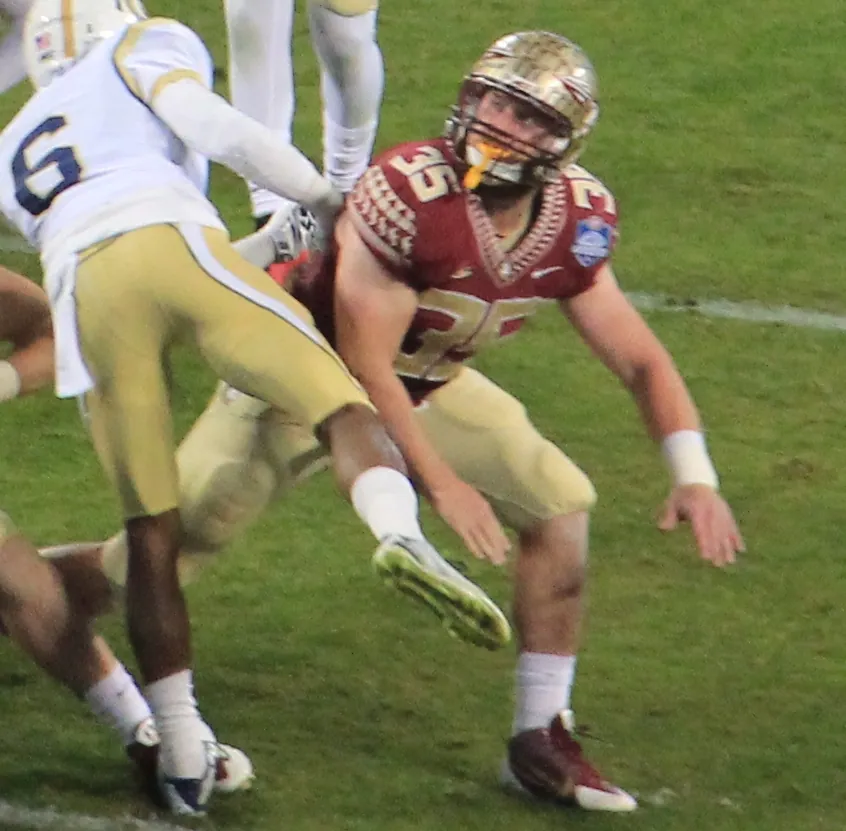
In college football, the tight end position follows a similar hybrid role, though the specific responsibilities can vary by offensive system. NCAA rules strongly recommend, but do not require, that tight ends wear jersey numbers 80 through 99. At the high school level, governed by the National Federation of State High School Associations, tight ends can wear any number except 50 through 79. The development path for professional tight ends often begins in college, where players refine their skills. Some notable NFL tight ends, like Antonio Gates and Jimmy Graham, played college basketball, highlighting the athletic crossover valued at the position.
In other football leagues, the tight end role differs significantly. In the Arena Football League, the tight end primarily served as a third offensive lineman and was rarely used as a receiver. In Canadian football, the tight end position is no longer used professionally in the Canadian Football League, though it is still present at the university level in U Sports. Former CFL star Tony Gabriel played tight end. Some Canadian university players, like Antony Auclair of Laval, have used that experience as a path to the NFL as undrafted free agents. These variations demonstrate how rule sets and field dimensions influence the utility and design of the tight end position.
Video
FAQ
What does a tight end do in football?
A tight end performs two main jobs: blocking and receiving. They block defensive players to protect the quarterback on pass plays and open holes for runners. As a receiver, they run pass routes and catch the ball, often using their size to create mismatches. On rare occasions, they may also carry the ball on designed rushing plays. Their specific duties on any given play depend on the offensive scheme and the situation.
Where does a tight end line up?
A tight end most commonly lines up on the line of scrimmage immediately next to an offensive tackle, a position described as in-line or tight. They are one of the seven players required to be on the line at the snap. Modern offenses also position tight ends in other alignments, including in the slot between a tackle and a wide receiver, split out wide like a receiver, or as an H-back behind the line of scrimmage. This flexibility helps create favorable matchups against the defense.
What is the typical size for a tight end?
Tight ends are typically among the largest skill-position players. The average height is around 6 feet 4 inches, and they often weigh more than 254 pounds. This size provides the strength needed to block defensive ends and linebackers effectively. They also need sufficient athleticism and speed to run routes and catch passes, though they are generally slower than wide receivers. Exceptional athletes at the position combine this size with near-wide-receiver speed.
How has the tight end position changed over time?
The tight end position has evolved from a primarily blocking role to a central receiving weapon. The 1980s saw a shift with players like Kellen Winslow running receiver-like routes. The 1990s and 2000s introduced ultra-athletic tight ends like Tony Gonzalez and Antonio Gates. By 2011, tight ends like Rob Gronkowski and Jimmy Graham were setting receiving records, and six of the NFL's top 15 in receptions were tight ends, highlighting the position's expanded role in the passing game.
Who are some of the most notable tight ends in NFL history?
Notable tight ends include pioneers like John Mackey and Mike Ditka. Kellen Winslow changed the position as a receiver in the 1980s. Shannon Sharpe was the first to reach 10000 career receiving yards. Tony Gonzalez pushed the position toward wide receiver speed and power forward strength. Rob Gronkowski set the single-season touchdown record. These players exemplify the evolution and impact of the position.
What statistics are used to judge a tight end's performance?
Traditional receiving statistics like receptions, receiving yards, and touchdowns are primary metrics. However, evaluating a tight end also requires analyzing their blocking effectiveness, which is graded by film review and advanced metrics. Key performance indicators include yards per route run, contested catch rate, red zone targets, and average depth of target. A tight end's true value is often seen in their versatility and ability to impact the game both as a pass catcher and a blocker, regardless of whether they show up on the stat sheet.
Sources
- Tight end (Wikipedia) Wikipedia
- What is a tight end in the NFL? dazn.com
- Tight End Film Evaluation & TE Position Guide | SAS schwartzathletespotlight.com
- NY Jets: The Roles of the Tight End in the NFL ganggreennation.com