The United States Football League was a professional American football league that played three full seasons from 1983 through 1985. Conceived by New Orleans businessman David Dixon, the league operated in the spring and summer to avoid direct competition with the National Football League. It launched with 12 teams in major television markets and later expanded to 18 franchises, attracting top talent including three straight Heisman Trophy winners. The league secured national television contracts with ABC and ESPN but suffered from financial instability. Its existence ended after owners voted to switch to a fall schedule and filed an antitrust lawsuit against the NFL, leading to its dissolution before a planned 1986 season. The league never played its scheduled 1986 autumn games and folded after losing over $163 million.
Origins and the Dixon Plan
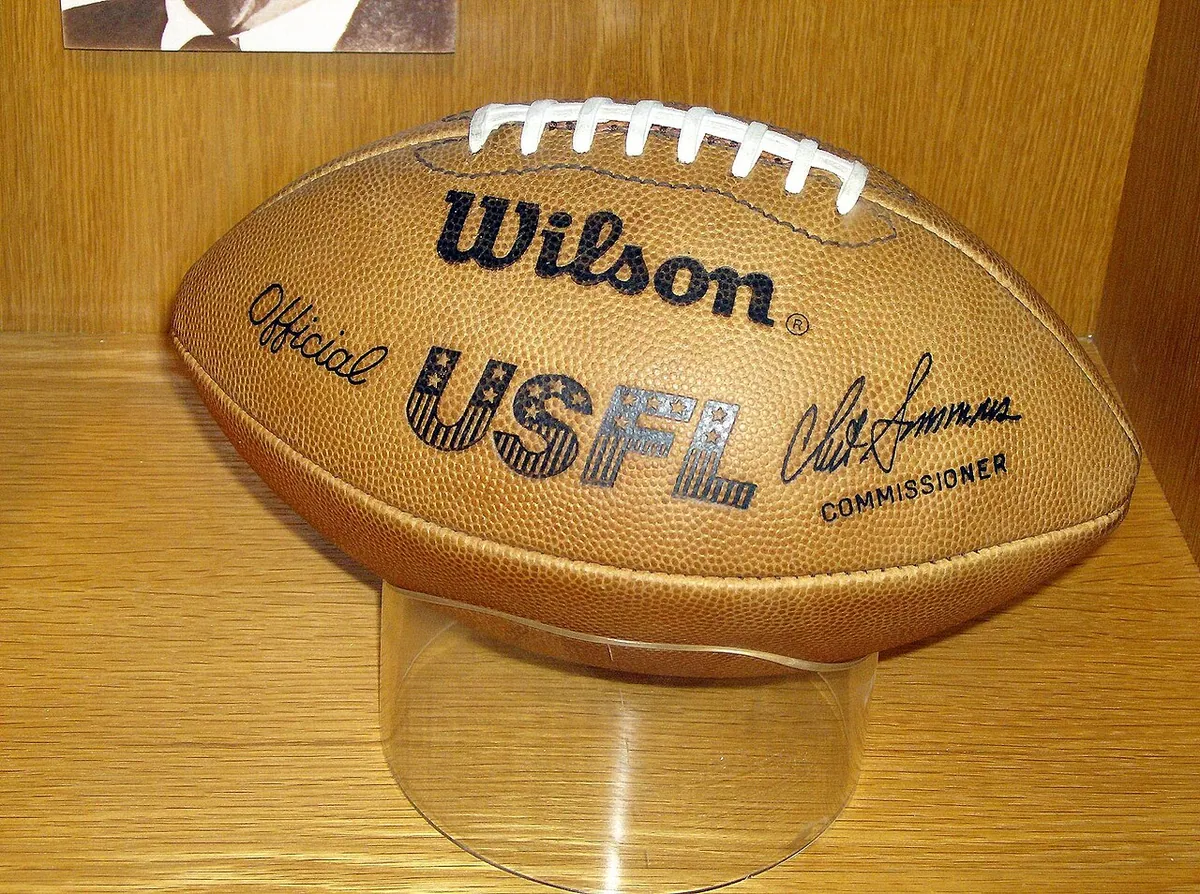
The concept for the USFL originated in 1965 with New Orleans businessman David Dixon. Dixon, who had been instrumental in bringing the NFL's Saints to New Orleans and building the Superdome, envisioned a professional football league that would operate during the NFL's offseason. He spent over 15 years studying previous challenger leagues like the American Football League and the World Football League. Dixon commissioned a market study in 1980 that indicated a promising market for spring football. He then developed a detailed operational blueprint known as the Dixon Plan. This plan called for franchises in top television markets, securing a national television contract, and strict financial controls to ensure owners could withstand initial losses. The league required potential owners to post a $1.5 million letter of credit and undergo rigorous financial vetting. On May 11, 1982, Dixon formally announced the league's formation at the 21 Club in New York City, with plans to begin play in 1983. The league soon named ESPN executive Chet Simmons as its first commissioner. Judge Peter Spivak, a part-owner of the Detroit franchise, served as president of the league, an interim position until a commissioner was named.
Early Challenges and League Launch
Despite the careful planning, the USFL encountered significant obstacles before its first game. Securing stadium leases proved difficult, often due to pressure from NFL teams or conflicts with baseball schedules. The original owner of the Los Angeles franchise, Alex Spanos, pulled out and instead became involved with the NFL's San Diego Chargers. The planned San Diego franchise was blocked from Jack Murphy Stadium by the MLB's Padres, leading its owners, Bill Daniels and Alan Harmon, to take over the Los Angeles market as the Express instead. The Boston Breakers struggled to find a suitable venue, unable to secure Harvard Stadium, Sullivan Stadium, or Fenway Park, eventually settling for 21,000-seat Nickerson Field. There were also early discussions about placing teams in Canada, but threats of protective legislation for the Canadian Football League led to that idea being abandoned. The league secured crucial television contracts with ABC and ESPN for its inaugural 1983 season. ESPN paid $4 million in 1983 and $7 million in 1984. These deals provided the national exposure and revenue that were central to Dixon's vision for the league's viability.
The 1983 Inaugural Season
The USFL made its debut on March 6, 1983, with a 12-team schedule. The league averaged about 25,000 fans per game, which aligned with initial forecasts, and television ratings achieved a 6.1 Nielsen average, exceeding the league's 5.0 target. The Michigan Panthers won the first championship, defeating the Philadelphia Stars 24-22 in a game considered highly entertaining. The Philadelphia Stars, coached by Jim Mora, posted the league's best record at 15-3 but fell short in the title game. Walker emerged as the league's first star, rushing for 1,812 yards and 17 touchdowns. The Oakland Invaders won the Pacific Division with a 9-9 record behind quarterback Fred Besana. Financially, the league lost nearly $40 million in its first year, an average of $3.3 million per team. Only the Denver Gold, which led the league in attendance, and the Tampa Bay Bandits managed to avoid large financial losses during the inaugural campaign.
Expansion and Escalating Costs in 1984
The USFL expanded to 18 teams for its second season in 1984, adding six new franchises. Each new team paid a $6 million entry fee to join the league. The expansion clubs included the Houston Gamblers, Memphis Showboats, Pittsburgh Maulers, San Antonio Gunslingers, Oklahoma Outlaws, and Jacksonville Bulls. The Boston Breakers relocated to New Orleans after the 1983 season. The league continued to attract elite talent, signing the 1983 Heisman winner, Mike Rozier, to the Pittsburgh Maulers. Future Hall of Fame quarterback Jim Kelly joined the Houston Gamblers and threw 44 touchdown passes in his rookie season. The Philadelphia Stars again had the best record at 16-2 and won the championship, defeating the Arizona Wranglers 23-3. Despite solid attendance and improved play, player costs escalated dramatically. Many owners, like Arizona's Ted Diethrich, lost millions for the second consecutive year, with negligible attendance increases despite fielding a competitive team.
- Jim Kelly, QB, Houston Gamblers
- Mike Rozier, RB, Pittsburgh Maulers
- Reggie White, DE, Memphis Showboats
- Steve Young, QB, Los Angeles Express
Franchise Instability and the 1985 Season
The 1985 season was marked by consolidation and relocation as the league prepared for its planned move to a fall schedule. The number of teams was reduced to 14. The Philadelphia Stars, fresh off a championship, left for Baltimore. The Pittsburgh Maulers folded after one season. The Washington Federals relocated to Orlando to become the Renegades. The Chicago Blitz suspended operations. The franchises in Oklahoma and Arizona combined to create the Arizona Outlaws. On the field, 1984 Heisman Trophy winner Doug Flutie signed with the New Jersey Generals, continuing the trend of top college players joining the league. The Baltimore Stars overcame a slow start to win the final USFL championship, defeating the Oakland Invaders 28-24. The Oakland team included players from the merged Michigan Panthers, making the final a near-rematch of the 1983 title game. This 1985 season was considered a lame-duck period, as the decision to move to the fall had already been announced, creating uncertainty for fans and franchises in NFL cities.
| Franchise Movement (1984 to 1985) | From | To |
|---|---|---|
| Stars | Philadelphia | Baltimore |
| Federals | Washington | Orlando (Renegades) |
The Move to Fall and Antitrust Lawsuit
In August 1984, led by New Jersey Generals owner Donald Trump, the USFL owners voted to move from a spring to a fall schedule beginning in 1986. The strategy was to force a merger with the NFL by competing directly against it. This decision had immediate negative consequences, making several franchises in NFL cities untenable and triggering the 1985 relocations and mergers. After a lengthy trial, a jury found that the NFL had indeed violated antitrust laws. However, in a verdict that stunned the league, the USFL was awarded only $1 in damages, which was tripled under antitrust law to $3. The court ruled that the USFL's own mismanagement, particularly the move to fall, was the primary cause of its failures. This symbolic victory provided no financial lifeline, and the league ceased operations before its planned 1986 fall season could begin. By the time it folded, the league had lost over $163 million, equivalent to roughly $410 million in 2025 dollars.
Notable Players and Hall of Fame Legacy
The USFL featured numerous individuals who left a lasting mark on football history. Founder David Dixon provided the initial vision and business plan. Commissioner Chet Simmons secured the vital television contracts. On the field, the league served as a launching pad for noted players. Future Pro Football Hall of Famers Jim Kelly, Steve Young, Reggie White, and Gary Zimmerman all began their pro careers in the USFL. Hall of Fame linebacker Sam Mills became a star with the Philadelphia/Baltimore Stars. The league also attracted established NFL veterans like 1980 MVP quarterback Brian Sipe, three-time Pro Bowl running back Joe Cribbs, and three-time Pro Bowl safety Gary Barbaro. Coaches like Jim Mora used the league as a springboard to successful NFL careers. The influx of Heisman winners Walker, Rozier, and Flutie brought immediate credibility and media attention, demonstrating the league's ability to compete with the NFL for top collegiate talent. Other personnel, including front office executive Bill Polian and coach Sid Gillman, were also involved with USFL teams.
Financial Collapse and Total Losses
The financial discipline outlined in the Dixon Plan eroded almost immediately after Herschel Walker's landmark contract. With no hard salary cap, player payrolls escalated rapidly as owners engaged in bidding wars. The league lost nearly $40 million in its first season alone. By the time the league played its last game in 1985, total losses were estimated to be in the neighborhood of $200 million. These massive deficits were driven by unsustainable player salaries that far outstripped league revenues from television and ticket sales. While Denver's Ron Blanding sold his team for a profit, most owners endured severe losses. The move to a fall schedule exacerbated these problems by forcing costly franchise relocations and eliminating the spring television niche the league had occupied. The antitrust lawsuit, intended as a financial lifeline, resulted in a token damage award that offered no relief. The collective financial failure of its teams, more than any single factor, led to the league's dissolution in 1986.
Legacy and Modern Revival
The USFL's impact on professional football was significant despite its short life. It proved there was a market for spring football and accelerated the integration of star players into the professional game. Several cities that hosted USFL teams, such as Jacksonville, Baltimore, and Phoenix, later received NFL franchises. The league's collapse also indirectly created an opening for Sunday Night Football, as the NFL moved to fill the prime-time television slot the USFL had vacated for the fall of 1986. The USFL name was revived in 2022 for a new spring football league that operated for two seasons. That league, which had no direct corporate connection to the original, featured eight teams using historical USFL brand names. Following the 2023 season, that league merged with the XFL to form the United Football League (UFL). The original league's game footage and history remain subjects of preservation efforts by fans and historians, ensuring the story of the ambitious 1980s venture is not forgotten.
Video
FAQ
What was the USFL?
The United States Football League was a professional American football league that played three full seasons from 1983 to 1985. It was founded by David Dixon with the goal of operating during the NFL's offseason in the spring and summer. The league started with 12 teams in major television markets and later expanded to 18 franchises. It attracted notable players like Herschel Walker and Jim Kelly before folding in 1986 after a failed attempt to move to a fall schedule and an antitrust lawsuit against the NFL. The league never played its scheduled 1986 autumn season.
Why did the USFL fail?
The USFL failed due to a combination of financial mismanagement and a strategic miscalculation. Owners abandoned the league's original plan for fiscal restraint, engaging in a bidding war for players that led to massive losses estimated at $200 million. The decision to move to a fall schedule in 1986 to directly challenge the NFL destabilized franchises and led to an antitrust lawsuit. Although the USFL won the lawsuit, it was awarded only $1 in damages, which provided no financial rescue and led to the league's dissolution before the 1986 season. The league had lost over $163 million by the time it folded.
Did any famous NFL players start in the USFL?
Yes, several players who later became NFL stars and Pro Football Hall of Famers began their professional careers in the USFL. This group includes quarterbacks Jim Kelly of the Houston Gamblers and Steve Young of the Los Angeles Express, defensive end Reggie White of the Memphis Showboats, and linebacker Sam Mills of the Philadelphia Stars. The league also attracted established NFL veterans like quarterback Brian Sipe and running back Joe Cribbs, who joined after their NFL careers had begun. Future Hall of Fame offensive tackle Gary Zimmerman also played in the USFL.
Who won the USFL championships?
The Michigan Panthers won the first USFL championship in 1983, defeating the Philadelphia Stars 24-22. The Philadelphia Stars won the championship in 1984, beating the Arizona Wranglers 23-3. For the 1985 season, the Stars relocated to Baltimore and won the final USFL title as the Baltimore Stars, defeating the Oakland Invaders 28-24. The Oakland team that season was a merged franchise that included the remnants of the original Michigan Panthers, making the 1985 game a quasi-rematch of the first championship. The Stars were the only team to win multiple titles.
Is the USFL connected to the current UFL?
The current United Football League is indirectly connected to the original USFL through a series of mergers. The USFL name was revived in 2022 for a new spring football league that operated for two seasons. After the 2023 season, that league merged with the XFL to form the United Football League. Therefore, the modern UFL is a successor to that revived USFL, but it is a separate entity from the original 1980s league, which has been defunct since 1986. The original league's teams, records, and history remain distinct.
Who were the three consecutive Heisman Trophy winners who signed with the USFL?
The three consecutive Heisman Trophy winners who signed with USFL teams directly out of college were Herschel Walker, Doug Flutie, and Mike Rozier. Herschel Walker, the 1982 winner from Georgia, signed with the New Jersey Generals. Doug Flutie, the 1984 winner from Boston College, also signed with the New Jersey Generals. Mike Rozier, the 1983 winner from Nebraska, signed with the Pittsburgh Maulers. This influx of top college talent was a significant part of the league's strategy to attract attention and compete for fans.
Sources
- United States Football League (Wikipedia) Wikipedia
- USFL News, Scores, Standings & Stats Fox Sports
- USFL Football: News, Videos, Highlights, Results & More NBC Sports
- Moments in NFL History: USFL expanded football's calendar Pro Football Hall of Fame
- The USFL History (1983 to 1985): Teams, Seasons and Why It Folded oursportscentral.com
- USFL History usflsite.com