A kicker, officially known as a placekicker, is a specialist player on a football team's special teams unit. The primary role of the kicker is to score points by kicking field goals and extra points after touchdowns. Kickers also perform kickoffs to begin each half and after scoring plays, aiming to give the opposing team poor field position. Due to the specialized nature of the role, kickers are often among the highest-scoring players on a team and are typically distinct from the punter, who handles a different type of kick.
Role and Responsibilities
The kicker's main assignments are field goals, extra points, and kickoffs. For a field goal, the kicker must accurately kick the ball through the uprights of the goalpost from a spot determined by the previous play. Under 2026 NFL rules, a successful field goal or extra point must be a placekick or drop kick from on or behind the line of scrimmage, with the whole ball passing above the crossbar and between the uprights. The extra point, or try, is snapped from the defense's 15-yard line unless moved by a penalty. On kickoffs, the kicker's job is to kick the ball as far downfield as possible, ideally into the end zone for a touchback to prevent a return. The standard 2026 NFL kickoff places the kicker at the kicking team's 35-yard line. Kickers may also be asked to execute specialized kickoffs like onside kicks, squib kicks, or pooch kicks to avoid a dangerous returner or attempt to recover the ball.
Beyond scoring, the kicker influences the field position battle. Conversely, a short or poorly placed kick can give the opponent advantageous field position. The kicker must also be prepared for sudden changes in strategy, such as an onside kick attempt when the team needs to regain possession quickly. These varied responsibilities require the kicker to master different kicking techniques and adapt to immediate game situations.
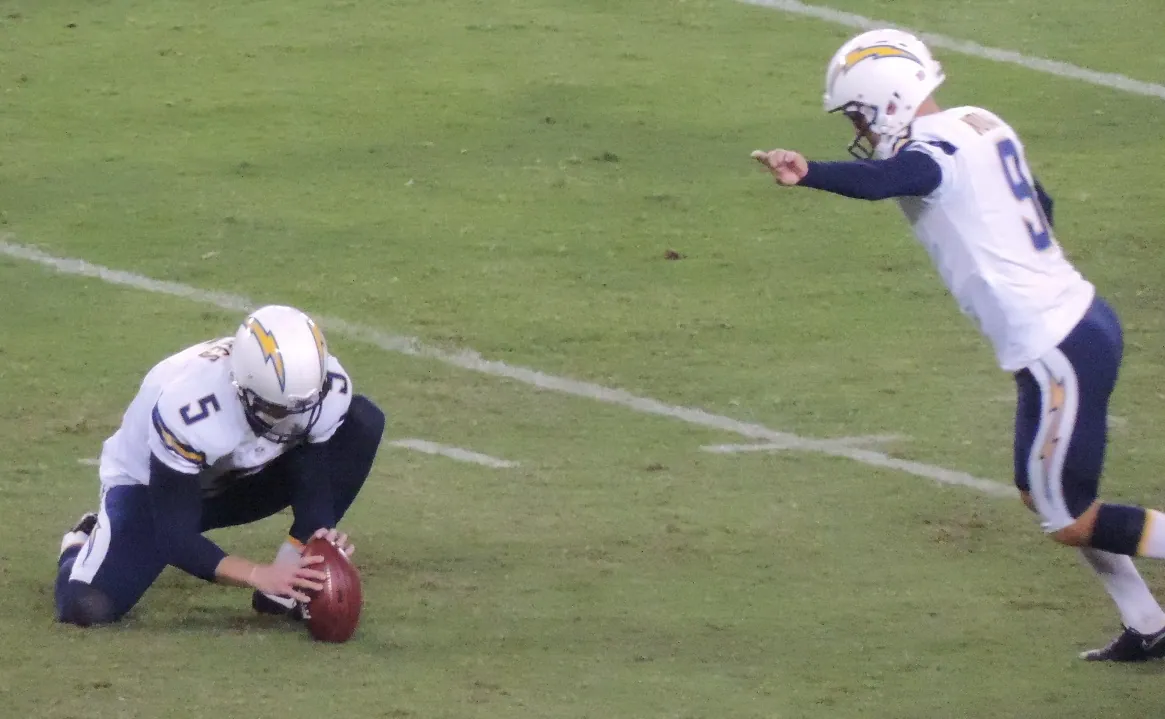
Alignment and the Kicking Operation
On kickoffs, a kicker typically lines up 7 to 10 yards behind the ball, which is placed on a tee. The primary goal is to generate significant lift and distance. For field goals and extra points, the operation is a precise three-player sequence involving a long snapper, a holder, and the kicker. The kicker's approach must reproduce the same spacing and tempo on every attempt to ensure repeatable timing. The plant foot establishes the body's relationship to the ball, and contact and follow-through shape the launch angle and trajectory. Field goal attempts require enough height to clear the line of scrimmage and avoid being blocked, often needing more than 11 feet of elevation.
The success of a field goal unit depends entirely on the flawless execution of this timed sequence. Any error in the snap, hold, or approach can lead to a missed kick or a block. The kicker must trust the spot provided by the holder and commit to the kicking motion without hesitation. Factors like the position of the ball on the hash marks change the visual angle to the uprights, requiring subtle adjustments in the kicker's alignment. Longer field goal attempts demand a balance between enough trajectory to clear the line and enough power to reach the goalposts.
- The field goal operation requires a long snapper, holder, and kicker.
- The holder must catch the snap and place the ball correctly on the ground.
- The kicker must time their approach to match the snap and hold.
- A stable plant foot is critical for consistent ball striking.
- Field goals need over 11 feet of elevation to avoid being blocked.
- Hash mark position alters the kicker's visual angle to the uprights.
- Longer kicks require a balance of trajectory and power.
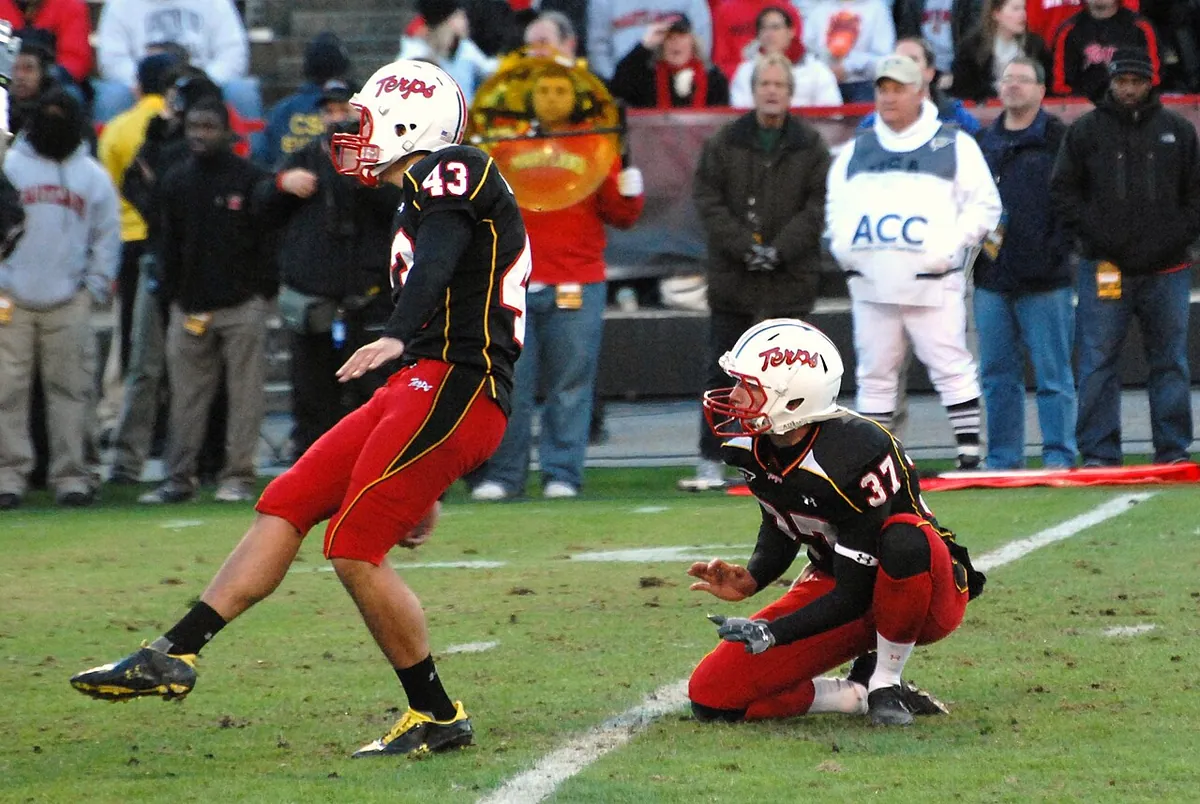
Skills, Physical Traits, and Variations
Effective kicking merges consistent contact with the capacity to modify the ball's flight path without altering the core mechanics of the motion. Key skills include operation timing, consistent ball striking, launch control for height and distance, and a stable reset routine after timeouts or misses. Kickers are frequently much smaller than other players on the field, which can make them a weak point in kickoff coverage if a returner breaks through. At high school and college levels, a team may use several kickers for specific tasks, such as one for field goals and another who focuses on kickoffs. In the NFL, roster restrictions mean teams usually have only one dedicated placekicker. Sometimes a punter will manage kickoff duties, but teams almost never carry more than two specialists on the active roster. The most common technique is a soccer-style approach, where the kicker approaches the ball from an angle.
The physical build of a kicker is distinct from that of other football positions. They do not require the size or strength of linemen or the speed of receivers. Instead, their value comes from leg strength, flexibility, and precise coordination. Practice for a kicker is highly specialized, focusing on hundreds of repetitions of the same motion to build muscle memory. This specialization allows them to perform a task that other players on the team typically cannot do with any reliability. The mental aspect is equally important, as kickers must maintain focus and confidence despite often long periods of inactivity during a game.
- Kickers need repeatable contact and adjustable launch control.
- They are often smaller than teammates, a disadvantage in coverage.
- High school and college teams may use multiple kickers for different jobs.
- NFL teams typically carry only one dedicated placekicker.
- A punter may sometimes handle kickoff duties.
- The soccer-style approach is the most common kicking technique.
- Practice focuses on building muscle memory through repetition.
- Mental focus during game inactivity is a key trait.
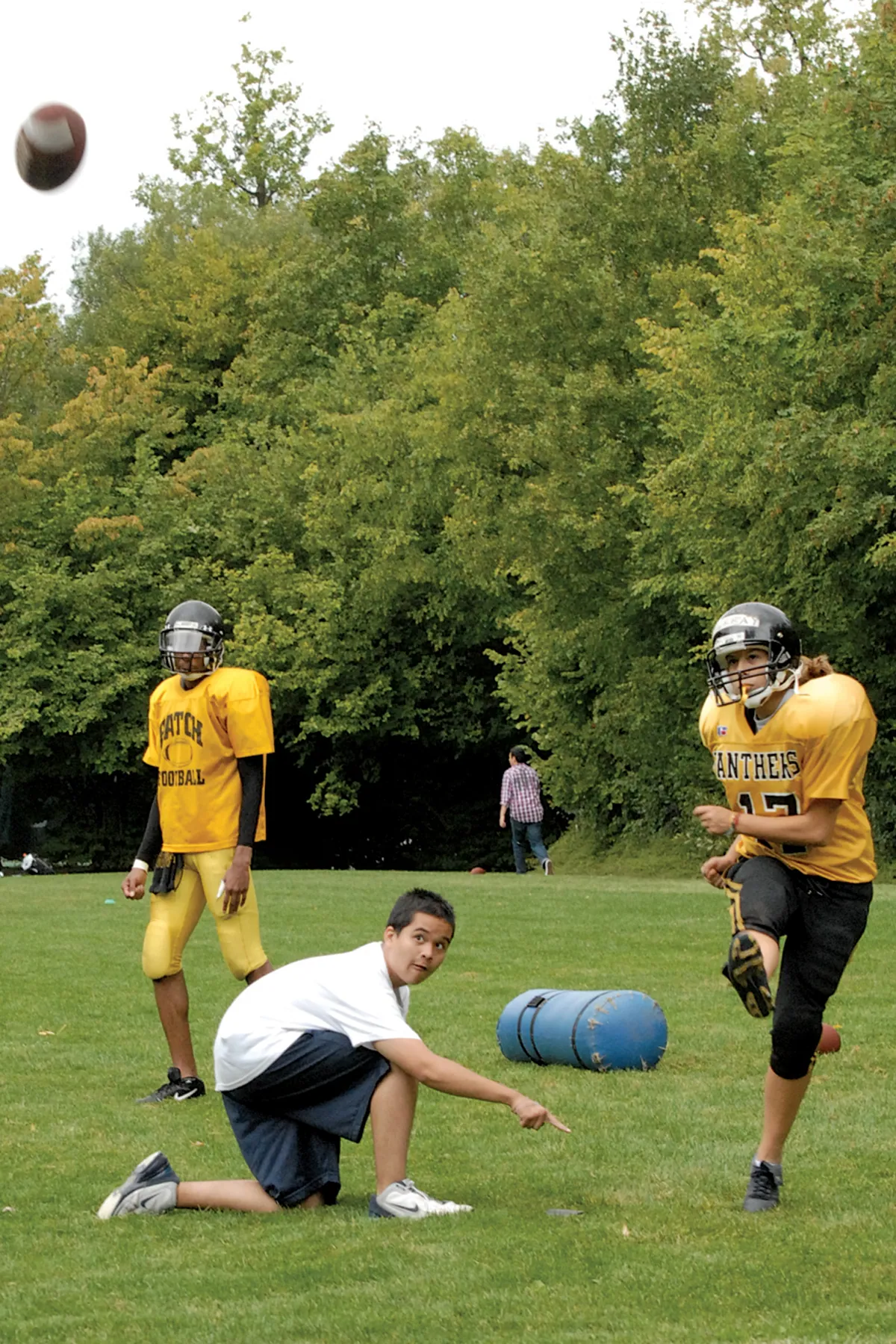
Kicker vs. Punter: A Comparison of Specialists
While both are specialists, the kicker and punter have distinct roles and techniques. A kicker makes contact with a ball that is either held in place on the ground by a holder or placed on a tee, used for scoring kicks and starting drives. A punter catches a longer snap, releases the ball, and kicks it before it hits the ground, with the main goal of improving field position on fourth down. Some players in the past managed both jobs, but contemporary NFL teams generally keep them separate due to major differences in their approach, point of contact, and weekly practice routines. The punter's main task is to kick the ball away on fourth down, aiming for both distance and hang time to allow the coverage team to get downfield. The kicker's primary tasks are scoring and beginning drives with kickoffs.
The technical demands of each position are unique. A placekicker's swing is designed for accuracy and a specific trajectory to clear the line and pass through the uprights. A punter's swing prioritizes power and ball control to achieve both distance and directional placement, often aiming to land the ball inside the opponent's 20-yard line. The difference in the snap also changes the timing. Punters have more time to receive the snap and set up their kick, while placekickers must operate in a faster, more synchronized sequence. This division of labor allows each specialist to hone a very specific skill set to a high degree.
Evolution of the Position Over Time
The placekicker has changed from a task shared among players to a highly focused NFL job. In earlier eras, players like Lou Groza performed kicking duties as part of a broader role, often also playing another position. Groza's career illustrates the transition of kicking from a secondary duty to a primary, dedicated position. Jan Stenerud helped make the specialist placekicker a standard feature, representing the period when teams began to view kicking technique as a unique craft. Morten Andersen's lengthy career, which spanned multiple rule changes and playing surfaces, emphasizes the value of performing consistently over many years. This specialization resulted from the need for dependable scoring from a player who could refine a single, high-pressure skill.
This evolution mirrors changes in the game's strategy and roster construction. As scoring became more vital and rules changed, the value of a reliable kicker increased. Teams began to dedicate a roster spot to a player whose only job was to kick, recognizing that the points they provided were worth the specialization. The soccer-style kicking technique, pioneered by players like Stenerud, replaced the straight-ahead style and improved accuracy and power. Today, kickers are scouted, drafted, and developed specifically for their role, with training regimens focused entirely on the mechanics and psychology of kicking.
- Lou Groza era: Kicking was a duty within a broader position role.
- Jan Stenerud era: Helped establish the dedicated specialist kicker.
- Morten Andersen era: Demonstrated consistency across rule changes.
- Shift from straight-ahead to soccer-style kicking technique.
- Increased value of reliable scoring led to dedicated roster spots.
- Modern kickers are specifically scouted and developed for the role.
Notable Players and Statistical Evaluation
Historical figures like Lou Groza, Jan Stenerud, and Morten Andersen trace the development of the specialist kicker in professional football. These players demonstrated that longevity and consistency are more valuable than occasional maximum-distance attempts. Kickers are judged primarily by their accuracy and reliability under pressure. Key statistics include field goal percentage, extra point percentage, and touchback rate on kickoffs. Since kickers are often the highest-scoring members of a team, their point total over a season is also a significant measure of contribution. The 2026 NFL regular season kicking leaders through available games included J. Sanders of the New York Jets, T. Bass of the Buffalo Bills, and W. Reichard of the Minnesota Vikings among the top performers.
Evaluating kickers goes beyond basic percentages. Performance in high-pressure situations, such as game-winning or game-tying kicks, is highly valued. The ability to perform consistently in outdoor stadiums with variable weather conditions is another differentiator. Teams also analyze the kicker's performance on kickoffs, including the average starting field position they force for the opponent. A kicker's career is often defined by both peak performance and the ability to perform over many years, as the role demands mental fortitude as much as physical skill.
Why the Position Is Challenging
The placekicker's job is difficult due to the precision and pressure involved in each attempt. A placekick is a three-player sequence performed under a short play clock and against a live defensive rush. The kicker must trust the holder's placement and commit to the swing without waiting to inspect it. Consistency across changing game situations, weather conditions, and field angles is more valuable than one dramatic long-distance kick. The kicker must manage variables like wind, surface traction, hash mark position, and the game score while maintaining a stable, repeatable routine. The mental challenge of resetting after a miss or a crucial moment adds to the position's difficulty, as the strategic value of each kick can be extremely high.
The isolation of the role amplifies the pressure. While other players have the next play to redeem a mistake, a kicker may only get one or two chances to directly impact the score in an entire game. Their performance is also easily quantifiable and publicly scrutinized through statistics like field goal percentage. Furthermore, the physical act requires exact coordination of several moving parts under extreme time constraints, with the threat of a blocked kick or a missed assignment always present. This combination of technical demand, mental pressure, and low margin for error makes the kicker position uniquely challenging in football.
Equipment and Specialized Footballs
Kickers use specialized equipment to perform their duties. For kickoffs, the ball is placed on a kicking tee, which holds it at the optimal angle for the kicker's approach. For field goals and extra points, the holder uses their hand to position the ball upright on the ground, often with the laces facing away from the kicker's foot. Some companies manufacture footballs specifically designed for kickers, focusing on consistency in shape and feel to aid performance. These balls are often built by hand to ensure precise standards. While the official game ball is used for all plays, kickers may practice with these specialized footballs to develop a consistent feel and striking point.
The condition of the football itself can significantly affect a kicker's performance. Factors like the inflation pressure, the slickness of the leather, and the orientation of the laces all matter during the strike. Kickers and holders spend considerable practice time working together to ensure the ball is placed exactly the same way every time. In adverse weather conditions, such as rain or snow, maintaining a grip on the ball and a stable plant foot becomes an additional challenge. Mastery over these equipment variables is a subtle but important part of a professional kicker's skill set.
Video
FAQ
What does a kicker do in football?
A kicker is responsible for scoring points via field goals and extra points after touchdowns. They also perform kickoffs to start each half and after scoring plays. On kickoffs, the goal is to kick the ball deep, ideally for a touchback. The kicker is a specialist who practices these specific skills separate from the rest of the team's offense or defense.
What makes the field goal operation so precise?
The field goal is a timed sequence involving three players. The long snapper must deliver the ball to a usable spot for the holder. The holder must catch the snap, place it on the ground, and orient it correctly, usually with the laces away from the kicker. The kicker must begin their approach so their plant foot is stable and they make contact at the exact right moment, all within a few seconds.
How has the kicker position changed in NFL history?
The kicker role transformed from a shared task to a specialized job. In earlier decades, a player like Lou Groza would kick while also playing another position, such as offensive tackle. His career marks the shift where kicking evolved from a secondary duty to a primary, dedicated role on the roster. Today, NFL teams employ specialists who train exclusively for kicking duties, reflecting the increased value placed on consistent scoring.
What are the primary responsibilities of a kicker in gridiron football?
A kicker's primary responsibilities are to attempt field goals and extra points for scoring, and to perform kickoffs to start drives or after scores. They are specialists on the special teams unit, focused on these specific kicking duties. Their main job is to assist the offense in scoring more points through extra points and field goals. They must be accurate and consistent for field goals, sending the ball between the uprights and over defenders, while on kickoffs they aim to kick the ball as far downfield as possible, often into the end zone for a touchback.
How does a kicker differ from a punter in football?
A kicker and a punter are different specialist positions. A kicker strikes a held or teed ball for placekicks like field goals, extra points, and kickoffs. While some players have handled both jobs historically, modern NFL teams usually separate them because the approach, contact, and weekly practice demands differ significantly. The punter's role is primarily to kick the ball away on fourth down, aiming for distance and hang time to win the field position battle.
What are the key skills that make an effective NFL kicker?
An effective NFL kicker requires repeatable operation timing, consistent ball striking, and launch control. They must match their steps and swing to the snap and hold without rushing contact. Repeatable contact that produces the intended start line and ball rotation is crucial, as is the ability to create enough height and distance for the situation. Useful kicking combines this repeatability with the ability to adjust the launch without rebuilding the entire motion. A good reset routine that returns to the same process after timeouts, misses, and changing conditions is also vital for consistency under pressure.
Sources
- Football: Kickers, Sports ducksters.com
- What Is a Kicker in Football? K Position Explained | PFM profootballmania.com
- ITP Glossary: Kicker scoutingacademy.com