Azteca Stadium, officially known as Estadio Banorte for sponsorship reasons, is a major football stadium located in the Coyoacán district of Mexico City. The venue holds 87,523 people, making it the biggest stadium in Latin America and the eighth biggest football-specific stadium in the world. It is historically significant for hosting three FIFA World Cups, including the finals in 1970 and 1986. Since 2005, it has also been a regular venue for the NFL's International Series, hosting regular-season American football games at an elevation of 2,241 meters (7,352 feet) above sea level. The stadium opened on May 29, 1966, and is owned by the Mexican multimedia conglomerate Televisa. Its field dimensions are 105 meters by 68 meters, or 115 yards by 74 yards.
Location and Construction
Azteca Stadium is situated in the Santa Úrsula neighborhood of the Coyoacán borough in southern Mexico City, at coordinates 19°18′11″N 99°09′02″W. The stadium was built on volcanic soil, which presented logistical challenges during its construction. Construction began in 1961 under the direction of architects Pedro Ramírez Vázquez and Rafael Mijares Alcérreca. The venue was officially opened on May 29, 1966, with an inaugural match between Club América and Torino F.C. that ended in a 2-2 draw. The original construction cost was 260 million Mexican pesos. The stadium was envisioned as a major sports venue ahead of the 1968 Summer Olympics, for which it hosted the football tournament, including the final. The first night game was played on June 5, 1966, following the installation of a modern illumination system. Mexican president Gustavo Díaz Ordaz performed the initial kick at the opening match, with FIFA president Sir Stanley Rous in attendance.
Capacity and Renovation History
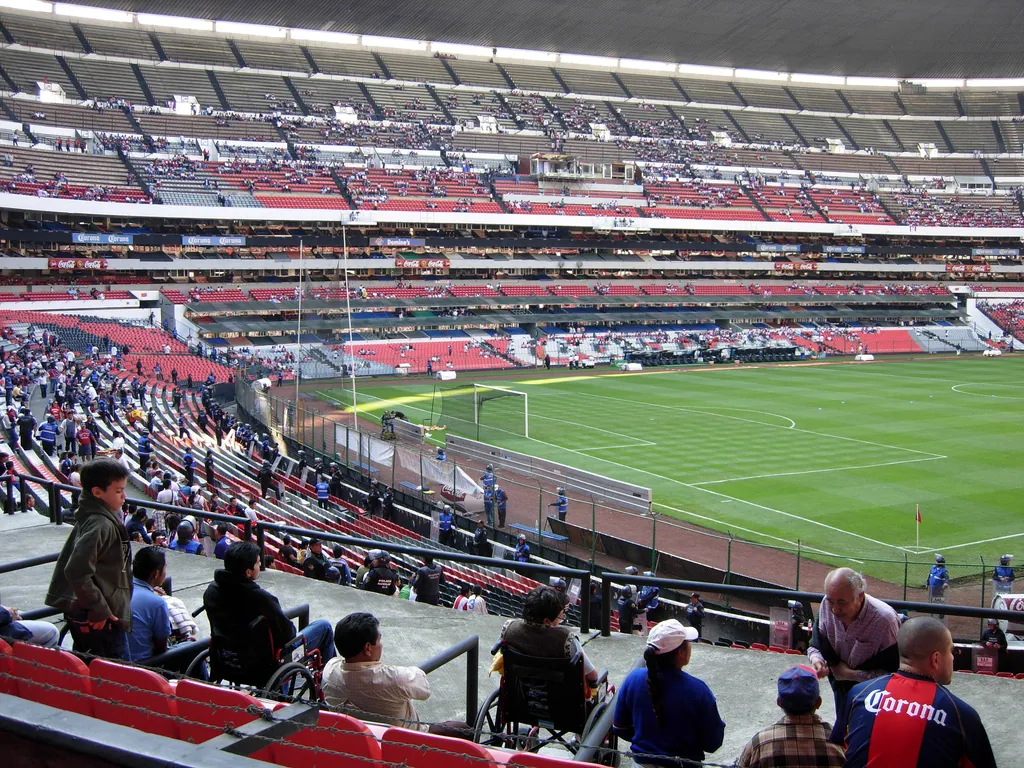
The seating capacity of Azteca Stadium has changed significantly through several major renovations tied to global events. When it opened in 1966, the stadium could hold 107,494 spectators. For the 1970 FIFA World Cup, its capacity was listed as 107,247, and it was expanded to 114,600 for the 1986 World Cup. In preparation for the 2026 FIFA World Cup, a major renovation began in May 2024, which increased the capacity to its current figure of approximately 87,500. This renovation included installing new high-resolution LED video screens, laying a hybrid turf pitch, and refurbishing the stadium facade and roof. The record attendance for a football match at the stadium is 119,853, set during a Mexico vs Brazil match on July 7, 1968. The all-time record attendance for any event is 132,247, set for a boxing match between Julio César Chávez and Greg Haugen on February 20, 1993. The stadium's capacity for its three World Cup hosting duties varied as follows.
- 1970 FIFA World Cup: 107,247 spectators.
- 1986 FIFA World Cup: 114,600 spectators.
- 2026 FIFA World Cup: 80,824 spectators (tournament configuration).
American Football at Azteca Stadium
The stadium hosted its first NFL regular-season game on October 2, 2005, as part of the league's international expansion, featuring the Arizona Cardinals and San Francisco 49ers before a crowd of 103,467. Since the 2016 season, the NFL has held an annual International Series game at the venue, branded as the NFL Mexico Game. The stadium is an outdoor facility with a natural grass surface, and its high altitude of 2,241 meters presents a unique challenge for players, who have been seen using oxygen masks on the sidelines. The 2016 game was also the first Monday Night Football game played outside the United States.
| Date | Away Team | Result | Home Team | Attendance |
|---|---|---|---|---|
| Oct 2, 2005 | San Francisco 49ers | 14-31 | Arizona Cardinals | 103,467 |
| Nov 21, 2016 | Houston Texans | 20-27 | Oakland Raiders | 76,473 |
| Nov 19, 2017 | New England Patriots | 33-8 | Oakland Raiders | 77,357 |
| Nov 18, 2019 | Kansas City Chiefs | 24-17 | Los Angeles Chargers | 76,252 |
| Nov 21, 2022 | San Francisco 49ers | 38-10 | Arizona Cardinals | 78,427 |
| Nov 22, 2026 | Minnesota Vikings | 10-35 | San Francisco 49ers | 85,612 |
The highest combined score in an NFL game at Azteca was 48 points, achieved in the 49ers' 38-10 victory over the Cardinals in 2022. The 2026 game saw a dominant 49ers performance in front of a crowd heavily favoring San Francisco, with players and coaches noting the intense fan energy. The NFL has an agreement to play games at the stadium through 2028, with plans to seek an extension. A game scheduled for 2018 between the Kansas City Chiefs and Los Angeles Rams was canceled due to poor field conditions and relocated to Los Angeles, where the Rams won 54-51.
Naming Rights and Stadium Names
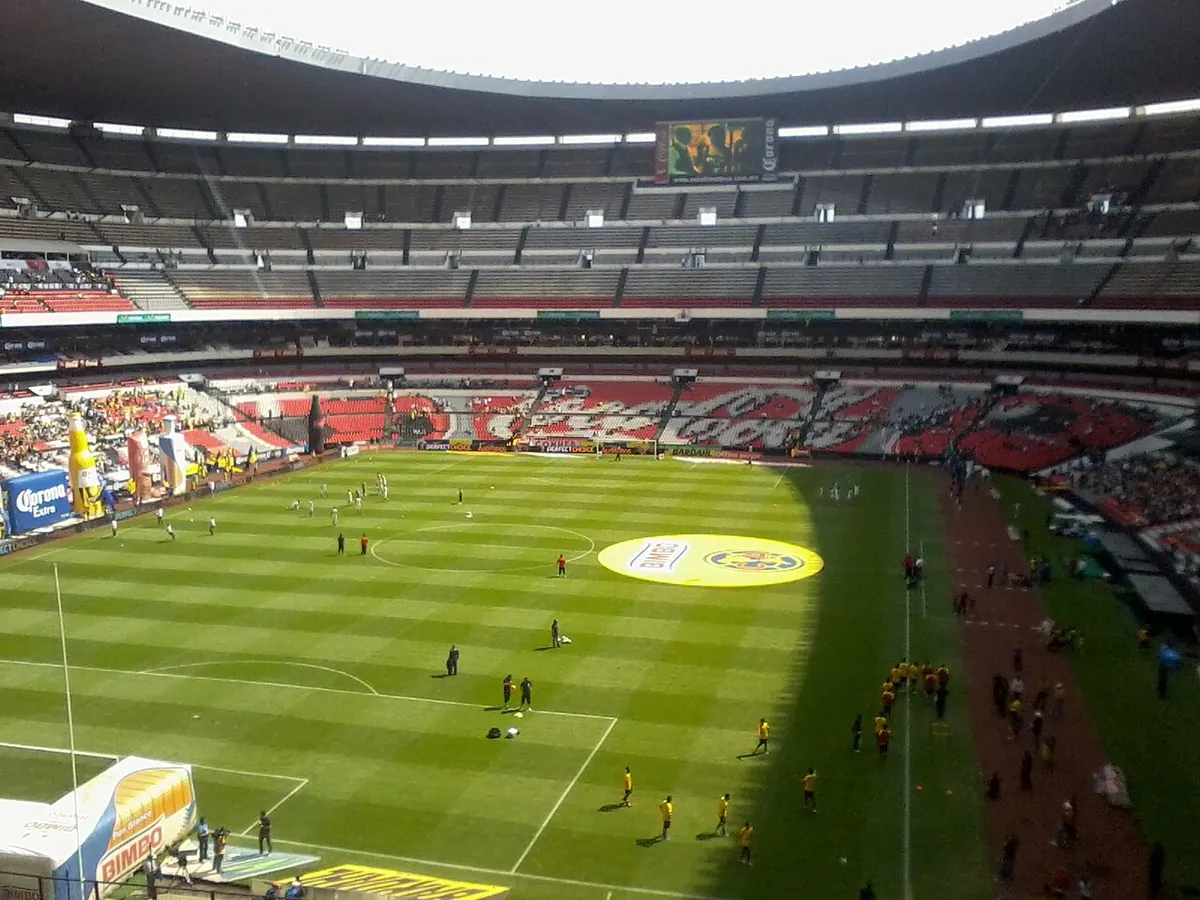
The stadium's original and most enduring name is Estadio Azteca, chosen as a tribute to the Aztec heritage of Mexico City. From January 1997 to 1998, the owner Televisa officially renamed it Estadio Guillermo Cañedo in honor of a deceased network executive and former Mexican Football Federation president, but the change proved unpopular and the Azteca name was restored. On March 14, 2025, the Mexican bank Banorte purchased the naming rights to help fund World Cup renovations, leading to the official name Estadio Banorte. This sponsorship name also met with significant negative public reception. For the 2026 FIFA World Cup, in accordance with FIFA's policy on corporate names, the venue was referred to as Mexico City Stadium (Estadio Ciudad de México). The stadium is also colloquially known as the Coloso de Santa Úrsula due to its massive structure and location. The naming rights deal was part of the financing for the extensive renovations completed ahead of the 2026 tournament.
FIFA World Cup History and Notable Matches
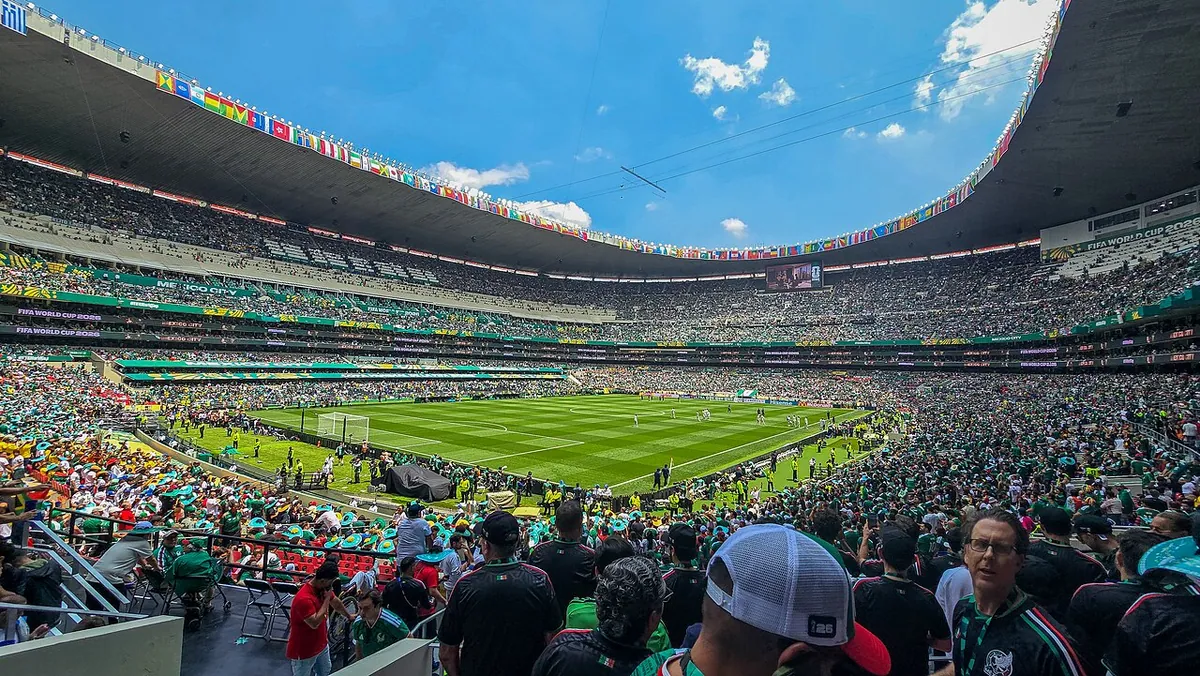
Azteca Stadium holds the unique distinction of being the only stadium to host three FIFA World Cup tournaments: 1970, 1986, and 2026. It is also the only stadium to have hosted two World Cup finals, with Brazil defeating Italy 4-1 in 1970 and Argentina beating West Germany 3-2 in 1986. The stadium hosted ten matches in 1970 and nine in 1986. For the 2026 World Cup, which Mexico co-hosted with the United States and Canada, Azteca was selected to host the opening match and a total of five games. The opening match on June 11, 2026, saw Mexico defeat South Africa 2-0, with the first goal scored by Mexico's Julián Quiñones in the ninth minute. The stadium also hosted Mexico's subsequent group stage match against the Czech Republic, a Round of 32 victory over Ecuador, and a Round of 16 loss to England during that tournament. The stadium has been the site of several noted football matches beyond the finals.
- The 1970 semi-final, known as the "Game of the Century," where Italy defeated West Germany 4-3 in extra time.
- The 1986 quarter-final between Argentina and England, where Diego Maradona scored both the "Hand of God" goal and the "Goal of the Century."
- The 1968 football final of the Summer Olympics.
- The final of the 1971 FIFA Women's World Cup.
- The 1978 and 1990 Copa Interamericana finals involving Club América.
Other Notable Events and Tenants
Beyond American football and World Cups, Azteca Stadium has been a venue for a wide array of major events. It is the official home stadium for Club América of Liga MX and the Mexico national football team. The stadium has also hosted other significant football tournaments including the 1975 Pan American Games, the 1977 and 1993 CONCACAF Championships, the 1999 FIFA Confederations Cup, and the 2011 FIFA U-17 World Cup. It has a notable history as a concert venue, hosting performances by major international artists. The stadium has also been used for political rallies, such as Mexican president Felipe Calderón's campaign closure in 2006, and religious events, including a visit by Pope John Paul II in 1999 and Jehovah's Witnesses conventions. From 2018, Cruz Azul also played home matches at the stadium temporarily while their own ground was being demolished. Major concerts held at the stadium include.
- Michael Jackson's Dangerous World Tour in 1993 (5 sold-out shows, 550,000 total attendance).
- U2 concerts in 2006 and 2011.
- Paul McCartney concerts in 2012 and 2017.
- Performances by Menudo in 1983, Luis Miguel, Maná, Juan Gabriel, and Gloria Estefan.
- Bronco's farewell concert in 1997.
Transportation, Access, and Facilities
Azteca Stadium is accessible via public transportation, primarily through the Estadio Azteca station on the Mexico City Light Rail line. This light rail line connects to the broader Mexico City Metro system at the Tasqueña station. A nearby transportation hub, CETRAM Huipulco, offers connections to local city bus routes. A bikeway named Ciclovía La Gran Tenochtitlán also services the area. Ticket offices are located at the front of the stadium near the exit ramps from the Azteca station. Ticket prices have historically ranged from around 100 Mexican pesos for lower-profile events to 500 pesos for major matches, equivalent to about $5 to $26 USD in 2016. The stadium features 856 executive suites and is equipped with Panasonic scoreboards and LED advertising boards installed during renovations.
Renovations for the 2026 World Cup
A major renovation project specifically for the 2026 FIFA World Cup began with the stadium's closure in May 2024. The work, which faced delays due to financing and access issues, aimed to modernize the historic venue. Key improvements included increasing the seating capacity from approximately 83,000 to 87,500, installing new high-resolution LED video screens throughout the stadium, and replacing all seating. The project also involved laying a new hybrid turf pitch, renovating the stadium's roof to address leaks, installing new LED lighting, and constructing new locker rooms and a player tunnel. The renovated stadium reopened on March 28, 2026, with a friendly football match between Mexico and Portugal that ended in a scoreless draw. The renovation allowed the stadium to host its third World Cup opener and five total matches during the 2026 tournament. The project was not without controversy, as FIFA was accused in March 2025 of not allowing labor union inspections of safety regulations during the work. After reopening, the stadium was monitored by NASA due to concerns about its structural stability.
Memorials and Cultural Significance
The stadium grounds feature several commemorative monuments that highlight its past in global football. A bronze plaque commemorates the 1970 "Game of the Century" semi-final between Italy and West Germany. Another plaque memorializes Diego Maradona's "Goal of the Century" scored against England in the 1986 World Cup quarter-final. A third plaque records the names of the first goal scorers in the stadium's inaugural match and its first night game. The stadium is often referred to as the "Temple of Football" or the "Cathedral of Football" due to its significance in the sport. It is the stadium where Pelé's Brazil in 1970 and Diego Maradona's Argentina in 1986 lifted the FIFA World Cup trophy for the last time in their careers. The opening ceremony for the 2026 World Cup at the stadium featured performances by artists including Maná, Danny Ocean, Los Ángeles Azules, Belinda, J Balvin, Ryan Castro, Shakira, and Burna Boy.
Recent games
| Date | Game | Week |
|---|---|---|
| Nov 22, 2026 | Minnesota Vikings 10 at San Francisco 49ers 35 | Week 11 |
| Nov 21, 2022 | San Francisco 49ers 38 at Arizona Cardinals 10 | Week 11 |
| Nov 18, 2019 | Kansas City Chiefs 24 at Los Angeles Chargers 17 | Week 11 |
| Nov 19, 2017 | New England Patriots 33 at Oakland Raiders 8 | Week 11 |
| Nov 21, 2016 | Houston Texans 20 at Oakland Raiders 27 | Week 11 |
| Oct 2, 2005 | San Francisco 49ers 14 at Arizona Cardinals 31 | Week 4 |
Video
FAQ
What is the capacity of Azteca Stadium?
Azteca Stadium currently holds 87,523 spectators following its most recent renovation. This makes it the largest stadium in Latin America and ranks it as the eighth-largest football-specific stadium globally. Its capacity has changed over time, reaching a peak of 114,600 for the 1986 FIFA World Cup. The record for the highest attendance at any event there is 132,247 people, set during a boxing match in 1993. For the 2026 World Cup, the configured capacity was 80,824 spectators.
How many NFL games have been played at Azteca Stadium?
Six NFL regular-season games have been played at the stadium from 2005 through late November 2026. The first regular-season contest was in 2005 between the Arizona Cardinals and San Francisco 49ers. The most recent was in 2026, where the San Francisco 49ers defeated the Minnesota Vikings 35-10 before a crowd of 85,612. The venue also hosted several preseason American Bowl games before 1999, including a 1994 game that holds the NFL's all-time attendance record of 112,376.
Why is Azteca Stadium famous?
Azteca Stadium is renowned for being the only stadium to have hosted the FIFA World Cup on three occasions, in 1970, 1986, and 2026. It is also unique for having staged two World Cup finals. The stadium is the largest in Latin America and serves as the home for Club América and the Mexico national team. For American football fans, it is known as a challenging, high-altitude venue for NFL International Series games. It also hosted the football tournament for the 1968 Summer Olympics.
What is the stadium called now?
The stadium's official sponsored name is Estadio Banorte, following a naming rights deal with the bank Banorte in March 2025. Its traditional and most recognized name remains Estadio Azteca. During the 2026 FIFA World Cup, tournament organizers used the name Mexico City Stadium (Estadio Ciudad de México) to comply with rules against corporate branding. A previous short-lived name change to Estadio Guillermo Cañedo in 1997 was reversed due to public disapproval. The nickname Coloso de Santa Úrsula is also commonly used.
What is the elevation of Azteca Stadium and how does it affect NFL games?
The stadium is located 2,241 meters, or 7,352 feet, above sea level. This significant altitude reduces oxygen availability, which can lead to player fatigue and shortness of breath more quickly than at sea-level venues. NFL players have been observed using supplemental oxygen on the sidelines during games there. The thin air can also affect the flight of the football, adding an extra layer of difficulty for teams not accustomed to the conditions. The elevation is a defining characteristic of playing American football at this venue.
Has Azteca Stadium been renovated recently?
Yes, a major renovation project took place from May 2024 to early 2026 in preparation for the 2026 FIFA World Cup. The work increased seating capacity to approximately 87,500, installed new LED video screens and lighting, and replaced the playing surface with a hybrid turf. The stadium facade and roof were also refurbished, and new locker rooms were built. It reopened in March 2026 and successfully hosted the World Cup opener that June, along with four other tournament matches. The renovation was funded in part by the Banorte naming rights deal.
Sources
- Estadio Azteca (Wikipedia) Wikipedia
- Mexican fans turn the NFL's return to Estadio Azteca into a roaring fiesta Yahoo Sports
- nflverse game, roster and draft data nflverse (CC BY 4.0)