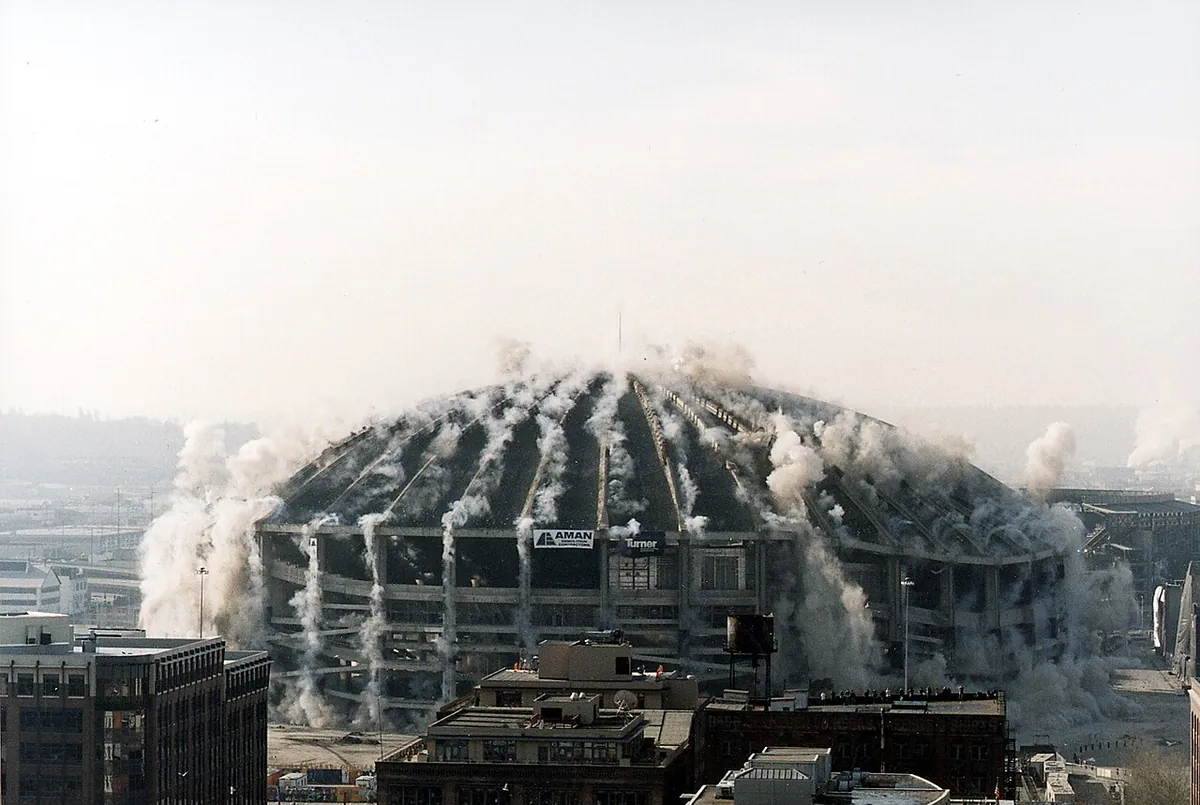
The Seattle Kingdome, officially the King County Stadium, was a multi-purpose domed stadium in Seattle, Washington. It opened in 1976 and served as the home of the NFL's Seattle Seahawks from their inaugural 1976 season through the 1999 season. The stadium also hosted the Seattle Mariners of MLB and the Seattle SuperSonics of the NBA. Known for its massive concrete roof and raucous football crowds, the Kingdome was demolished by implosion on March 26, 2000, to make way for the Seahawks' new stadium, Lumen Field.
Concept and Early Proposals
The idea for a covered stadium in Seattle originated in 1959 with a letter from restaurateur David L. Cohn to the city council. The frequent rain in the region made a dome seem essential for hosting major league sports. The first bond issue for $15 million was placed before King County voters on November 8, 1960, but it was defeated with only 48 percent approval. A second measure in September 1966 received 51.5 percent support but failed to reach the required 60 percent supermajority mandated by a 1932 initiative. The push gained urgency in 1967 when the American League awarded Seattle the expansion Pilots, contingent on a new domed stadium being completed by 1970. On February 13, 1968, voters finally approved a $40 million bond issue with 62 percent in favor as part of the Forward Thrust group of propositions.
Site Selection and Community Opposition
After the bond approval, a committee considered over 100 potential sites throughout King County for the new stadium. They initially selected the grounds of Seattle Center, site of the 1962 World's Fair, but community opposition forced a reconsideration. From 1970 to 1972, officials studied the feasibility of a site on King Street adjacent to Pioneer Square and the International District. This location drew sharp opposition from the International District community, which feared impacts on housing, parking, pollution, and property values. Activists, including Bob Santos and many Manongs, protested the groundbreaking ceremony on November 2, 1972, disrupting speakers and throwing mud balls. The protests continued as a means to pressure the county into funding community services, eventually resulting in the creation of a neighborhood health clinic and other offsetting measures.
Construction Challenges and Delays
The Donald M. Drake Company of Portland, Oregon, won the initial construction contract with bids of $28.9 million for the stadium and $5.9 million for the roof. To alleviate community tension, Drake emphasized hiring minority workers, who eventually represented 13 percent of the construction workforce. Construction was plagued by significant problems from the start. In January 1973, six support beams for the roof toppled in a domino effect after one or two of them buckled. By July 1974, the project was only 60 percent complete, and it was clear Drake would not meet the deadline. The company was ill-prepared for the project's scale, with numerous errors, delays, and short-staffing slowing progress. The county fired Drake on December 10, 1974, and brought in Peter Kiewit Sons Construction Company to finish the job. The stadium finally opened on March 27, 1976, at a final cost of $67 million, $20 million over budget.
Football Tenants and Notable Games
The expansion Seattle Seahawks began play in 1976 as the Kingdome's primary football tenant. Their first preseason game was on August 1, 1976, a 27-20 loss to the San Francisco 49ers before 60,825 fans. The first regular season game was a 30-24 loss to the St. Louis Cardinals on September 12, 1976, with 58,441 in attendance. The stadium hosted the Pro Bowl on January 17, 1977. The Seahawks developed a formidable home-field advantage, selling out 117 consecutive regular-season home games between 1979 and 1993. The Kingdome hosted 12 Monday Night Football games, with the Seahawks compiling a 9-3 record. A famous Monday Night moment occurred in 1987 when the Los Angeles Raiders' Bo Jackson rushed for 221 yards, the most ever on MNF, including a 91-yard touchdown. In the 1999 season, the stadium hosted 9 NFL games. The highest-scoring of those games was the Seattle Seahawks 37, Cincinnati Bengals 20 contest on November 7, 1999, totaling 57 points. The Seahawks' final game at the Kingdome was a first-round playoff loss to the Miami Dolphins on January 9, 2000.
- First Preseason Game: August 1, 1976 vs. San Francisco 49ers.
- First Regular Season Game: September 12, 1976 vs. St. Louis Cardinals.
- Final Game: January 9, 2000 vs. Miami Dolphins (playoffs).
- Monday Night Football Record: 9 wins, 3 losses.
- Consecutive Sellouts: 117 games from 1979 to 1993.
Stadium Design, Capacity, and Construction Materials
The Kingdome was an engineering marvel with the world's largest thin-shell concrete roof, spanning 7.85 acres. The interior was 660 feet wide and 250 feet high, wider than the Space Needle is tall. The construction of the facility required 52,800 cubic yards of concrete and 443 tons of structural steel. For football, the seating capacity was 66,400. The stadium also had configurations for baseball at 59,166 seats and basketball at 40,192 seats. It featured 46 executive suites, a Diamond Vision scoreboard, and public transit access via King Street Station. The roof was 250 feet at its highest point above the AstroTurf playing surface. The underlying base of the field was asphalt, with the AstroTurf consisting of a carpet on top of a pad. A new roof and ceiling were completed in 1994.
| Aspect | Detail |
|---|---|
| Roof Area | 7.85 acres |
| Interior Width | 660 feet |
| Interior Height | 250 feet |
| Concrete Used | 52,800 cubic yards |
| Structural Steel | 443 tons |
| Football Capacity | 66,400 |
| Baseball Capacity | 59,166 |
| Basketball Capacity | 40,192 |
| Executive Suites | 46 |
Playing Surface and Player Safety
The Kingdome featured AstroTurf artificial turf, a necessity under its roof which inhibited natural grass growth. The surface was first replaced in July 1983 during the MLB All-Star break at a cost of $1.2 million. It was replaced again in October and December 1990 for $2.56 million, after which the Seahawks and Mariners used separate surfaces attached by zippers. The AstroTurf was laid over an asphalt base and was notorious for its hardness, lumps, holes, and ridges. Players from both football and baseball despised the surface. A survey by the NFL Players Association after the 1998 season found that 56.7 percent of Seahawks players rated the surface as poor or fair. This was the worst rating given to any stadium surface in the AFC West. The surface is partly blamed for significant injuries, including season-ending knee injuries to Seahawks running backs Sherman Smith in 1980 and Curt Warner in 1984.
Fan Culture and League Impact
The Kingdome earned a noted reputation as one of the loudest stadiums in the NFL. Opposing teams practiced with jet engine sounds blaring to prepare for the high decibel levels. Seahawks fans, long called the 12th Man, led the team to retire the number 12 in their honor in 1984. The crowd noise was so disruptive that it contributed to the NFL voting in 1989 to enact a rule penalizing home teams for excessive noise. Fan displeasure with this rule during preseason games led Commissioner Pete Rozelle to soften its enforcement before the regular season began. Fans at the Kingdome were also among the earliest performers of The Wave.
Decline and Push for New Stadiums
After Ken Behring took over ownership of the Seahawks in 1988, the team's performance declined, hitting a franchise-worst 2-14 record in 1992. Season ticket sales, which had peaked at 62,000 with a 30,000-person waiting list, gradually decreased to 46,000 by 1995. The team began failing to sell out games, resulting in local television blackouts starting in 1993. KING-TV, the local NBC affiliate, purchased unsold tickets to prevent blackouts for several games in 1993 and 1994. Both the Seahawks and Mariners began questioning the Kingdome's suitability in the early 1990s, citing shared tenancy as unprofitable. The falling ceiling tiles in July 1994 intensified safety concerns. The city made multiple bids to host the Super Bowl but was never successful, with its closest chance being for Super Bowl XXVI in 1989.
Closure, Demolition, and Financial Legacy
Public funding packages for new stadiums were approved for the Mariners in 1995 and for the Seahawks in 1997. The Mariners moved to Safeco Field midway through the 1999 MLB season. The Seahawks played their final season at the Kingdome in 1999, then temporarily relocated to the University of Washington's Husky Stadium for the 2000 and 2001 NFL seasons. The Kingdome was imploded on March 26, 2000. The Seahawks' new stadium, now known as Lumen Field, opened in 2002 on the site. The original construction cost was $67 million, with an additional $47 million spent on capital improvements. The remaining debt on the stadium was $57 million at the time of demolition.
Other Events and Overall Legacy
Beyond football, the Kingdome hosted a vast array of events over its 23-year history. It was home to the Seattle Mariners from 1977 to 1999, the Seattle SuperSonics from 1978 to 1985, and the NASL's Seattle Sounders. The venue hosted the 1979 MLB All-Star Game, the 1987 NBA All-Star Game, and the NCAA Men's Basketball Final Four in 1984, 1989, and 1995. Its first professional sporting event was an NASL soccer match between the Seattle Sounders and New York Cosmos on April 9, 1976, drawing 58,120 fans. More than 72 million people attended over 3,250 major events at the venue, including concerts, rodeos, and trade shows. The largest attendance recorded was 74,000 for a Billy Graham Crusade on May 14, 1976. The stadium's legacy is defined by its role as Seattle's first modern major league venue and the incredibly loud environment it created for Seahawks football.
Recent games
| Date | Game | Week |
|---|---|---|
| Jan 9, 2000 | Miami Dolphins 20 at Seattle Seahawks 17 | Wild Card |
| Dec 26, 1999 | Kansas City Chiefs 14 at Seattle Seahawks 23 | Week 16 |
| Dec 12, 1999 | San Diego Chargers 19 at Seattle Seahawks 16 | Week 14 |
| Nov 28, 1999 | Tampa Bay Buccaneers 16 at Seattle Seahawks 3 | Week 12 |
| Nov 14, 1999 | Denver Broncos 17 at Seattle Seahawks 20 | Week 10 |
| Nov 7, 1999 | Cincinnati Bengals 20 at Seattle Seahawks 37 | Week 9 |
| Oct 24, 1999 | Buffalo Bills 16 at Seattle Seahawks 26 | Week 7 |
| Oct 3, 1999 | Oakland Raiders 21 at Seattle Seahawks 22 | Week 4 |
| Sep 12, 1999 | Detroit Lions 28 at Seattle Seahawks 20 | Week 1 |
Video
FAQ
What was the Seattle Kingdome?
The Seattle Kingdome was a multi-purpose domed stadium located at 201 South King Street in Seattle, Washington. It opened on March 27, 1976, and served as the home venue for the Seattle Seahawks of the NFL from 1976 through the 1999 season. The stadium also hosted the Seattle Mariners of Major League Baseball and the Seattle SuperSonics of the NBA. It was demolished by implosion on March 26, 2000, to make way for Lumen Field.
What was the football capacity of the Kingdome?
The Kingdome had a football seating capacity of 66,400 spectators. The stadium's configuration allowed for different capacities depending on the sport, with 59,166 seats for baseball and 40,192 for basketball. The venue featured 46 executive suites and a large Diamond Vision scoreboard. The largest event attendance ever recorded was 74,000 for a religious crusade in 1976.
Why was the Kingdome demolished?
The Kingdome was demolished because its primary tenants, the Seahawks and Mariners, successfully lobbied for new, modern stadiums. Safety concerns arose after ceiling tiles fell into the seating area in 1994. Voters approved public funding for new stadiums in the mid-1990s. After the Mariners moved out during the 1999 season and the Seahawks left after the 1999 NFL season, the stadium was imploded on March 26, 2000, to clear the site for new construction.
What did players think of the Kingdome's playing surface?
Players widely disliked the Kingdome's AstroTurf playing surface. A survey conducted by the NFL Players Association after the 1998 season revealed that 56.7 percent of Seahawks players rated the surface as poor or fair. This rating was the worst among stadiums in the AFC West. The artificial turf was laid over an asphalt base and was known for being hard and uneven, contributing to a higher rate of injuries.
Where did the Seahawks play after the Kingdome?
The Seattle Seahawks played their final game at the Kingdome on January 9, 2000, a playoff loss to the Miami Dolphins. For the next two NFL seasons, the team temporarily relocated to the University of Washington's Husky Stadium. They played there for the 2000 and 2001 seasons while their new stadium was built on the former Kingdome site. That new stadium, now called Lumen Field, opened in September 2002.
What was the official name of the Seattle Kingdome?
The official name of the Seattle Kingdome was King County Stadium. It was a multi-purpose stadium owned and operated by King County. The stadium was located in the Industrial District, later SoDo, neighborhood of Seattle, Washington. It served as the home for the Seattle Seahawks, Seattle Mariners, and for a time, the Seattle SuperSonics.
Sources
- Kingdome (Wikipedia) Wikipedia
- The Kingdome, Former Seattle Seahawks Stadium seahawks.com
- Kingdome, history, photos and more of the Seattle Mariners former ballparkKINGDOME ballparksofbaseball.com
- Kingdome, History, Photos & More of the former NFL stadium of the Seattle Mariners Stadiums of Pro Football
- nflverse game, roster and draft data nflverse (CC BY 4.0)