Tampa Stadium, also known as The Big Sombrero and later as Houlihan's Stadium, was a large open-air football stadium located in Tampa, Florida. It opened in 1967 with an initial capacity of 46,481 and was significantly expanded in 1974 to 1975 to accommodate the new Tampa Bay Buccaneers NFL franchise. The stadium served as the Buccaneers' home from their inaugural 1976 season until 1997 and hosted Super Bowls in 1984 and 1991. It was also the venue for the University of Tampa and University of South Florida football programs and the 1984 USFL Championship Game. The stadium was closed in 1998 and demolished in 1999.
Construction, Design, and Expansion
Construction of Tampa Stadium began on October 9, 1966, on land that was part of the former Drew Field airfield. The stadium was built adjacent to Al Lopez Field as part of a larger community sports complex envisioned by the city of Tampa. It was designed by Watson & Company Architects, Engineers & Planners and built by Jones-Mahoney Construction Co. The facility opened on November 4, 1967, at a cost of $4.4 million. The original design featured two large arch-shaped concrete grandstands with open end zones, backless aluminum bench seating, and a steep slope for unobstructed sightlines. The playing surface was natural Bermuda grass, specifically Tifway 419, which was consistently rated among the best in the NFL. In 1974, after Tampa was awarded an NFL expansion team, a major expansion project began to enclose the open end zones with permanent seating. The expansion gave the stadium its distinctive undulating roofline, which ESPN's Chris Berman nicknamed "The Big Sombrero. Further renovations in the early 1980s added luxury suites and an expanded press box in preparation for Super Bowl XVIII.
NFL Tenancy and the Tampa Bay Buccaneers
Tampa Stadium's primary purpose was to host professional football, culminating in the arrival of the Tampa Bay Buccaneers in 1976. The path to an NFL team began with exhibition games, including an August 10, 1968, preseason contest between the Washington Redskins and Atlanta Falcons that drew 42,000 fans. After several successful preseason events, the NFL awarded Tampa an expansion franchise on April 24, 1974. The Buccaneers played their first regular season home game at the expanded stadium on September 19, 1976, a 23-0 loss to the San Diego Chargers. The Buccaneers' peak at the stadium came during the 1979 season when they hosted the NFC Championship Game, losing 9-0 to the Los Angeles Rams. The franchise hosted only one other playoff game at the venue, a win over the Detroit Lions on December 28, 1997, which proved to be their final game there. The Buccaneers' Krewe of Honor, initiated in 1991, featured inductees Lee Roy Selmon, John McKay, Ricky Bell, Doug Williams, and owner Hugh Culverhouse, with their mural displayed at the stadium.
The Buccaneers' tenure at the stadium included several key milestones and notable figures. The team's first game at Tampa Stadium was on August 21, 1975. Head coach John McKay led the team from 1976 through 1984. Owner Hugh Culverhouse owned the franchise from 1976 until his death in 1994. Defensive end Lee Roy Selmon, the team's first-ever draft pick, played his entire career from 1976 to 1984 at the stadium. Quarterback Doug Williams played for the Buccaneers at the stadium from 1978 to 1982. Running back Ricky Bell played his Buccaneers career from 1977 to 1981 at Tampa Stadium.
College Football and Other Major Football Events
Beyond the NFL, Tampa Stadium served as a major venue for college football and other significant football events. The University of Tampa Spartans were the stadium's first tenant, playing from its opening in 1967 until the program was discontinued after the 1974 season. The University of South Florida Bulls played their initial season at the stadium in 1997. The stadium hosted the NFL Pro Bowl on January 29, 1978. It was the annual site for the Florida Classic rivalry game between Bethune-Cookman and Florida A&M from 1978 to 1996. The Outback Bowl was played at Tampa Stadium from 1986 through 1998. The venue also hosted two professional football championship games in 1984: Super Bowl XVIII in January and the USFL Championship Game in July. Other notable football events included the Can-Am Bowl in 1978 and 1979 and several regular-season games for the University of Florida Gators between 1968 and 1989.
The stadium hosted a wide variety of football games beyond its primary tenants. The first game ever was on November 4, 1967: Tennessee defeated the University of Tampa 38-0. The University of Florida played nine regular season games there between 1968 and 1989. The Can-Am Bowl, a college all-star game using Canadian rules, was held in 1978 and 1979. The 2nd USFL Championship Game was played on July 15, 1984, between Philadelphia and Arizona. The final football game at the stadium was a USF Bulls victory on September 12, 1998. A 1964 AFL exhibition game at the smaller Phillips Field demonstrated the need for a larger stadium, which motivated civic leaders to pursue the construction of Tampa Stadium.
Capacity and Stadium Features Over Time
Tampa Stadium's capacity evolved significantly from its opening through its final configuration. The original 1967 seating capacity was 46,481. Following the major expansion completed in 1975, the capacity for the 1976 season was 71,951. Through subsequent minor adjustments, the capacity increased over the years, reaching its final official figure of 74,301 from 1993 until the stadium's closure. The open-air, concrete bowl design lacked any roof or significant overhang, which exposed fans and players to Tampa's intense sun and heat. The steeply pitched grandstands provided excellent sightlines from every seat. The playing field was highly crowned for drainage, with the sidelines nearly 18 inches lower than the center. For the 1990 season, which culminated in Super Bowl XXV, the stadium was updated with a JumboTron screen in the south end zone, smaller scoreboards above field-level tunnels, and large flagpoles on the upper rim that flew team flags.
| Years | Official Capacity |
|---|---|
| 1967 to 1975 | 46,481 |
| 1976 to 1978 | 71,951 |
| 1979 to 1981 | 72,126 |
| 1982 to 1984 | 72,812 |
| 1985 to 1988 | 74,315 |
| 1989 to 1992 | 74,296 |
| 1993 to 1998 | 74,301 |
The stadium's nickname, The Big Sombrero, originated from ESPN commentator Chris Berman due to its unique wave-shaped roofline. In 1996, naming rights were sold to the Houlihan's restaurant chain, and the facility was officially renamed Houlihan's Stadium until its demolition. The stadium's concrete construction and aluminum benches could become extremely hot, influencing game schedules to avoid afternoon heat and leading the Buccaneers to often wear white jerseys at home to force opponents into darker, hotter uniforms. The Buccaneers adopted a practice of flying large red flags on the stadium's flagpoles when the team entered the opponent's 20-yard line, a tradition that continued at Raymond James Stadium.
Other Professional Tenants and Notable Non-Football Events
Tampa Stadium was a multi-purpose venue that hosted several other professional sports teams and major non-sporting events. The Tampa Bay Rowdies of the North American Soccer League played at the stadium from their inaugural 1975 season through 1984. The Rowdies continued to use the stadium in other leagues through 1990, moved to another venue for 1991 and 1992, and returned for a final season in 1993. The Tampa Bay Bandits of the United States Football League called the stadium home from 1983 through 1985. The Tampa Bay Mutiny of Major League Soccer also used the facility. The stadium was a major concert venue, hosting acts like The Rolling Stones, U2, Paul McCartney, and The Grateful Dead. In March 1979, evangelist Billy Graham held a five-day crusade at the stadium that drew a combined crowd of approximately 175,000. The venue also regularly hosted the American Invitational show jumping competition and the USHRA Monster Jam truck rally after each football season.
The stadium's concert history includes several landmark events. Led Zeppelin returned on June 3, 1977, but the concert was cut short by a thunderstorm, leading to crowd unrest and police intervention with tear gas. Other major artists who performed there include The Who, Pink Floyd, The Eagles, and Whitney Houston. The 1988 Monsters of Rock Tour featured several major hard rock and heavy metal acts. The concert pause after the 1977 incident led to a year-long hiatus for concerts at the stadium until security protocols were revised. These events cemented Tampa Stadium's reputation as a premier large-scale entertainment venue in the Southeastern United States beyond its sporting legacy.
Closure, Demolition, and Legacy
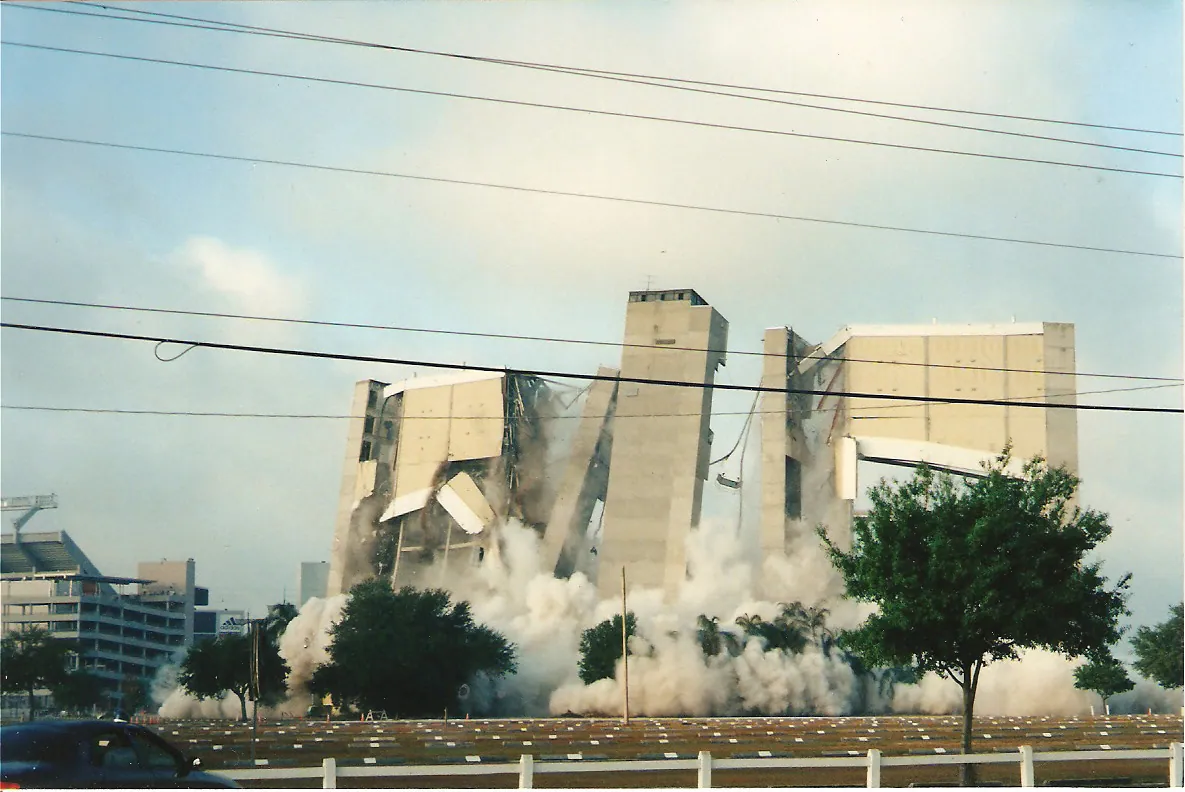
Pressure for a new stadium began soon after Malcolm Glazer purchased the Buccaneers in 1995. Glazer declared Tampa Stadium was inadequate and threatened to move the team unless a new stadium was built. The Tampa Sports Authority responded by constructing Raymond James Stadium adjacent to the old venue. The Buccaneers played their last game at Tampa Stadium on September 13, 1998. The University of South Florida played the final football game there on September 12, 1998. The stadium was demolished on April 11, 1999, and the site was converted into a parking lot for Raymond James Stadium. It successfully brought the NFL to the region and hosted two Super Bowls, cementing Tampa's status as a major football city. Its unique design and challenging game-day environment for visiting teams made it a memorable venue. The stadium also hosted landmark concerts, most notably a Led Zeppelin show on May 5, 1973, that drew 56,800 fans and set a world record for the largest audience for a single artist at the time.
The stadium's influence extended directly to its replacement. Key features and events transitioned to Raymond James Stadium. The Outback Bowl moved to the new stadium for the 1999 edition. The Buccaneers' tradition of flying large flags when the team entered the red zone continued at the new venue. The Monster Jam event continues to be held at Raymond James Stadium. The American Invitational equestrian competition also moved to the new stadium. The site of the old stadium now serves as parking for the new complex. Tampa Stadium's role was foundational, proving the market could support major league sports and large-scale events, which directly led to the development of the more modern facilities that followed.
Financing and the Push for a New Stadium
The financial story of Tampa Stadium involves initial public investment and eventual private pressure for replacement. The original stadium was built for $4.4 million by the city of Tampa using land purchased from the federal government in 1949. The 1974 to 1975 expansion was funded through the Tampa Sports Authority's sale of bonds, with the renovation costing $13 million. This investment was made alongside the Buccaneers' 30-year lease, which was approved by the Tampa City Council in April 1975. For nearly two decades, this arrangement was sufficient. The dynamic changed radically with the 1995 sale of the Buccaneers to Malcolm Glazer. Glazer immediately deemed the stadium inadequate for generating modern NFL revenues. To meet his revenue demands, a new stadium was deemed necessary. Glazer's acquisition of naming rights and the subsequent sale to Houlihan's in 1995 was a short-term revenue move that also resulted in a lawsuit from the restaurant chain's stockholders. The ultimate solution was the construction of Raymond James Stadium, which broke ground in 1996. The final cost for Tampa Stadium's renovations totaled $13 million, equivalent to $42 million in 2025 dollars. The push for a new stadium highlighted the evolving economics of professional sports in the late 20th century, where older, publicly-built venues were often replaced by newer facilities with greater revenue-generating capabilities for team owners.
FAQ
What was the capacity of Tampa Stadium?
Tampa Stadium's capacity changed over its lifetime. When it opened in 1967, the official capacity was 46,481. After a major expansion in 1974 to 1975 to accommodate the new Tampa Bay Buccaneers, the capacity increased to 71,951 for the 1976 season. Through further minor adjustments, the stadium reached its final official capacity of 74,301 seats from 1993 until it closed in 1998. At its peak, it was one of the largest stadiums in the NFL.
Why was Tampa Stadium called The Big Sombrero?
The stadium earned the nickname The Big Sombrero from ESPN commentator Chris Berman. The nickname referred to the unique, undulating shape of the stadium's roofline created by the 1975 expansion. The design featured the highest points at the center of the two sideline grandstands, which gently sloped down to meet the lower end zone sections, resembling the brim of a large sombrero hat. The nickname became widely used by fans and media.
When did the Tampa Bay Buccaneers play at Tampa Stadium?
The Tampa Bay Buccaneers played all of their home games at Tampa Stadium from their inaugural NFL season in 1976 until the 1997 season. Their first regular season home game was on September 19, 1976, and their final game was a playoff victory over the Detroit Lions on December 28, 1997. The team moved to the newly built Raymond James Stadium next door for the 1998 season. The Buccaneers hosted the 1979 NFC Championship Game and the 1997 NFC Wild Card Game at Tampa Stadium.
What Super Bowls were played at Tampa Stadium?
Tampa Stadium hosted two Super Bowls. Super Bowl XVIII was played in January 1984, and Super Bowl XXV was played in January 1991. The stadium underwent renovations prior to Super Bowl XVIII, including the addition of luxury suites and an expanded press box. The success of these events helped establish Tampa as a recurring host city for the NFL's championship game in subsequent years at Raymond James Stadium.
What other teams played at Tampa Stadium besides the Buccaneers?
Several other football teams called Tampa Stadium home. The University of Tampa Spartans were the original tenants from 1967 to 1974. The University of South Florida Bulls played their first season there in 1997. The stadium also hosted the Tampa Bay Bandits of the USFL from 1983 to 1985. For many years, it was the site of the annual Florida Classic game between Bethune-Cookman and Florida A&M from 1978 to 1996 and the Outback Bowl from 1986 to 1998. Other professional tenants included the Tampa Bay Rowdies of the NASL and the Tampa Bay Mutiny of MLS.
When was Tampa Stadium demolished?
Tampa Stadium was demolished on April 11, 1999. The demolition occurred after the Tampa Bay Buccaneers moved to the newly built Raymond James Stadium next door in 1998. The stadium had been closed for events since September 13, 1998, following the Buccaneers' final game there. The decision to replace the venue was driven by the revenue demands of the team's new ownership, who deemed the older facility inadequate.
Sources
- Tampa Stadium (Wikipedia) Wikipedia
- Raymond James Stadium tampasportsauthority.com
- Houlihan Stadium, History, Photos & More of the former NFL stadium of the Tampa Bay Buccaneers Stadiums of Pro Football
- Tampa Bay Buccaneers Stadium History & Records | Archive buccaneersfan.com
- TAMPA STADIUM tampapix.com
- Tampa Stadium, USFL (United States Football League) usflsite.com