The Princeton Tigers football program represents Princeton University in NCAA Division I Football Championship Subdivision competition. It is one of the oldest football programs in the United States, dating its first season to 1869, when it participated in the first intercollegiate football game against Rutgers. Princeton has claimed 28 national championships, more than any other school, with the majority won in the late 19th and early 20th centuries. The program competes as a member of the Ivy League, which it helped formally organize in 1955, and plays its home games at Princeton Stadium. The Tigers have produced one Heisman Trophy winner, Dick Kazmaier in 1951, and maintain historic rivalries with Harvard, Penn, Rutgers, and Yale.
Founding and Early History
The Princeton football program began on November 6, 1869, when students from the college traveled to New Brunswick, New Jersey, to play Rutgers College in what is recognized as the first intercollegiate American football game. That contest, played under modified London Football Association rules with a round ball that could only be advanced by kicking, resulted in a 6-4 Rutgers victory. A week later, Princeton hosted the rematch and won 8-0. In the sport's formative decades, Princeton was a dominant force, winning 22 of the first 40 national titles between 1869 and 1909. The program was instrumental in early football organization, helping found the Intercollegiate Football Association in 1876. Notable early stars included Hec Cowan, John Haxall, Alec Moffat, Snake Ames, and the six Poe brothers, with Edgar Allan Poe being an All-American quarterback in 1889.
- 1878: The team, with Woodrow Wilson co-directing the football association, went 6-0 and claimed a national title.
- 1889: Edgar Allan Poe was an All-American quarterback.
- 1898 and 1899: Arthur Poe earned All-America honors with standout performances against Yale.
- 1903: Coach Art Hillebrand led the Tigers to an 11-0 record and a national championship.
- 1911: Princeton claimed another national title with an 8-0-2 record.
Conference Membership and the Ivy League
Princeton was a founding member of the Ivy League, which formally organized as an athletic conference in 1955. A policy of the Ivy League was the prohibition of postseason play, which remained in effect until the 2025 season. This rule shifted the primary objective to winning the Ivy League title. In 1978, the NCAA split Division I football into I-A and I-AA subdivisions. The Ivy League initially remained in I-A but moved down to I-AA in 1982 after the NCAA instituted a 15,000 average attendance requirement for I-A membership. This move ended Princeton's annual football series with rival Rutgers after the 1980 season. The conference's decision to forgo postseason play for decades meant that even undefeated Ivy teams, like Princeton in 1964, were not considered for the national championship polls.
Head Coaches and Key Eras
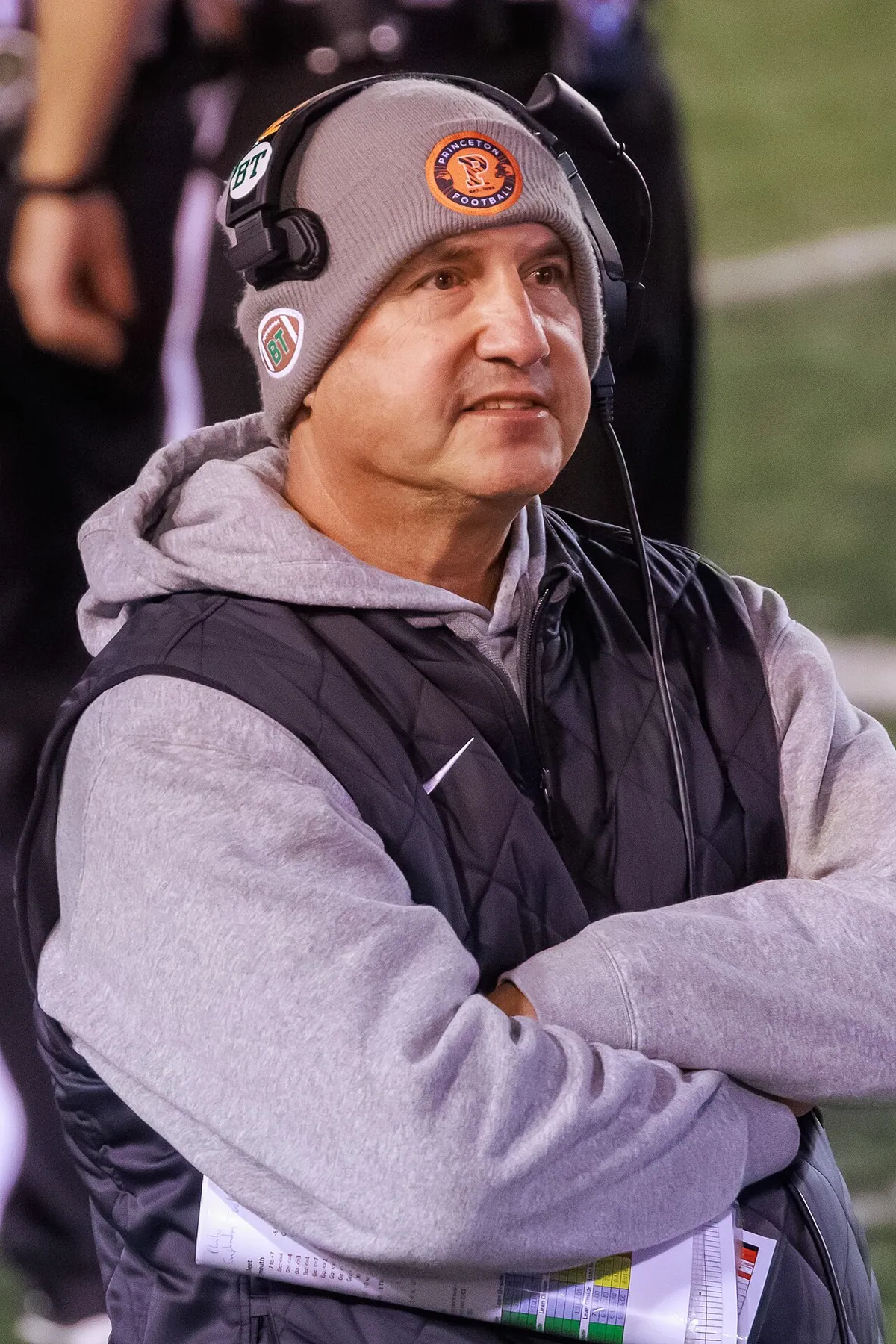
In the early national championship years, teams were often led by player-coaches or had no formal coach. Key figures from the early 20th century include Art Hillebrand, who coached the 1903 national champions, and Bill Roper, who led the 1906 title team. Fritz Crisler coached the undefeated 1933 and 1935 squads. Charlie Caldwell guided Princeton to its last claimed national championship in 1950 and coached Heisman winner Dick Kazmaier. In the Ivy League era, Dick Colman won championships in 1957, 1963, and 1964. Steve Tosches led the team to Ivy titles in 1989, 1992, and 1995. Roger Hughes won a share of the title in 2006. Under Surace, Princeton has won or shared Ivy League championships in 2013, 2016, 2018, and 2021, including a perfect 10-0 season in 2018. His overall record is 90 wins and 70 losses.
National and Conference Championships
Princeton claims 28 national championships, a record among all college football programs. These titles were awarded by various historical selectors, with most coming in the 19th century. The Tigers claim championships in 20 different seasons during a 30-year span from 1869 to 1899. Their last claimed national title came in 1950 under coach Charlie Caldwell. Since joining the Ivy League, Princeton has won 12 conference championships. Four of those titles were won outright, in 1964, 1995, and 2018. The other eight were shared with other Ivy League members.
Princeton Stadium and Facilities
Princeton football was played in Palmer Stadium from 1914 until 1996. Modeled after a Greek Olympic stadium, it seated 45,750 spectators and was the third college football stadium ever built. The university chose to demolish it rather than renovate, leading to the construction of the current venue. Princeton Stadium opened on September 19, 1998, with a capacity of 27,773. For the 2006 season, an artificial FieldTurf surface was installed and the field was named Powers Field in honor of donor and former punter William C. Powers. The stadium is located on the university campus in Princeton, New Jersey. The team's practice facilities consist of the Finney-Campbell practice fields east of the stadium, which feature two full FieldTurf football fields. During the 1997 construction season, the Tigers played a schedule of nine away games and one home game against Yale at Giants Stadium.
Heisman Winner and Notable NFL Players
Princeton's sole Heisman Trophy winner is halfback Dick Kazmaier, who won the award in 1951. Kazmaier was a unanimous All-American in both 1950 and 1951, leading the Tigers to undefeated seasons in those years. Since the 1974 season, 23 Princeton alumni have played in the NFL, with eight of them being drafted. No Princeton player has ever been selected with the number one overall pick in the NFL Draft. As of the 2026 NFL season, four Princeton graduates are on active rosters. They are tight end Stephen Carlson with the Chicago Bears, wide receiver Andrei Iosivas with the Cincinnati Bengals, and offensive linemen Henry Byrd with the Minnesota Vikings and Jalen Travis with the Indianapolis Colts.
Main Rivalries
The rivalry with Harvard is one of the oldest in college football, with Princeton leading the series 55 wins, 48 losses, and 7 ties. The annual game against Yale is another significant rivalry. The series with the University of Pennsylvania is also a long-standing Ivy League tradition. Perhaps the most historically significant rivalry is with Rutgers, as the two schools played in the first intercollegiate football game in 1869. That series continued until 1980, ending when the Ivy League's move to Division I-AA made competition less feasible. These rivalries are central to the program's identity and schedule each season.
- Harvard: Princeton leads the series 55-48-7.
- Yale: The annual contest is a historic Ivy League matchup.
- Penn: A traditional Ivy League opponent.
- Rutgers: The series ran from 1869 to 1980, beginning with the first intercollegiate game.
Recent Seasons and Postseason Eligibility
In recent years under coach Bob Surace, Princeton has been a consistent contender in the Ivy League. The team achieved a perfect 10-0 season in 2018, winning the Ivy League title outright. They followed that with an 8-2 record in 2019. The Ivy League canceled the 2020 season due to the COVID-19 pandemic. Upon resuming play in 2021, Princeton posted a 9-1 record and earned a share of the Ivy League championship. A landmark change occurred in 2025 when the Ivy League reversed its long-standing policy and allowed its football champions to participate in the NCAA FCS postseason. This change grants Princeton and other Ivy teams the opportunity to compete for a national championship for the first time in the modern playoff era. Future non-conference opponents for Princeton, as of early 2026, include teams like Bryant, Albany, Lehigh, Wagner, Howard, Monmouth, and North Carolina A&T.
- 2018: A 10-0 undefeated season and outright Ivy League championship.
- 2021: A 9-1 record and a share of the Ivy League title.
- 2025: The first season Ivy League teams became eligible for the FCS postseason.
NFL players from Princeton
| Player | Pos | Years | Main team |
|---|---|---|---|
| Jason Garrett | QB | 1993–2004 | Dallas Cowboys |
| Carl Barisich | DT | 1973–1981 | Miami Dolphins |
| Stephen Carlson | TE | 2019– | Chicago Bears |
| Dennis Norman | OT | 2001–2009 | Jacksonville Jaguars |
| Caraun Reid | DT | 2014–2021 | Los Angeles Chargers |
| Henry Byrd | G | 2023– | Minnesota Vikings |
| Karl Chandler | C | 1974–1979 | New York Giants |
| Jesper Horsted | TE | 2019–2024 | Chicago Bears |
| Andrei Iosivas | WR | 2023– | Cincinnati Bengals |
| Seth DeValve | TE | 2016–2020 | Cleveland Browns |
| Keith Elias | RB | 1994–1999 | New York Giants |
| Ross Tucker | OT | 2001–2005 | Washington Redskins |
| Mike Catapano | OLB | 2013–2017 | New York Jets |
| Bob Holly | QB | 1982–1985 | Washington Redskins |
| Jalen Travis | OT | 2025– | Indianapolis Colts |
Video
FAQ
What conference is Princeton football in?
Princeton football competes in the Ivy League. The university was a founding member when the conference formally organized in 1955. The Ivy League competes at the NCAA Division I Football Championship Subdivision level. For decades, conference rules prohibited member schools from participating in postseason football, but that policy changed starting with the 2025 season.
Who is the head football coach at Princeton?
The head football coach at Princeton University is Bob Surace. As of the 2026 season, Surace is in his 16th season leading the program. He is a Princeton alumnus, having been an All-Ivy League center for the Tigers, graduating in 1990. Under his leadership, Princeton has won or shared four Ivy League championships in 2013, 2016, 2018, and 2021, compiling an overall record of 90 wins and 70 losses.
What is the name and capacity of Princeton's football stadium?
Princeton plays its home games at Princeton Stadium, which opened on September 19, 1998. The stadium has a seating capacity of 27,773 spectators. The playing surface is named Powers Field, after former punter and donor William C. Powers. Princeton's previous stadium was Palmer Stadium, which served from 1914 until 1996 and seated 45,750 fans before being demolished.
How many national championships has Princeton football won?
Princeton claims 28 national championships in football, which is the most of any college football program. The vast majority of these titles were won in the 19th and early 20th centuries, with the Tigers claiming 22 of the first 40 national titles awarded. Their last claimed national championship was in 1950. These championships are based on retroactive selections by various historical polls and selectors.
Has a Princeton player ever won the Heisman Trophy?
Yes, one Princeton player has won the Heisman Trophy. Halfback Dick Kazmaier won the award in 1951. Kazmaier was a unanimous All-American in both 1950 and 1951, leading the Tigers to undefeated seasons in those years. He is Princeton's only Heisman Trophy winner.
Which NFL players went to Princeton?
Since 1974, 23 Princeton alumni have played in the NFL, with eight being drafted. As of the 2026 NFL season, four Princeton graduates are on active rosters. They are tight end Stephen Carlson of the Chicago Bears, wide receiver Andrei Iosivas of the Cincinnati Bengals, and offensive linemen Henry Byrd of the Minnesota Vikings and Jalen Travis of the Indianapolis Colts. Historically, other notable NFL Tigers include Bob Perina and Hank Bjorklund.
Sources
- Princeton Tigers football (Wikipedia) Wikipedia
- Princeton Senior High football hoping to make 2025 their “Eye of the Tiger” year Yahoo Sports
- Princeton Football: A Brief History njsports.com
- nflverse game, roster and draft data nflverse (CC BY 4.0)