Cleveland Municipal Stadium was a multi-purpose stadium located on the Lake Erie shore in Cleveland, Ohio. It opened in 1931 and was best known as the long-time home of the Cleveland Browns of the National Football League from 1946 to 1995. It was demolished in 1996 to make way for Cleveland Browns Stadium, which opened on the same site in 1999. The facility was one of the early multi-purpose stadiums built to accommodate both baseball and football, and it was added to the National Register of Historic Places in 1987.
Location and Construction
Cleveland Municipal Stadium was constructed on reclaimed landfill on the city's lakefront. The site was chosen near Lake Erie, filled with old cars and tires to create a foundation. Ground was broken on June 24, 1930. The stadium was built with steel and concrete and featured an early use of structural aluminum. It was designed by the architectural firms Walker and Weeks and the Osborn Engineering Company. The project was financed through a $2.5 million bond issue approved by Cleveland voters in November 1928, marking one of the first instances of public financing for a sports stadium. The final construction cost overran the bond amount, totaling approximately $3 million. The stadium was dedicated on July 1, 1931, and opened without a primary tenant. The first event was a heavyweight boxing championship between Max Schmeling and Young Stribling on July 3, 1931, drawing 37,000 fans. This event was the first heavyweight boxing bout held in Cleveland.
Stadium Capacity and Features
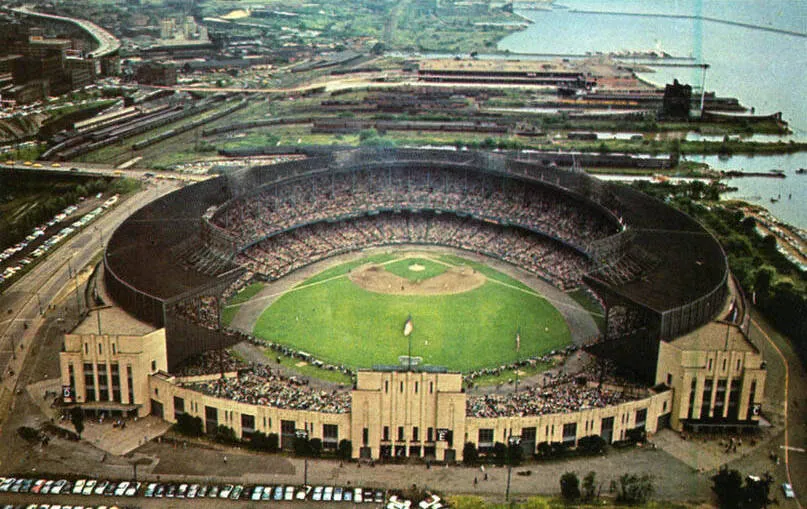
Upon its completion, Cleveland Municipal Stadium had a seating capacity of slightly more than 78,000. Its original baseball capacity was 78,189, which included 37,896 seats in the lower level, 29,380 in the upper level, and 10,913 bleacher seats. For football, the stadium seated approximately 80,000 people, with a capacity of 81,000 in 1995. The structure featured a covered double-decked grandstand in a horseshoe shape with an uncovered bleacher section beyond one end zone. The playing surface was natural grass throughout its history. The stadium's massive scale and its location on the lakefront led to its enduring nickname, the Mistake by the Lake. The field was laid out straight up the center of the baseball diamond for football games, requiring few changes for the transformation between sports.
Early Football Tenants: Indians and Rams
Before the arrival of the Cleveland Browns, two other NFL franchises called the stadium home. The Cleveland Indians football team played two home games there during their 1931 season. They drew a crowd of only about 2,000 for a September game against the Brooklyn Dodgers and 10,000 for a November loss to the Chicago Cardinals. The Cleveland Rams were founded in 1936 as a member of the second American Football League and joined the NFL in 1937. They played home games at the stadium in 1937 and again from 1939 through the 1941 season before moving to League Park. The Rams returned to the stadium one final time to host the 1945 NFL Championship Game, defeating the Washington Redskins 15-14. That victory marked the final Rams game in Cleveland before the team relocated to Los Angeles 27 days later.
- The team joined the National Football League in 1937.
- They played home games at Cleveland Stadium in 1937 and from 1939 to 1941.
- The Rams hosted and won the 1945 NFL Championship Game at the stadium.
- The team relocated to Los Angeles 27 days after winning the 1945 championship.
The Cleveland Browns Era
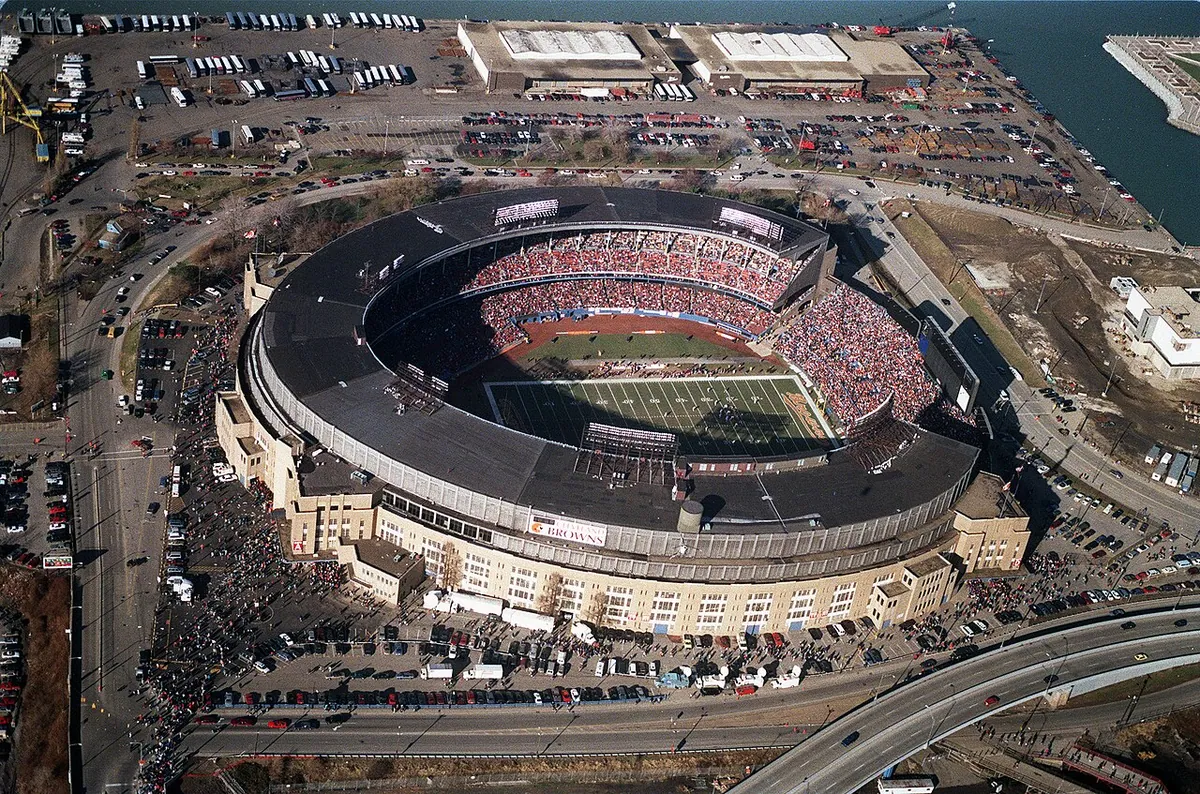
The stadium's most famous and longest-tenured football tenant was the Cleveland Browns. The Browns began play in the All-America Football Conference (AAFC) in 1946, drawing a then-record professional football crowd of 60,135 for their first game, a 44-0 win over the Miami Seahawks. They joined the NFL in 1950 and played at the stadium through the 1995 season. The Browns were one of the NFL's best teams during much of their tenure, hosting multiple championship games. The team's most avid fans occupied the center field bleachers at the east end of the stadium during the 1980s, a section that became known as the Dawg Pound. Fans there would bark to disrupt opposing teams, wear dog masks, and throw dog biscuits. The Browns' final game at the stadium was a 26-10 victory over the Cincinnati Bengals on December 17, 1995. After the 1995 season, owner Art Modell moved the franchise to Baltimore, citing the stadium's condition as a major factor. Major Browns achievements at the stadium included.
- Winning three AAFC Championship Games at the stadium in 1946, 1948, and 1949.
- The Browns had a perfect regular season in 1948.
- The Browns won the AAFC championship in 1948.
- Hosting and winning NFL Championship Games in 1950, 1954, and 1964.
- The Browns played their final game at the stadium on December 17, 1995.
Championship Games and Major Football Events
Cleveland Municipal Stadium was a frequent host of professional football championship games. It hosted three AAFC Championship Games in 1946, 1948, and 1949, all won by the Cleveland Browns. The stadium hosted six NFL Championship Games. The Browns won the title at home in 1950, 1954, and 1964, and lost championship games there in 1952 and 1968. In addition to professional football, the stadium was a significant venue for college football. It hosted the annual Notre Dame vs. Navy game 11 times between 1932 and 1978. The 1947 edition drew a crowd of 84,090 fans, with Notre Dame winning 27-0. The average attendance for these 11 games was 69,730. Local college teams from the Big Four Conference, including Western Reserve, Case Tech, John Carroll, and Baldwin Wallace, frequently used the stadium for home games. The stadium hosted the Great Lakes Bowl in 1947.
| Year | Game | Result |
|---|---|---|
| 1945 | NFL Championship | Cleveland Rams 15, Washington Redskins 14 |
| 1950 | NFL Championship | Cleveland Browns 30, Los Angeles Rams 28 |
| 1952 | NFL Championship | Detroit Lions 17, Cleveland Browns 7 |
| 1954 | NFL Championship | Cleveland Browns 56, Detroit Lions 10 |
| 1964 | NFL Championship | Cleveland Browns 27, Baltimore Colts 0 |
Notable Moments and Heartbreaks
The stadium was the site of several memorable and painful moments in Cleveland Browns history. On January 4, 1981, in an AFC Divisional playoff game, quarterback Brian Sipe was intercepted in the end zone on a play called Red Right 88 with less than a minute remaining, resulting in a 14-12 loss to the Oakland Raiders. Six years later, on January 11, 1987, John Elway led the Denver Broncos on a 98-yard touchdown drive known as The Drive to tie the AFC Championship Game with 5:32 remaining. The Broncos won the game 23-20 in overtime. The stadium also hosted the first-ever Monday Night Football game on September 21, 1970, which saw the Browns defeat the New York Jets. These events, along with the creation of the Dawg Pound, secured the stadium's place in NFL history for more than five decades.
Renovations and Stadium Operations
Throughout its history, Cleveland Municipal Stadium underwent several renovations. In 1947, an inner fence was installed to reduce the enormous size of the baseball outfield, which originally stretched 470 feet to the center field bleachers. A major renovation occurred in 1967 when the original wooden seats were replaced with plastic ones. Another renovation in 1974 added a new scoreboard and luxury suites. The city of Cleveland operated the stadium from 1931 until 1973. Control then passed to the Cleveland Stadium Corporation, which was controlled by Browns owner Art Modell, from 1973 until the stadium's closure in 1995. Despite these improvements, the stadium deteriorated rapidly in its final two decades. Its dual-purpose design led to poor sight lines for baseball, with many upper deck seats too far from the action. The facility was known for cold winds off Lake Erie and for attracting swarms of midges and mayflies during hot summer nights.
- Installation of an inner fence in 1947 to cut down the outfield size.
- Replacement of original wooden seats with plastic ones in 1967.
- Addition of a new scoreboard and luxury suites in 1974.
- Lights were installed at the stadium in 1939.
Final Years and Demolition
The decline of Cleveland Municipal Stadium accelerated in the late 1980s and early 1990s. The Cleveland Indians played their last game there on October 3, 1993, a 4-0 loss to the Chicago White Sox before 72,390 fans, and moved to Jacobs Field the following season. After failing to secure a deal for a new stadium, Browns owner Art Modell announced the team's move to Baltimore after the 1995 season. Following the Browns' final game, many fans cut out and removed their seats as souvenirs. As part of an agreement between Modell, the city, and the NFL, the Browns were deactivated for three seasons and the city was required to build a new stadium on the site. Demolition officially began on November 4, 1996, and was completed by March 1, 1997. A fire occurred during demolition on December 3, 1996. The Osborn Engineering Company, which helped design the original stadium, oversaw its demolition. Much of the debris was placed in Lake Erie to create an artificial reef. Cleveland Browns Stadium opened on the site in 1999 for the reactivated Browns expansion team.
- The Cleveland Indians' final game was a 4-0 loss on October 3, 1993.
- Demolition began on November 4, 1996.
- Demolition was completed on March 1, 1997.
Other Sports and Events
Beyond football, Cleveland Municipal Stadium hosted a wide array of other events. It was the primary home of the Cleveland Indians from 1932 to 1993, hosting four MLB All-Star Games in 1935, 1954, 1963, and 1981. Only Yankee Stadium also hosted four All-Star Games. The Indians set a single-season attendance record of 2,620,627 fans in 1948. On September 12, 1954, a regular season baseball game between the New York Yankees and Cleveland Indians drew a league record 84,587 people. Len Barker pitched a perfect game for the Indians at the stadium on May 15, 1981. The infamous Ten Cent Beer Night promotion led to a forfeit by the Indians on June 4, 1974. The stadium also hosted two World Series in 1948 and 1954. It was a major concert venue, hosting The Beatles in 1966 and Pink Floyd in 1977 before a crowd of 83,199.
- Four MLB All-Star Games (1935, 1954, 1963, 1981).
- Concerts by The Beatles (1966) and Pink Floyd (1977).
- Heavyweight boxing match between Max Schmeling and Young Stribling (1931).
- The installation of Donald Gray Gardens in 1936.
Video
FAQ
When was Cleveland Municipal Stadium built and opened?
Construction on Cleveland Municipal Stadium began on June 24, 1930. The stadium was completed and dedicated on July 1, 1931. The first public event took place two days later on July 3, 1931, featuring a heavyweight boxing championship. The Cleveland Indians played their inaugural baseball game at the venue on July 31, 1932.
What was the seating capacity of Cleveland Municipal Stadium?
The stadium's original baseball capacity was 78,189 seats upon its opening. For football games, it seated approximately 80,000 spectators. By its final years, the listed capacity for baseball was 74,438 in 1993, and for football it was 81,000 in 1995. When it opened, it held the record for the largest outdoor seating capacity of any stadium in the world.
What championship games were played at Cleveland Municipal Stadium?
The stadium hosted three All-America Football Conference Championship Games in 1946, 1948, and 1949, all won by the Cleveland Browns. It also hosted six NFL Championship Games, including in 1945, 1950, 1952, 1954, 1964, and 1968. The Cleveland Browns won the NFL title on their home field in 1950, 1954, and 1964. The Cleveland Rams won the NFL championship in 1945.
What happened to the site after the stadium was demolished?
Cleveland Municipal Stadium was demolished between November 1996 and March 1997. As part of a deal to bring an NFL team back to the city, a new stadium was constructed on the identical lakefront location. Cleveland Browns Stadium opened in 1999 as the home of the reactivated Cleveland Browns expansion franchise. A significant portion of the rubble from the old stadium was deposited into Lake Erie to form an artificial reef.
What were some of the notable non-sporting events held at Cleveland Municipal Stadium?
Cleveland Municipal Stadium hosted several major concerts and other events. The British rock band The Beatles performed at the stadium on August 14, 1966. Pink Floyd also held a concert there on June 25, 1977, which drew a crowd of 83,199 people. The Donald Gray Gardens were installed on the stadium's north side in 1936. These events showed the stadium's role as a multi-purpose venue beyond baseball and football.
Why did the Cleveland Indians temporarily leave Cleveland Municipal Stadium after the 1933 season?
The Cleveland Indians returned to their previous home, League Park, for the 1934 and 1935 seasons due to several issues with the new stadium. Players and fans complained about the enormous outfield, which significantly reduced the number of home runs hit. Furthermore, as the Great Depression worsened, attendance at the massive stadium plummeted. Since the Indians owned League Park, it made financial sense to play in the smaller, more intimate venue during those difficult economic years before returning to the stadium for select games starting in 1936.
Sources
- Cleveland Stadium (Wikipedia) Wikipedia
- Cleveland Municipal Stadium, History, Photos & More of the former NFL.. Stadiums of Pro Football
- Municipal Stadium clevelandhistorical.org