Franklin Field is a historic sports stadium located on the campus of the University of Pennsylvania in Philadelphia. Opened on April 20, 1895, it is recognized as the oldest still-operating stadium used for college football. The stadium has been the home field for the Penn Quakers football team since its inception and served as the home of the NFL's Philadelphia Eagles from 1958 through 1970. Franklin Field is also famous for hosting the annual Penn Relays, the first radio broadcast of a football game in 1922, and the 1960 NFL Championship Game.
Construction, Opening, and Renovations
Franklin Field was built on the site of a former potter's field at a cost of $100,000, which is equivalent to $3.87 million in 2025 dollars. It was dedicated on April 20, 1895, for the inaugural Penn Relays. The original structure was a wooden stadium with a seating capacity of 30,000 and featured the nation's first scoreboard. The first major reconstruction occurred in 1903, costing $525,000, and opened on September 26 of that year for a Penn football game against Dickinson. This renovation increased capacity to 25,000 and added facilities including Weightman Hall gymnasium. The most significant transformation began in 1922 when the wooden stands were demolished and replaced with a concrete lower tier, designed by the architecture firm Day & Klauder, boosting capacity to 50,000. A second tier was added in 1925, making Franklin Field the second and largest two-tiered stadium in the United States at the time. A major $44 million renovation to reinforce the original 1895 concrete structure began in 2015 and was completed by September 2023, receiving a historic preservation award.
Capacity and Physical Features
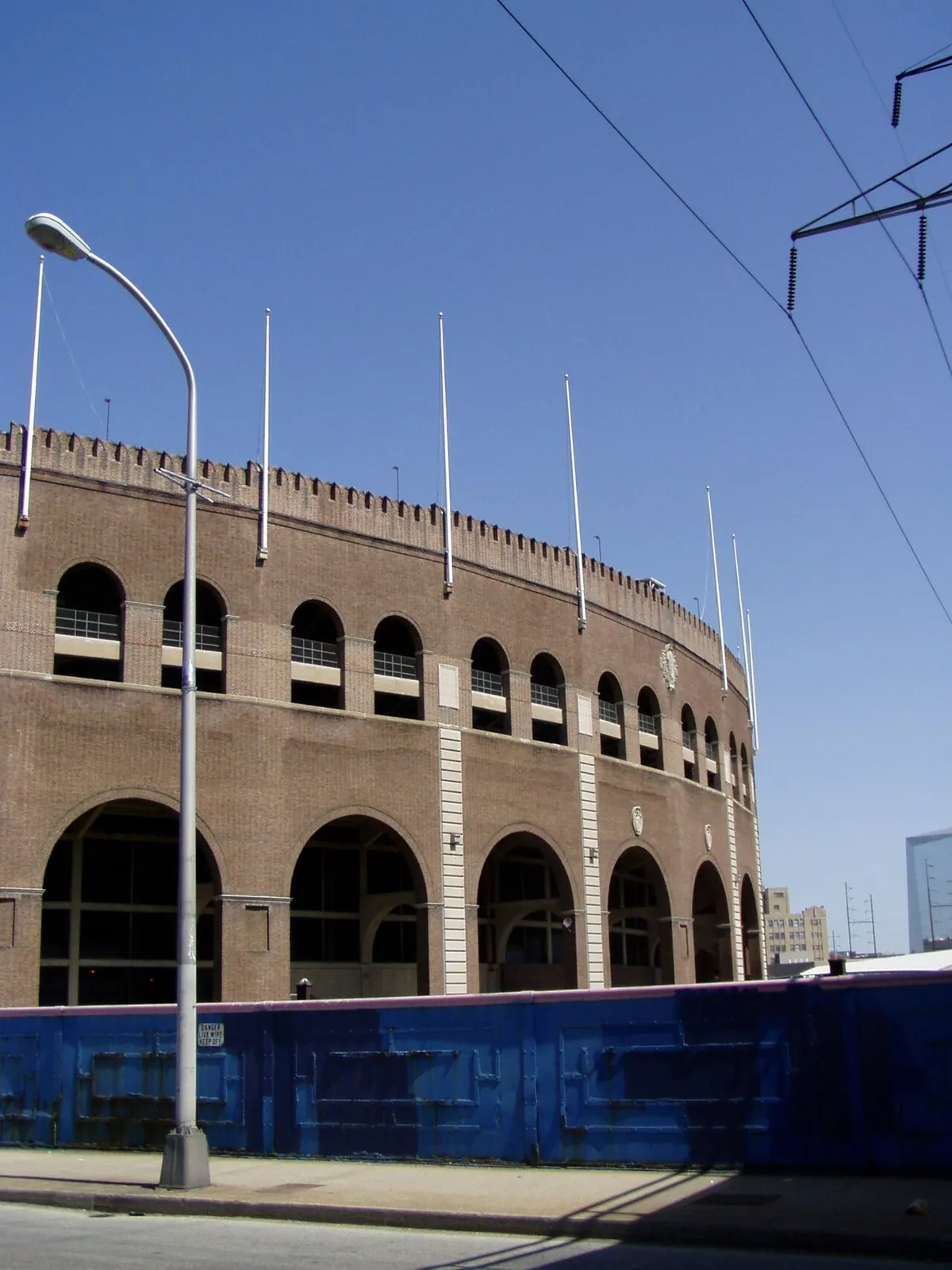
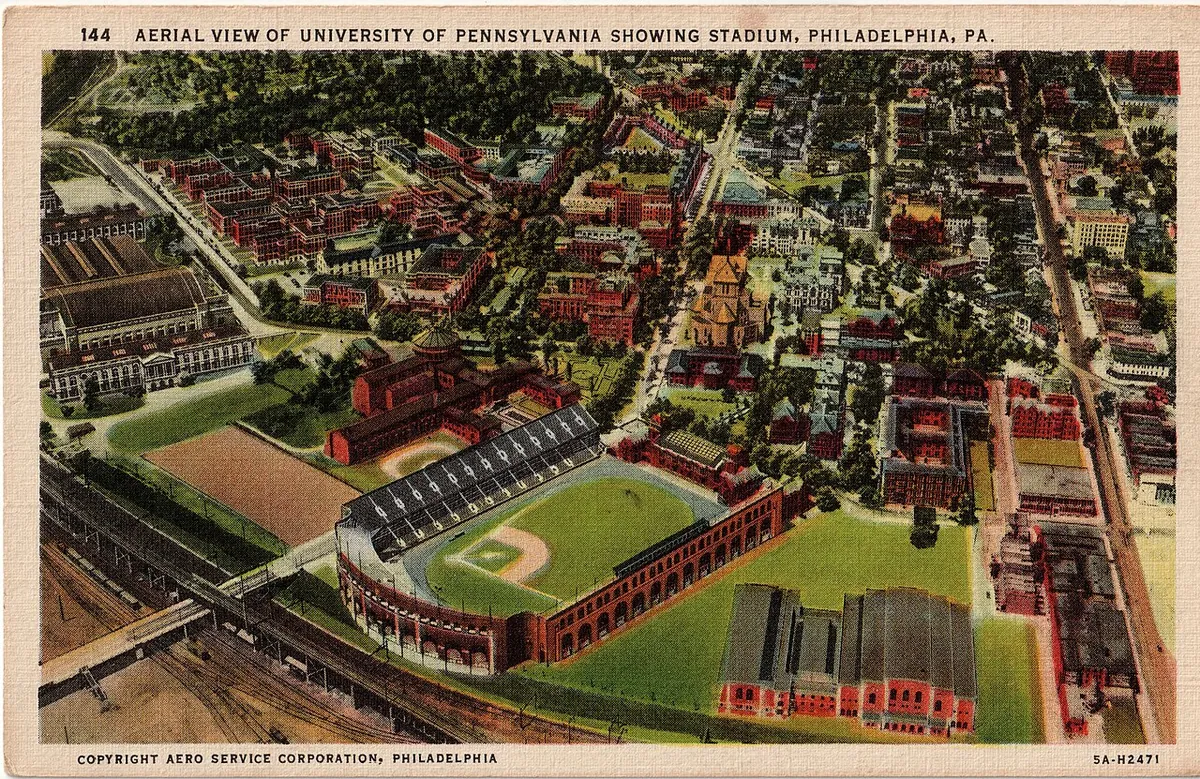
The seating capacity of Franklin Field has changed numerous times throughout its history. It opened in 1895 with 30,000 seats. After the 1922 rebuild, it held 50,000, and the 1925 upper deck addition expanded it to 78,000. Capacity was later adjusted to 60,658 during the Eagles' tenure, then to 60,546, and later to 52,593. Since 2003, the official capacity has been 52,958. The stadium is a U-shaped structure made of steel and concrete. Its playing surface has evolved from natural grass, which was used from 1895 to 1968. In 1969, it became the first NFL stadium to install AstroTurf. The fifth AstroTurf surface was installed in 1993, and the current Sprinturf synthetic field was installed in 2004. The stadium also features a Rekortan running track, which replaced a cinder track in 1988. The field dimensions were originally 714 feet long and 443 feet wide, accommodating a quarter-mile track, a football field, and a baseball diamond.
Financing and Ownership
The initial funding for Franklin Field was spearheaded by Penn Athletic Association director Henry Laussat Geyelin. The 1895 construction cost was $100,000. The 1903 renovation, which cost $525,000, was also financed by alumni and student contributions. When the Philadelphia Eagles used the stadium from 1958 to 1970, the financial arrangement was unique. Because the University of Pennsylvania is a not-for-profit organization, the Eagles did not pay traditional rent. Instead, the team donated between $75,000 and $100,000 per year to cover maintenance and other expenses. In return, the university retained all revenue from concessions and parking at Eagles games. This arrangement allowed the Eagles to nearly double their available seating compared to their previous home at Connie Mack Stadium, which had a capacity of only 39,000.
College Football at Franklin Field
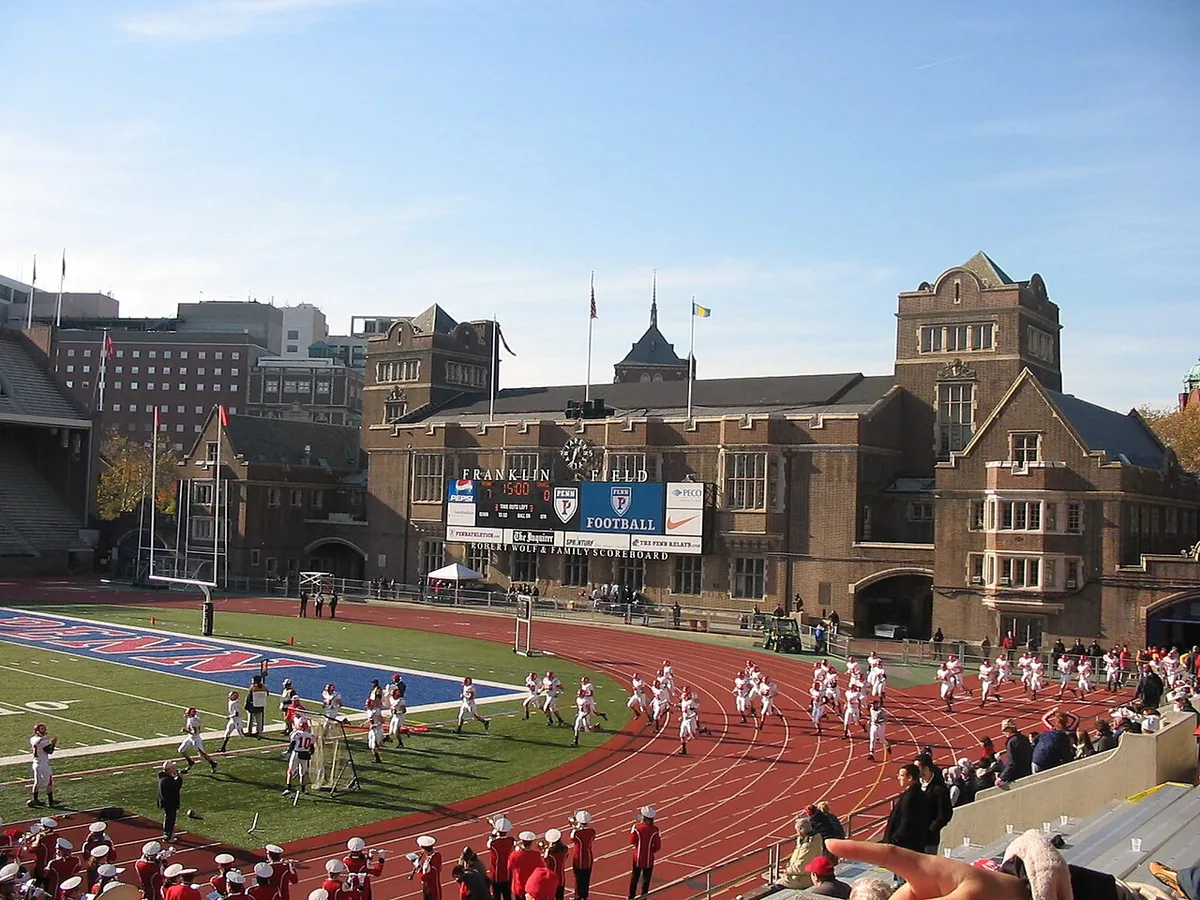
The University of Pennsylvania Quakers have played football at Franklin Field since 1895, making it the oldest active site for college football. Penn was considered a national champion in several early years, including 1895, 1897, 1904, and 1908. The stadium has hosted many historic college games and players. On October 31, 1925, Red Grange of the University of Illinois rushed for an NCAA-record 331 yards against Penn before 67,877 spectators. The Army, Navy Game was played at Franklin Field 18 times between 1899 and 1935, establishing Philadelphia as its traditional home. Temple University used Franklin Field for select home games from the late 1970s through the 2002 season when conflicts arose at Veterans Stadium. The Penn Quakers played their 800th game at the stadium on October 4, 2008, against Dartmouth. The Quakers have played over 850 games at Franklin Field since 1895.
- 1895: Penn Quakers begin playing at Franklin Field.
- 1899: First Army, Navy Game held at the stadium.
- October 31, 1925: Red Grange sets NCAA rushing record (331 yards).
- November 16, 2002: First FCS ESPN College GameDay broadcast.
- October 4, 2008: Penn's 800th game at Franklin Field.
Professional Football Tenants and the NFL Championship
The Philadelphia Eagles of the NFL called Franklin Field home from the 1958 season through 1970. The move from Connie Mack Stadium nearly doubled the team's seating capacity. The Eagles did not pay rent but contributed between $75,000 and $100,000 annually for maintenance, while the university kept concessions and parking revenue. The franchise's most successful season at the venue was 1960, which culminated in the NFL Championship Game on December 26. The Eagles defeated Vince Lombardi's Green Bay Packers 17-13 before a crowd of 67,325. This game, which started at noon due to a lack of stadium lights, was Lombardi's only career playoff loss. Other professional teams also used the stadium. The Frankford Yellow Jackets hosted an NFL game there in 1927. The World Football League's Philadelphia Bell played their 1975 home games at Franklin Field before the league folded. The USFL's Philadelphia Stars played their 1984 playoff games at the stadium, defeating the New Jersey Generals and the Birmingham Stallions there en route to the league championship.
| Team | League | Years at Franklin Field |
|---|---|---|
| Philadelphia Eagles | NFL | 1958 to 1970 |
| Frankford Yellow Jackets | NFL | 1927 (one game) |
| Philadelphia Bell | WFL | 1975 |
| Philadelphia Stars | USFL | 1984 (playoff games) |
Notable Events and Incidents
Franklin Field has been the site of numerous landmark broadcasts and memorable, sometimes infamous, events. In 1922, Philadelphia radio station WIP originated the first broadcast of a football game from the stadium. The first commercial television broadcast of a football game was also held there in 1939. On October 11, 1959, NFL Commissioner Bert Bell suffered a fatal heart attack at the stadium during an Eagles-Steelers game. The most famous incident happened on December 15, 1968, during a halftime Christmas show. With the planned Santa Claus absent, a 19-year-old fan in a Santa suit, Frank Olivo, was invited onto the field. Disgruntled Eagles fans, frustrated with the team's 2-11 record, booed Olivo and threw snowballs at him, creating the enduring myth that Philadelphia fans booed Santa Claus. During the debut season of Monday Night Football in 1970, broadcaster Howard Cosell fell ill at an Eagles versus New York Giants contest on November 23. Cosell vomited on the boots of his broadcast partner Don Meredith shortly before halftime and then departed the stadium, taking a taxi back to New York City. Cosell later claimed he felt dizzy from running laps on the stadium track before the game.
The Penn Relays and Major Track Events
Franklin Field's primary annual event is the Penn Relays Carnival, the largest and oldest track and field meet in the United States. The event has been held annually since, with cancellations only in 2020 and 2021 due to the COVID-19 pandemic. The meet was included in the very first episode of the ABC television series Wide World of Sports, which premiered on April 29, 1961. The stadium has also hosted other significant track meets. The second USSR-United States dual meet was held there on July 18 and 19, 1959, featuring stars like Wilma Rudolph, Parry O'Brien, and Igor Ter-Ovanesyan. In June 1961, Franklin Field was the site of the NCAA Men's Outdoor Track and Field Championship, marking the first time that national championship was contested on the East Coast. Seven records were set at that meet, and the University of Southern California won its 21st team title. The stadium was also the site of The Bicentennial Meet of Champions following the 1976 Summer Olympics.
Historic Firsts and Broadcast Milestones
Franklin Field holds a distinguished place in sports broadcasting and stadium innovation history. When it opened in 1895, it was the first college stadium in the nation to feature a scoreboard. In October 1895, it became the first field to use a scoreboard during a college football game. It also hosted the first commercial television broadcast of a football game in 1939 by the Philco company. Beyond sports, the stadium served as a venue for the conclusion of the 1936 Democratic National Convention, where President Franklin D. Roosevelt delivered his acceptance speech for a second term. In the modern era, the stadium achieved another first on November 16, 2002, when ESPN's College GameDay made its first broadcast from a Football Championship Subdivision (FCS) school prior to the Penn versus Harvard game. In 2010, Franklin Field hosted the first Ivy League women's lacrosse tournament.
Location, Access, and Stadium Experience
Franklin Field is situated at the eastern edge of the University of Pennsylvania's campus in West Philadelphia, at the intersection of South 33rd and Spruce Streets. The stadium is easily accessible via public transportation. The Penn Medicine Station on the SEPTA Regional Rail line is approximately a four-minute walk from the venue. Multiple SEPTA bus routes, including the 30, 40, 42, 49, and LUCY, serve the area. Driving and parking in the urban campus environment can be difficult, making public transit the recommended option for most visitors. The stadium's location places it near the Schuylkill River, just across from central Philadelphia and its major tourist attractions like Independence Hall and the Liberty Bell. Concession options at the stadium include Philadelphia cheesesteaks, pizza, hot dogs, and pretzels, with prices ranging from $5.49 to $13.79 for food. Beverages, including bottled water, soda, and beer, are also available at premium prices. The stadium features a modern video scoreboard, and the atmosphere is often defined by a passionate but smaller crowd of alumni and students within the vast 52,958-seat venue.
Video
FAQ
What is the capacity of Franklin Field?
The current seating capacity of Franklin Field is 52,958, a figure that has been in place since 2003. The stadium's capacity has changed many times throughout its history. When it opened in 1895, it held 30,000 fans. After major expansions in 1922 and 1925, its peak capacity reached 78,000. During the Philadelphia Eagles' tenure from 1958 to 1970, the capacity was 60,658. It was later adjusted to 60,546 and then 52,593 before settling at the current number.
When did the Philadelphia Eagles play at Franklin Field?
The Philadelphia Eagles played their home games at Franklin Field for 13 seasons, from 1958 through 1970. They moved to the university stadium from Connie Mack Stadium to access a larger seating capacity. The Eagles' most successful season at Franklin Field was 1960, when they won the NFL Championship Game on that field. The team played its final game at Franklin Field on December 20, 1970, against the Pittsburgh Steelers before moving to Veterans Stadium for the 1971 season.
Is Franklin Field the oldest football stadium?
Franklin Field is recognized as the oldest stadium still in operation for college football. It opened on April 20, 1895, and has been continuously used for Penn Quakers football since that year. The stadium is also the oldest two-tiered stadium in the United States. While Harvard Stadium opened later and is sometimes called the first dedicated football stadium, Franklin Field is older and remains in active use for football, making it the oldest operating college football site.
What was the 1960 NFL Championship Game at Franklin Field?
The 1960 NFL Championship Game was held at Franklin Field on December 26, 1960. The hometown Philadelphia Eagles defeated the Green Bay Packers by a score of 17-13. This victory gave the Eagles their third NFL championship. The game is notable as the only playoff loss in the career of Packers noted coach Vince Lombardi. The attendance was 67,325. Because Franklin Field lacked permanent lighting at the time, the game started at noon to ensure it could be completed in daylight if it went into overtime.
What is the playing surface at Franklin Field?
Franklin Field currently has a Sprinturf synthetic playing surface, which was installed in 2004. This replaced five generations of AstroTurf that had been used since 1969. When Franklin Field switched to AstroTurf in 1969, it became the first NFL stadium to feature artificial turf. From the stadium's opening in 1895 until 1968, the field had a natural grass surface. The stadium also features a Rekortan running track, which was installed in 1988, replacing the original cinder track.
What other events are held at Franklin Field besides football?
Franklin Field hosts a wide variety of events beyond football. Its signature event is the annual Penn Relays Carnival, the oldest and largest track and field meet in the United States, held every April since 1895. The stadium is also used for University of Pennsylvania commencement exercises, lacrosse games, and other university athletics. It has hosted major track meets like the 1959 USSR-USA dual meet and the 1961 NCAA Men's Outdoor Championships. Historically, it was the site of the 1936 Democratic National Convention's concluding session where Franklin D. Roosevelt delivered his acceptance speech.
Sources
- Franklin Field (Wikipedia) Wikipedia
- Franklin Field Through The Years philadelphiaeagles.com
- Franklin Field, Penn Quakers stadiumjourney.com
- Franklin Field, History, Photos & More of the former NFL stadium of the Philadelphia Eagles Stadiums of Pro Football
- No matter what Harvard claims, Penn's Franklin Field is the oldest collegiate stadium being used for football inquirer.com