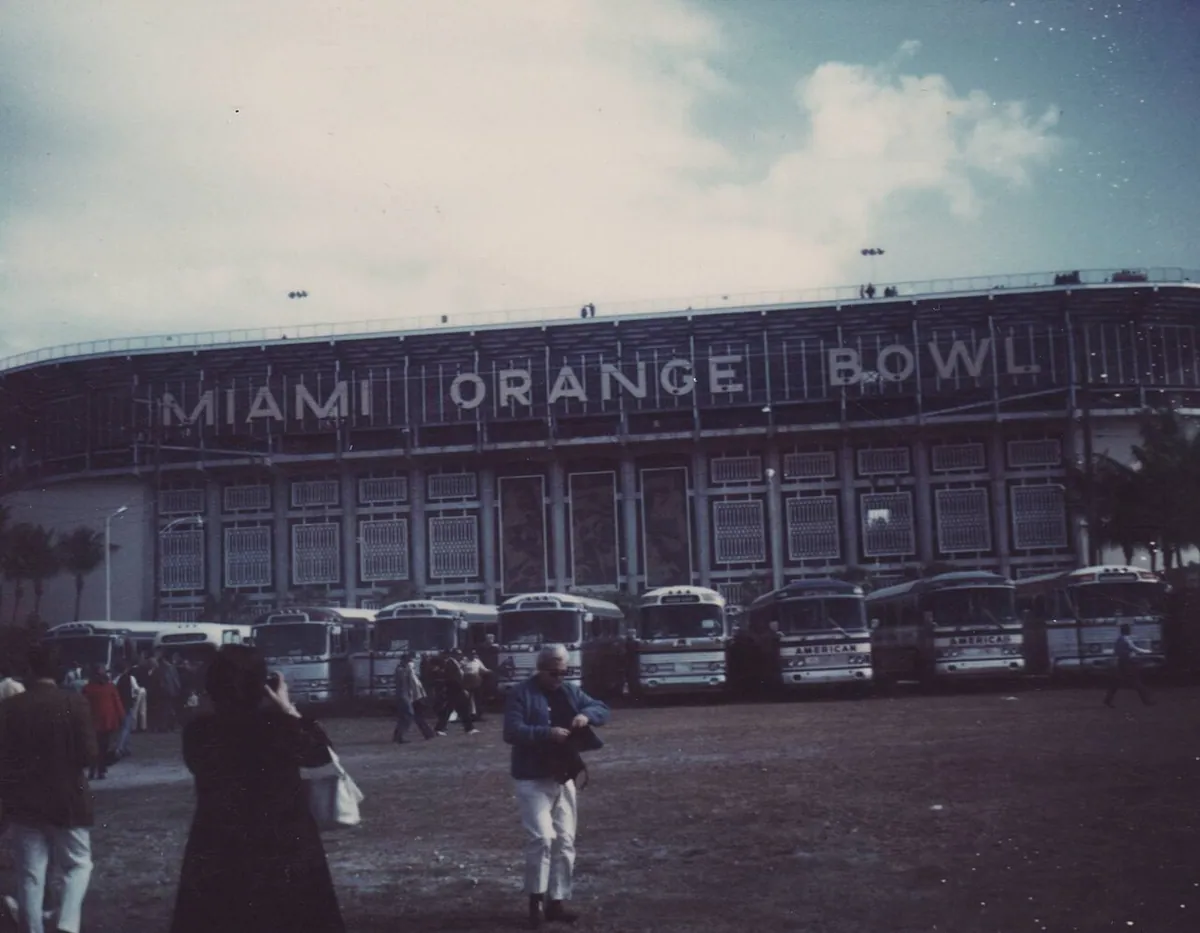
The Orange Bowl stadium was an outdoor football venue in the Little Havana neighborhood of Miami, Florida. Opened in 1937 as Burdine Stadium, it served as the long-time home for the University of Miami Hurricanes and the Miami Dolphins of the NFL. After closing in 2008, the Orange Bowl was demolished and replaced by LoanDepot Park, the baseball stadium for the Miami Marlins. The venue was located at 1501 Northwest 3rd Street and was owned and operated by the City of Miami for its entire existence.
Construction and Early History
Construction on the stadium began in 1936 as a project by the City of Miami Public Works Department. The venue was built to provide a permanent home for the University of Miami football program and to host the Orange Bowl game, which was conceived to boost winter tourism during the Great Depression. It opened on December 10, 1937, as Burdine Stadium, named for local civic leader Roddy Burdine. The inaugural game featured the Miami Hurricanes losing to the University of Georgia 0-26. The original stadium was a simple concrete-and-steel structure with a seating capacity of 23,739 along the sidelines and featured stadium lights. The first Orange Bowl game was played there in January 1938, drawing an attendance under 19,000 spectators. The stadium's lighting system partially failed during the first game, a high school contest on September 24, 1936, leaving the midfield dark with five minutes remaining in the fourth quarter.
The venue underwent numerous expansions to accommodate growing crowds, driven by promoter Earnie Seiler. In 1944, over 10,000 seats were added to the end zones, enclosing the stadium and raising capacity to 35,030. A major addition of 25,000 seats came in 1947, bringing the total to about 60,000. Further expansions between 1950 and 1957 completed the double-decking of the sidelines, transforming the venue. The stadium was renamed the Orange Bowl in 1949, aligning with the famous bowl game it hosted. By 1955, capacity exceeded 76,000, making it the third-largest bowl stadium in the United States. A west end zone upper deck was added in the 1960s, increasing the stadium's capacity.
Capacity Evolution and Stadium Features
The Orange Bowl's seating capacity changed dramatically over its 70-year history due to repeated renovations and changing needs. The original 1937 configuration held 23,739 fans. After the expansions of the 1940s and 1950s, the stadium's capacity was significantly increased. In 1977, the permanent seats in the east end zone were removed, creating an open end that offered a view of the Miami skyline and reducing capacity to 75,500. This open end featured a modern scoreboard and palm trees. Further modifications in the early 1990s, including the addition of contour seats and VIP areas, brought the capacity down to 74,712. Renovations in 1996 to accommodate Olympic soccer and improvements for handicap accessibility further reduced the official capacity to 72,319 by the time the stadium closed.
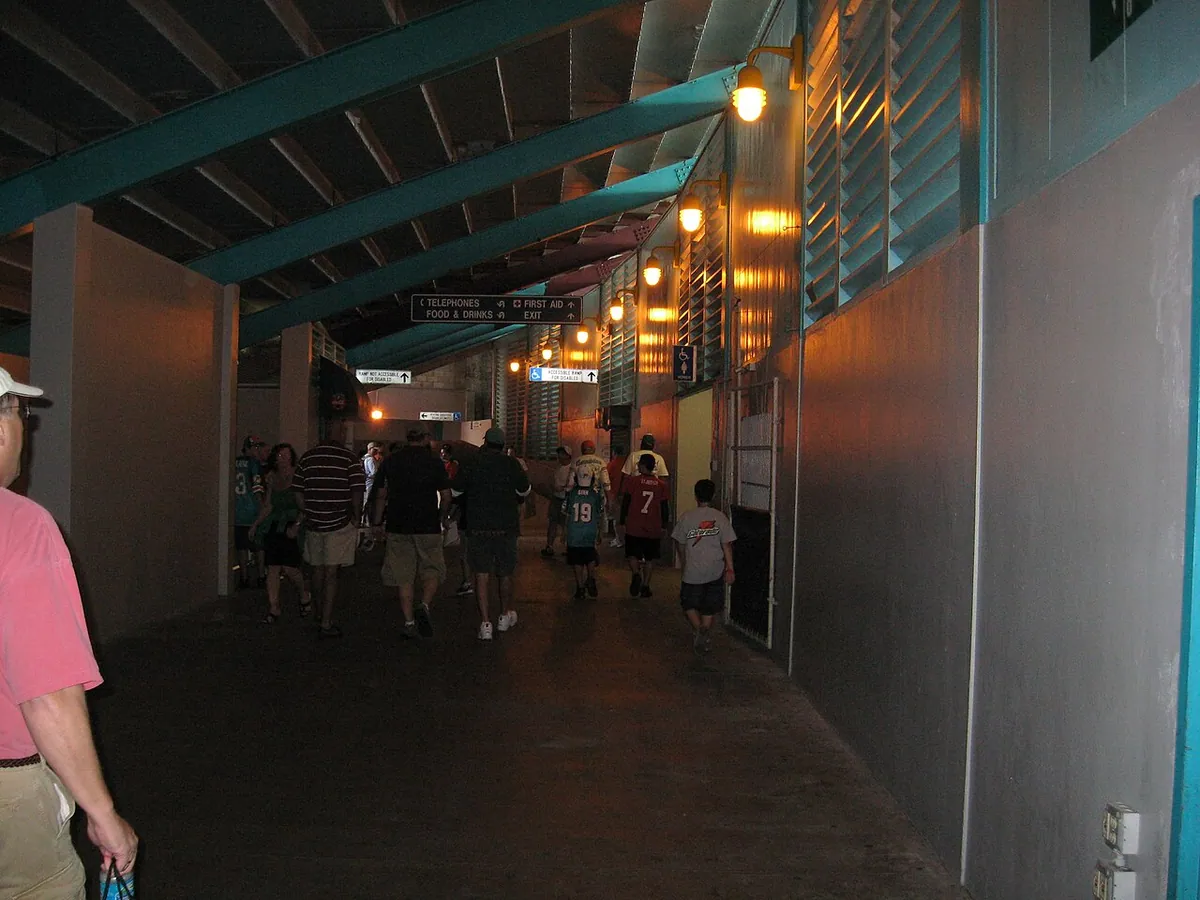
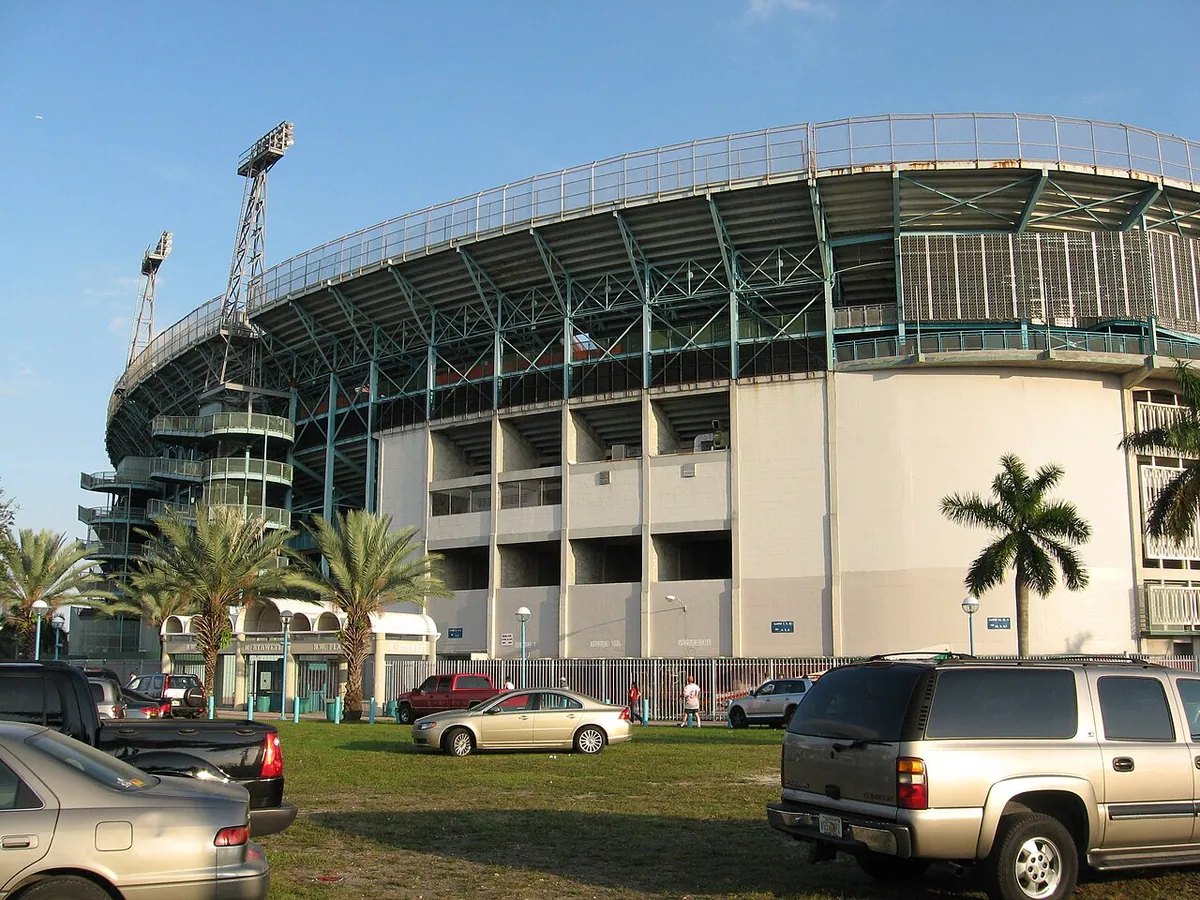
The stadium's final design was a horseshoe with two levels of seating wrapping around the field, closed at the west end zone and open at the east. The metal bleachers and steel structure were famously loud, contributing to a significant home-field advantage. For concerts and other events, additional seating placed on the playing field could increase capacity to approximately 82,000. The playing surface also evolved. From 1937 to 1969, it was natural grass. For the 1970 season, Poly-Turf, an early artificial surface, was installed. This turf was used for six seasons and was the surface for Super Bowl V in 1971, the first Super Bowl on artificial turf, and Super Bowl X in 1976. It was removed after Super Bowl X in January 1976 and replaced with a natural grass system known as Prescription Athletic Turf, which remained until the stadium closed.
- 1937: Opened as Burdine Stadium with a capacity of 23,739.
- 1944: Enclosed with end zone seats, capacity increased to 35,030.
- 1947: Added 25,000 seats, raising capacity to about 60,000.
- 1955: Capacity exceeded 76,000.
- 1977: East end zone seats removed, capacity reduced to 75,500.
- 1990s: Contour seats and renovations set final capacity at 72,319.
Primary Football Tenants and Records
The Orange Bowl was primarily a football stadium, hosting two major tenants for decades. The University of Miami Hurricanes called it home from its opening game in 1937 through the 2007 season. The Miami Dolphins of the American Football League and later the NFL played there from their inaugural regular season game on September 2, 1966, through the 1986 season. For one season in 2007, the FIU Golden Panthers used the stadium while their on-campus venue was renovated. The stadium also briefly hosted the Miami Seahawks of the All-America Football Conference in 1946 and the Miami Tropics of the Spring Football League in 2000.
Both the Hurricanes and Dolphins established noted home winning streaks and records at the Orange Bowl. The Miami Dolphins, under coach Don Shula, compiled an outstanding home record at the Orange Bowl from 1966 to 1986. This period included a 31-game home winning streak from 1971 to 1975, which encompassed the team's perfect 1972 season and four playoff wins. The Dolphins also held the best home winning percentage in the NFL from 1980 to 1989 at 80 percent. Under Shula, the Dolphins were 57-9-1 against AFC East opponents at the Orange Bowl, with perfect records against 11 visiting franchises. The University of Miami set the NCAA record for longest home winning streak, winning 58 consecutive games at the Orange Bowl between 1985 and 1994. The streak was ended by the Washington Huskies in 1994.
Super Bowls and Major Bowl Games
The Orange Bowl hosted five Super Bowls, a mark of its status as a premier NFL venue in the 1960s and 1970s. Super Bowl V in 1971 was the first Super Bowl played on artificial turf, which had been installed in 1970. Super Bowl X in 1976 was the last game played on that Poly-Turf surface before it was replaced with natural grass. Super Bowl XIII in 1979 was the final Super Bowl held at the Orange Bowl, featuring the Pittsburgh Steelers defeating the Dallas Cowboys 35-31.
| Super Bowl | Date | Winner | Loser | Score | Attendance |
|---|---|---|---|---|---|
| II | Jan 14, 1968 | Green Bay Packers | Oakland Raiders | 33-14 | 75,546 |
| III | Jan 12, 1969 | New York Jets | Baltimore Colts | 16-7 | 75,389 |
| V | Jan 17, 1971 | Baltimore Colts | Dallas Cowboys | 16-13 | 79,204 |
| X | Jan 18, 1976 | Pittsburgh Steelers | Dallas Cowboys | 21-17 | 80,187 |
| XIII | Jan 21, 1979 | Pittsburgh Steelers | Dallas Cowboys | 35-31 | 79,484 |
Beyond the Super Bowl, the stadium was the annual home of the Orange Bowl college football game from 1938 to 1996. The event moved to Pro Player Stadium beginning on December 31, 1996, but returned to the Orange Bowl for a final time in January 1999 due to a scheduling conflict. The 1965 Orange Bowl was the first college bowl game televised in prime time. The venue also hosted the NFL's Playoff Bowl, a third-place game, from 1961 to 1970, and the 1975 NFL Pro Bowl. The North-South Shrine Game for college all-stars was held there from 1948 to 1973.
Other Notable Events and Features
While primarily a football stadium, the Orange Bowl hosted a wide array of other events and had unique features. From 1966 to 1968 and again in the 1970s, a live dolphin named Flipper was kept in a water tank in the open east end zone, jumping to celebrate Dolphins scores. The stadium was used as a holding facility for Cuban refugees during the 1980 Mariel boatlift. It served as a FEMA relief center after Hurricane Wilma caused structural damage in 2005. The stadium hosted concerts, with a capacity expanded to 82,000 for such events. It was also the site of a tragic accident during a U.S. Hot Rod Monster Jam show on February 8, 1997, where stunt motorcyclist Corey Scott fell 70 feet to his death in front of 30,000 spectators.
For a brief period in the 1950s, the minor league Miami Marlins baseball team played occasional games there. An estimated 57,000 fans watched 50-year-old pitcher Satchel Paige play for the Marlins on August 7, 1956. The stadium also hosted high school football, including the longest game in high school history between Miami Palmetto and Coral Gables High Schools from September 11 to November 8, 1976. The Orange Bowl's home-field advantage was noted, partly due to fans stomping on the steel structure to create a rumbling noise before concrete reinforcement silenced it. The narrow radius of the closed west end zone also amplified fan noise, contributing to the so-called Wide Right curse for visiting Florida State kickers.
- Live dolphin mascot Flipper in a tank (1966 to 1968, 1970s).
- Satchel Paige minor league baseball game (August 7, 1956).
- Longest high school football game (September, November 1976).
- Monster Jam stunt accident fatality (February 8, 1997).
- Hosted the North-South Shrine Game (1948 to 1973).
Final Years, Demolition, and Legacy
By the 2000s, the aging stadium required significant investment. The University of Miami demanded renovations, but the city's focus shifted to building a new baseball park for the Florida Marlins. After Hurricane Wilma caused damage in 2005, discussions about the stadium's future intensified. In August 2007, the University of Miami announced a 25-year deal to move its home games to Dolphin Stadium, now Hard Rock Stadium, beginning in 2008. The Hurricanes played their final game at the Orange Bowl on November 10, 2007, a 48-0 loss to Virginia, which was the most lopsided home shutout loss in the Miami program's history at the time. FIU played the last college football game there on December 1, 2007, a 38-19 win over North Texas that snapped a 23-game losing streak.
The final events at the stadium included a high school all-star game on January 4, 2008, and a farewell flag football game on January 26, 2008, featuring alumni like Dan Marino, Jim Kelly, and coach Don Shula. The stadium was open to the public for the last time February 8-10, 2008, for an auction of stadium artifacts. Demolition began on March 3, 2008, and was completed by May 14, 2008. The Orange Bowl is one of eight now-demolished stadiums to have hosted a Super Bowl. Its memory is preserved in the rearranged 10-foot-tall concrete letters from its original sign, installed as a public art piece by Daniel Arsham at LoanDepot Park. The name Orange Bowl lives on as the title of the annual college football bowl game, which has been played at Hard Rock Stadium since 1996.
Miami Dolphins Playoff History at the Orange Bowl
The Miami Dolphins enjoyed considerable playoff success at their original home. From 1970 through the 1985 season, the Dolphins hosted numerous postseason games at the Orange Bowl, compiling a strong record in playoff contests there. Key victories included AFC Championship games in 1971 and 1982, where they shut out their opponents. The stadium was the site of several memorable playoff moments during the team's peak years under Don Shula.
- 1971 AFC Championship: Miami Dolphins 21, Baltimore Colts 0.
- 1972 Divisional Round: Miami Dolphins 20, Cleveland Browns 14.
- 1973 AFC Championship: Miami Dolphins 27, Oakland Raiders 10.
- 1982 AFC Championship: Miami Dolphins 14, New York Jets 0.
- 1984 AFC Championship: Miami Dolphins 45, Pittsburgh Steelers 28.
- 1985 AFC Championship: New England Patriots 31, Miami Dolphins 14.
Video
FAQ
What happened to the Orange Bowl stadium?
The Orange Bowl stadium was demolished in 2008. After the University of Miami Hurricanes moved to Hard Rock Stadium for the 2008 season, the city of Miami demolished the venue to make way for a new baseball park. Demolition took place between March 3 and May 14, 2008. The site is now occupied by LoanDepot Park, home of the Miami Marlins Major League Baseball team, which opened in 2012.
What was the seating capacity of the Orange Bowl?
The Orange Bowl's capacity changed many times. It opened in 1937 with a capacity of 23,739. After numerous expansions, its peak capacity reached 80,010. The removal of east end zone seats in 1977 reduced it to 75,500. Further renovations in the 1990s brought it down to a final official capacity of 72,319 when it closed in 2008. For concerts and other events, additional seating on the field could increase capacity to about 82,000.
How many Super Bowls were played at the Orange Bowl?
The Orange Bowl hosted five Super Bowls. These were Super Bowl II in 1968, Super Bowl III in 1969, Super Bowl V in 1971, Super Bowl X in 1976, and Super Bowl XIII in 1979. Super Bowls II and III are the only two Super Bowls played in consecutive years at the same stadium. Super Bowl V was the first played on artificial turf, and Super Bowl X was the last game on that surface at the venue.
Is Hard Rock Stadium the same as the Orange Bowl?
No, Hard Rock Stadium is a completely different venue located in Miami Gardens, about 15 miles northwest of the former Orange Bowl site. Hard Rock Stadium opened in 1987 as Joe Robbie Stadium and became the home of the Miami Dolphins. The University of Miami Hurricanes moved there in 2008, and it now also hosts the Orange Bowl game. The original Orange Bowl stadium was demolished in 2008 and no longer exists.
What was the original name and cost of the stadium that later became the Orange Bowl?
The stadium was originally known as Burdine Stadium when it opened in 1937. The construction cost was $340,000. It was built by the City of Miami Public Works Department and named after Roddy Burdine, a Miami pioneer and department store owner. The facility was later renamed the Orange Bowl in 1949 for the college football bowl game played there.
What notable non-football events took place at the Orange Bowl stadium?
Beyond football, the Orange Bowl hosted concerts and could seat up to 82,000 for such events. It occasionally hosted Miami Marlins minor league baseball games from 1956 to 1960. In 1980, the stadium was used as a holding facility for Cuban refugees during the Mariel Boatlift. It also hosted a U.S. Hot Rod Monster Jam event in 1997.
Sources
- Miami Orange Bowl (Wikipedia) Wikipedia
- Orange Bowl, History, Photos & More of the former NFL stadium of the Miami Dolphins Stadiums of Pro Football
- Hard Rock Stadium | Events, Sports & Music hardrockstadium.com
- Hard Rock Stadium miamihurricanes.com
- Miami Orange Bowl pro-football-history.com
- The Orange Bowl Stadium: Miami's Football Shrine, Miami History miami-history.com