Joseph Vincent Paterno was an American college football coach who led the Penn State Nittany Lions from 1966 until his dismissal in 2011. His 45-year tenure as head coach at one school is the longest continuous period for a head coach in NCAA Division I history. He accumulated 409 career victories, the most in NCAA FBS history at the time of his retirement. Paterno's teams won two national championships and participated in 37 bowl games. His career ended amid the Jerry Sandusky child sex abuse scandal, and he died from lung cancer complications on January 22, 2012.
Early Life and Playing Career
Joe Paterno was born on December 21, 1926, in Brooklyn, New York, to parents of Italian ancestry. He graduated from Brooklyn Preparatory School in 1944 and was drafted into the United States Army during World War II. After serving for one year, he was discharged and enrolled at Brown University in 1946 with financial support from the Busy Arnold fund. At Brown, Paterno was a member of the Delta Kappa Epsilon fraternity and played for the Bears football team. He played both quarterback and cornerback, and he shares the Brown career record for interceptions with 14. Paterno graduated in 1950 with a degree in English literature and had been accepted to Boston University School of Law.
Assistant Coaching Career at Penn State
Paterno chose to pursue coaching over law after his college coach, Rip Engle, offered him an assistant position at Penn State University. He joined Engle's staff in 1950, beginning a 16-year tenure as an assistant coach. Paterno was promoted to associate coach, the top assistant position, in June 1964. When Engle retired after the 1965 season, Penn State named Paterno as his successor the following day, making him head coach for the 1966 season.
Head Coaching Tenure and Season-by-Season Overview
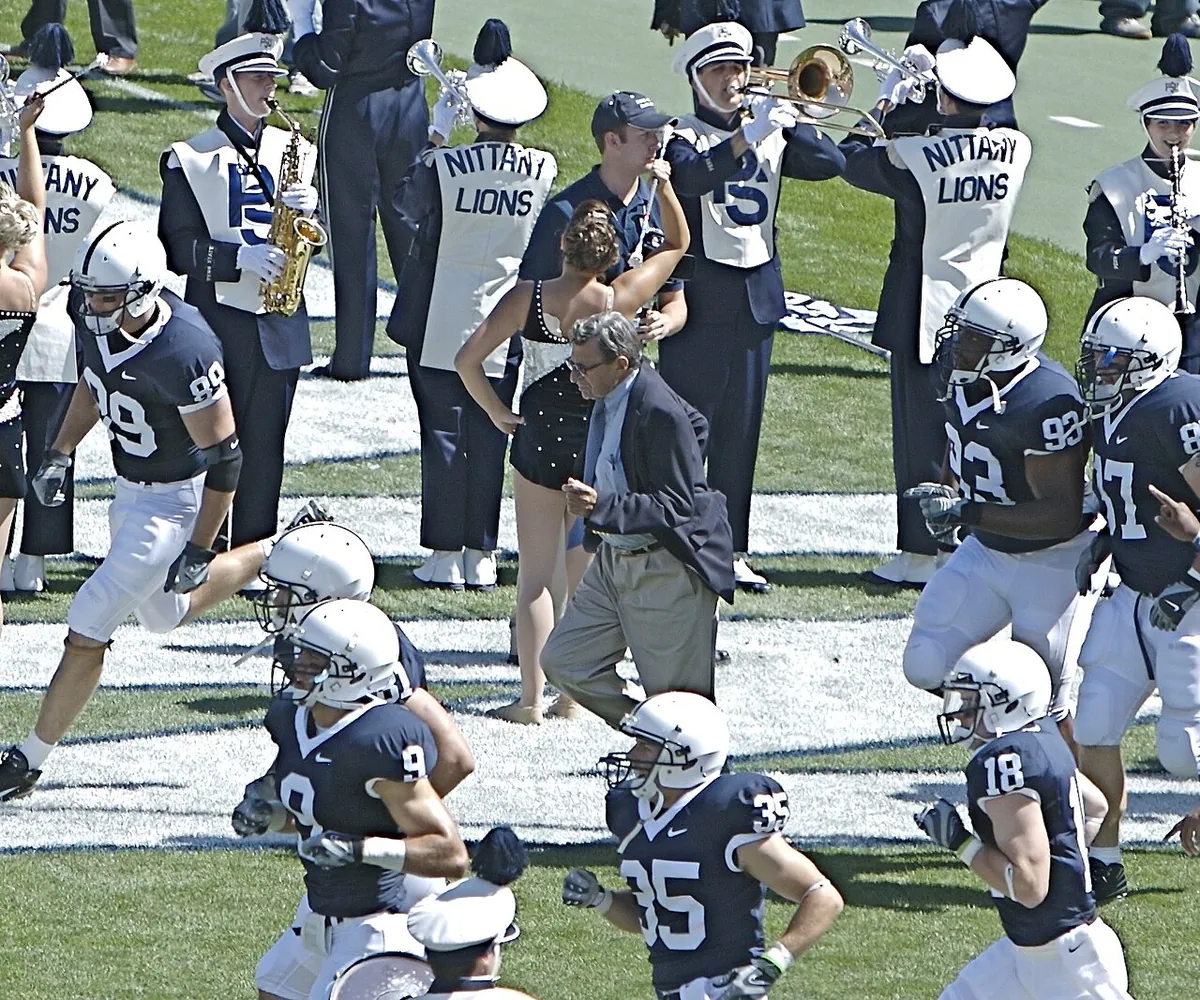
Joe Paterno served as the head coach of the Penn State Nittany Lions for 45 consecutive seasons, from 1966 through 2011. His overall record was 409 wins, 136 losses, and 3 ties, giving him a .749 winning percentage. Paterno's teams made 37 bowl game appearances, an NCAA record, and posted a bowl record of 24 wins, 12 losses, and 1 tie. He recorded his 409th and final victory on October 29, 2011. The program's physical stature grew significantly during his tenure, with Beaver Stadium undergoing six expansions, increasing capacity to 106,572 by 2001.
Penn State joined the Big Ten Conference in 1993, and under Paterno, the team won three conference championships in 1994, 2005, and 2008. The program experienced a pronounced slump from 2000 to 2004, posting a 26-33 record over that five-year span, which led to public criticism and calls for his retirement. Paterno rebounded strongly, leading the team to an 11-1 record and a Big Ten title in 2005, capped by a triple-overtime victory over Florida State in the 2006 Orange Bowl. His final six seasons all resulted in winning records, including three top-ten national finishes.
| Decade | Key Achievements and Records |
|---|---|
| 1980s | National Championships (1982, 1986), fourth undefeated season in 1986. |
| 2010 to 2011 | Final victory in 2011, dismissal in November 2011. |
Championships, Bowl Success, and Schemes
Paterno led Penn State to two consensus national championships in 1982 and 1986. He also coached five undefeated and untied teams in 1968, 1969, 1973, 1986, and 1994. Four of those unbeaten teams won major bowl games but were not awarded a national championship. Paterno was the first coach to win all four major New Year's Day bowls, the Rose, Orange, Fiesta, and Sugar, plus the Cotton Bowl Classic, at least once. His teams won at least three bowl games in each of the four full decades he coached from the 1970s through the 2000s. Penn State finished ranked in the Top 10 of the national polls 29 times during his career.
- National Championships: 1982, 1986.
- Undefeated Seasons: 1968, 1969, 1973, 1986, 1994.
- Major Bowl Victories: Orange Bowl (1968, 1969, 1973, 2005), Cotton Bowl Classic (1972, 1974), Fiesta Bowl (1977, 1980, 1981, 1986, 1991, 1996), Sugar Bowl (1982), Rose Bowl (1994).
- Other Bowl Wins: Liberty Bowl (1979), Aloha Bowl (1983), Holiday Bowl (1989), Citrus Bowl (1993, 2010), Outback Bowl (1995, 1998, 2006), Alamo Bowl (1999, 2007).
- Big Ten Championships: 1994, 2005, 2008.
Paterno's teams were not known for a single, rigid offensive or defensive scheme but evolved over his long career. He was known for a fundamental, tough style of play. His emphasis was on execution and discipline rather than complex systems. Paterno's coaching tree includes several former assistants who became head coaches. Other assistants like Tom Bradley, who served as interim head coach after Paterno's dismissal, and Greg Schiano also had significant coaching careers.
Honors, Awards, and Academic Impact
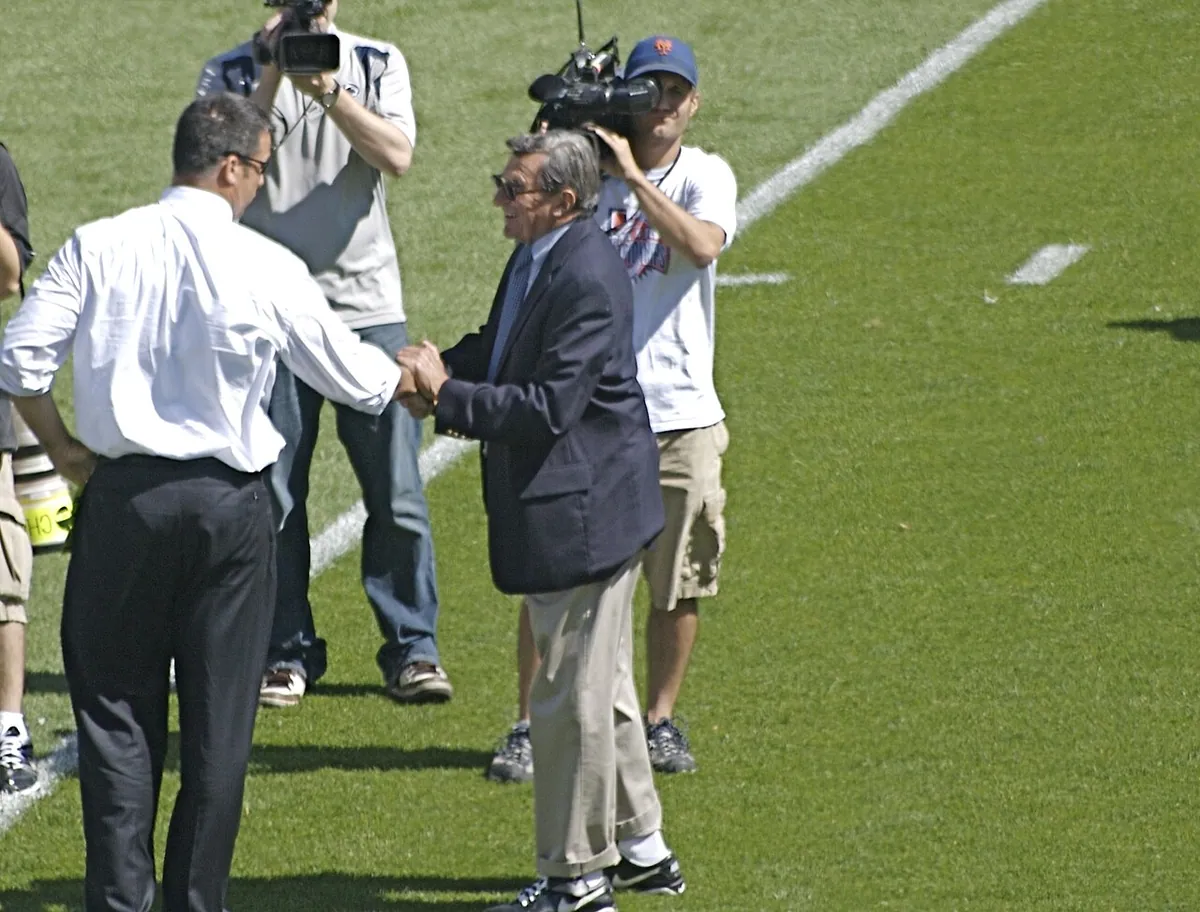
Joe Paterno received numerous coaching awards throughout his career. He earned the AFCA Coach of the Year award in 1968, 1978, 1982, 1986, and 2005. He won the Paul "Bear" Bryant Award in 1986 and was named Sports Illustrated's Sportsperson of the Year that same year. Paterno was a three-time winner of the Dave McClain Big Ten Coach of the Year award (1994, 2005, 2008). He also received the Bobby Dodd Coach of the Year Award in 1981 and 2005, and the Eddie Robinson Coach of the Year Award in 1978, 1982, and 1986.
The National Football Foundation gave him the Distinguished American Award in 1992 and the Gold Medal Award in 2006. He was elected to the College Football Hall of Fame in 2007 and was enshrined in 2008. In 2009, Sporting News ranked him 13th on its list of the 50 greatest coaches across all major American sports. Paterno was also known for stressing academics, and Penn State football players under his watch achieved high graduation rates. He and his wife were significant donors to the university, contributing millions to academic programs and library expansions.
Several awards were created in his name but later discontinued or renamed following the 2011 scandal. The Maxwell Football Club established the Joseph V. Paterno Award in 2010, but it was discontinued a year later. The Big Ten Conference created the Stagg-Paterno Championship Trophy in 2010, but removed Paterno's name from the trophy in November 2011. The George Munger Award and the Gerald R. Ford Award that had been presented to Paterno were subsequently revoked.
The Jerry Sandusky Scandal and Dismissal
Joe Paterno's coaching career ended abruptly in November 2011 in the wake of the child sex abuse scandal involving his former defensive coordinator, Jerry Sandusky. A grand jury report stated that in 2002 (prosecutors later amended the date to 2001), then-graduate assistant Mike McQueary informed Paterno that he had witnessed Sandusky sexually abusing a young boy in the Penn State football showers. Paterno reported the incident to Athletic Director Tim Curley and later to Vice President Gary Schultz, but he did not notify police. Pennsylvania state law at the time required employees to report suspected abuse to their immediate supervisor, which Paterno did. State police officials, however, publicly stated he had a moral obligation to do more.
On November 9, 2011, Paterno announced he would retire at the end of the season. Hours later, the Penn State Board of Trustees voted to terminate his contract effective immediately, stating his failure to do more constituted a failure of leadership. The board also cited the growing public outrage and the distraction his continued presence would cause. University President Graham Spanier also resigned. Paterno's dismissal triggered student riots on campus in support of the coach. He died 74 days later, on January 22, 2012, from complications of lung cancer.
Post-Scandal Actions and Legacy
The NCAA imposed severe sanctions on Penn State in 2012, including vacating all of the program's wins from 1998 through 2011, which removed 111 victories from Paterno's record. A subsequent lawsuit by Pennsylvania State Senator Jake Corman challenged the NCAA's process, revealing regular contact between NCAA officials and Louis Freeh, who led an independent investigation for Penn State. In a 2015 legal settlement, the NCAA reversed its decision and restored the 111 wins to Paterno's official record. A separate critique of the Freeh Report commissioned by the Paterno family argued against his involvement in any cover-up. The lead prosecutor in the Sandusky case, Frank Fina, stated in a 60 Minutes interview that he did not find evidence Paterno was involved in an alleged cover-up.
Joe Paterno's legacy is defined by his unprecedented longevity and on-field success, which is now inextricably linked to the Sandusky scandal. He held the record for most wins by a major college football coach at the time of his dismissal. Paterno was known for his distinctive gameday appearance, which included thick glasses, rolled-up dress slacks, and white socks. Following his death, the statue of Paterno that stood outside Beaver Stadium was removed in July 2012. In the years since, Penn State has taken steps to recognize its football history, including plans for a museum that would include Paterno's tenure. His complex legacy ensures he remains a polarizing figure in college sports history.
Video
FAQ
How many national championships did Joe Paterno win?
Joe Paterno led the Penn State Nittany Lions to two consensus national championships. The team won the national title in 1982 and again in 1986. He also coached five undefeated and untied teams, in 1968, 1969, 1973, 1986, and 1994, but only the 1982 and 1986 squads were crowned national champions. Four of his unbeaten teams won major bowl games but were not awarded the championship.
What was Joe Paterno's overall win-loss record?
Joe Paterno's official career record as a head coach is 409 wins, 136 losses, and 3 ties. This record includes his 46 seasons leading the Penn State Nittany Lions from 1966 to 2011. His 409 victories made him the winningest coach in NCAA FBS history at the time of his retirement. His teams also participated in 37 bowl games, winning 24, losing 12, and tying one.
What happened to Joe Paterno's wins after the scandal?
In 2012, the NCAA vacated 111 of Penn State's wins from 1998 through 2011 as a penalty related to the Sandusky scandal. This action would have reduced Paterno's official win total. However, in a 2015 legal settlement with Penn State, the NCAA reversed that decision and restored all 111 victories to Paterno's record. His official win total therefore remains 409, as it was at the end of the 2011 season.
What college did Joe Paterno attend and play football for?
Joe Paterno attended and played football for Brown University from 1946 to 1949. At Brown, he played both quarterback and cornerback for the Bears and shares the career record for interceptions with 14. He graduated in 1950 as an English literature major. His college coach, Rip Engle, later persuaded him to join the Penn State coaching staff as an assistant in 1950 instead of attending law school.
When was Joe Paterno inducted into the College Football Hall of Fame?
Joe Paterno was inducted into the College Football Hall of Fame in 2007. He was elected in May 2006 after a rule change allowed coaches over 75 to be eligible. An injury from a sideline collision in November 2006 delayed his travel to the ceremony, so he was inducted as part of the 2007 class on December 4, 2007, and officially enshrined on July 19, 2008. He was a five-time National Coach of the Year.
What was the nature of Joe Paterno's involvement in the Jerry Sandusky child sex abuse scandal?
Joe Paterno was informed in 2001 by graduate assistant Mike McQueary that he had witnessed Jerry Sandusky acting inappropriately with a young boy in a team shower. Paterno reported this incident to his immediate supervisor, Athletic Director Tim Curley, fulfilling his legal obligation under Pennsylvania state law at the time. However, he did not follow up further or report the matter directly to the police. The Penn State Board of Trustees later terminated his contract, citing a failure of leadership for not doing more beyond the minimum legal requirement.
Sources
- Joe Paterno (Wikipedia) Wikipedia
- Joe Paterno allsportsassociation.org
- Joe Paterno | Biography | Research Starters | EBSCOhost ebsco.com
- Inductee | Joseph Vincent Paterno 2007 College Football Hall of Fame
- Joe Paterno myhero.com
- Joe Paterno, American football player and coach baike.baidu.com