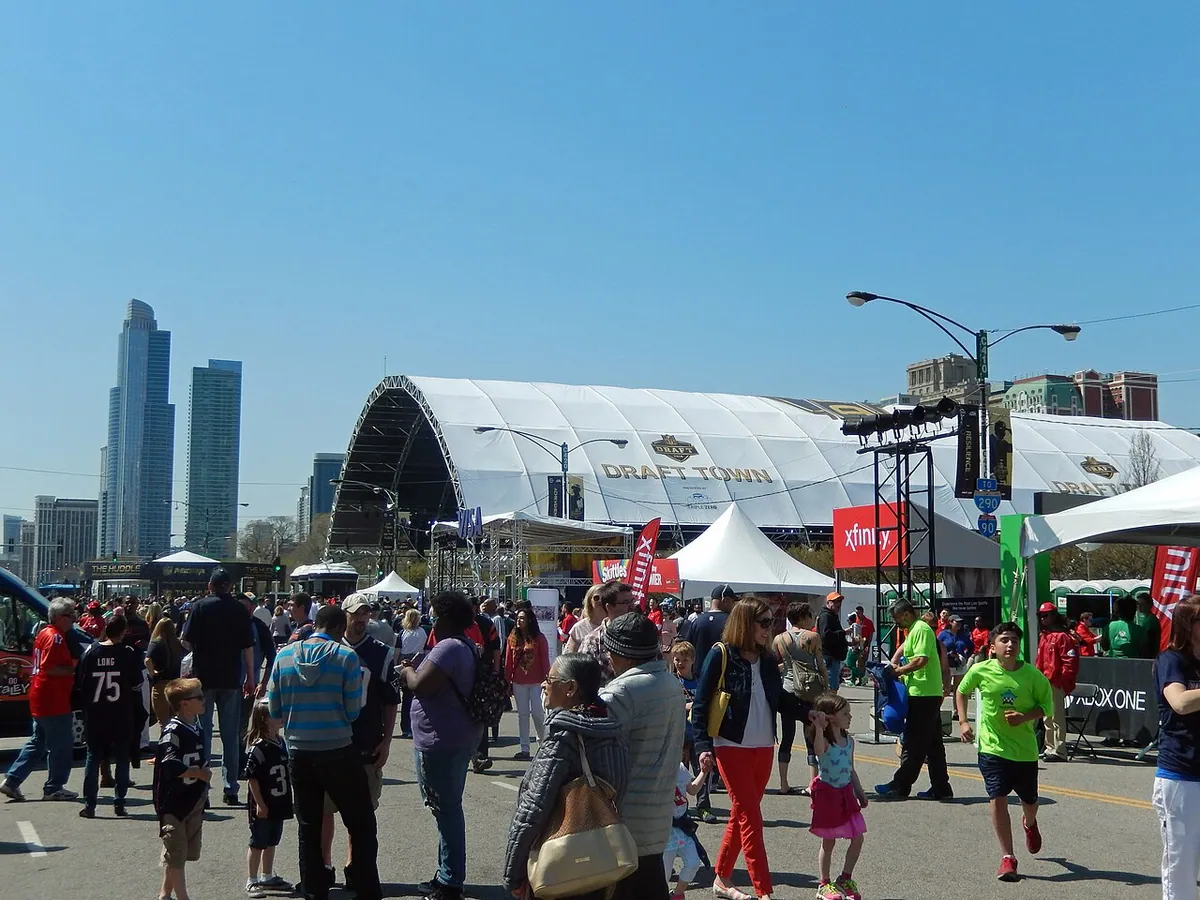
The 2015 NFL Draft was the 80th annual meeting of National Football League franchises to select newly eligible football players. The Tampa Bay Buccaneers selected Florida State quarterback Jameis Winston with the first overall pick, while the Tennessee Titans followed by taking Oregon quarterback Marcus Mariota second. The draft class produced 256 total selections, with the Cleveland Browns making the most picks at 12, and the event introduced a large-scale fan festival called Draft Town. The draft order was determined by the reverse order of the previous season's standings, with tiebreakers based on strength of schedule. The Tampa Bay Buccaneers, having finished the 2014 season with a league-worst 2-14 record, earned the right to the first overall selection. They used that pick on Florida State quarterback Jameis Winston, the 2013 Heisman Trophy winner. The Tennessee Titans, who also finished 2-14, held the second pick and selected Oregon quarterback Marcus Mariota, the 2014 Heisman Trophy winner. This was the sixth time in NFL history that quarterbacks were selected with the first two overall picks, and the first time the top two selections were both Heisman Trophy winners. The selection of Winston and Mariota created one of the major storylines of the draft, as scouts debated their transition from college systems to the professional game.
First Round Selections Pick by Pick
After the top three picks, the Oakland Raiders selected Alabama wide receiver Amari Cooper fourth overall. The Washington Redskins chose Iowa offensive lineman Brandon Scherff with the fifth pick. A surprise of the top ten was the fall of USC defensive end Leonard Williams, widely considered the draft's best overall prospect, to the New York Jets at pick six. The St. Louis Rams made a bold move at pick ten, selecting Georgia running back Todd Gurley, who was recovering from a torn ACL. Other first-round standouts included Clemson defensive end Vic Beasley to the Atlanta Falcons at eight, Washington cornerback Marcus Peters to the Kansas City Chiefs at 18, and Connecticut cornerback Byron Jones to the Dallas Cowboys at 27. The New England Patriots closed the first round by selecting Texas defensive tackle Malcom Brown with the 32nd pick.
- Wide receiver was the most selected position in the first round with 6 picks.
- Offensive guard was the second-most selected with 5 picks.
- Quarterback and running back were each chosen 2 times, and safety was chosen once.
Notable Trades and Event Logistics
The 2015 draft was notable for its change in venue and format. After a scheduling conflict at New York's Radio City Music Hall forced a postponement of the 2014 draft, the NFL opened bidding for a new host city. Chicago won the bid, proposing the Auditorium Theatre for the draft itself and the adjacent Grant Park for a massive fan festival dubbed Draft Town. The festival drew an estimated 200,000 visitors over the three days and featured the final round held outdoors in an area called Selection Square. During the draft itself, the league shortened selection times for the seventh round and all compensatory picks from five minutes to four minutes per pick. Notable trades included a swap between the San Diego Chargers and San Francisco 49ers affecting the 15th and 17th overall picks. The Cleveland Browns acquired the 19th pick from the Buffalo Bills to select Florida State offensive lineman Cameron Erving. The New York Giants traded up to the first pick of the second round, 33rd overall, to select Alabama safety Landon Collins.
Picks by Position, College, and Conference
The 256 players selected in the 2015 draft came from a wide array of college programs and conferences. By position, wide receiver was the most commonly drafted, with 35 players selected. Only seven quarterbacks were drafted in total. Florida State led all colleges with 11 players drafted, followed by Louisville with 10. Florida had eight players selected, while Alabama and Miami each had seven. In terms of conference representation, the Southeastern Conference (SEC) led the way with 54 total draftees. The Atlantic Coast Conference (ACC) was close behind with 47 selections, and the Pac-12 Conference had 39. The Big Ten Conference contributed 35 players, and the Big 12 Conference had 25.
| Conference | Total Picks |
|---|---|
| Atlantic Coast Conference (ACC) | 47 |
| Pacific Twelve Conference (Pac-12) | 39 |
| Big Ten Conference | 35 |
| Big Twelve Conference | 25 |
| American Athletic Conference | 11 |
Notable Later-Round Picks
While the first round garnered the most attention, the 2015 draft produced significant talent in later rounds. Other impactful second-day picks included Mississippi State linebacker Benardrick McKinney to the Houston Texans and Michigan wide receiver Devin Funchess to the Carolina Panthers. The draft also featured a notable supplemental draft pick on July 9, 2015, where the St. Louis Rams selected Clemson offensive tackle Isaiah Battle, forfeiting a 2016 fifth-round pick. Seven players were available in the supplemental draft, but Battle was the only one selected. The depth of the class extended into day three, with contributors emerging from rounds four through seven, including many players who became long-term NFL starters.
Impactful Undrafted Free Agents
The pool of undrafted free agents from the 2015 class proved exceptionally deep, with several players carving out NFL careers. Teams immediately after the draft competed to sign these players, many of whom became key contributors. This trend highlighted the depth of talent available beyond the 256 drafted selections. Notable undrafted players included Dallas Cowboys offensive tackle La'el Collins from LSU, Chicago Bears long snapper Rick Lovato from Old Dominion, and Detroit Lions running back Zach Zenner from South Dakota State. Other undrafted signees who played in the NFL included Green Bay Packers cornerback LaDarius Gunter from Miami, Cincinnati Bengals cornerback Troy Hill from Oregon, and Houston Texans center Greg Mancz from Toledo. Chicago Bears cornerback Bryce Callahan from Rice and Minnesota Vikings cornerback Justin Coleman from Tennessee also entered the league as undrafted free agents. The success of these players demonstrated that NFL rosters could be built through effective scouting of both the draft and the post-draft free agent market.
Records Set and Draft Class Performance
The 2015 NFL Draft set a precedent for the event's future scale and fan engagement. The introduction of Draft Town in Chicago transformed the draft from a television studio event into a major public festival, a model that has been used in every host city since. In terms of on-field performance, the class has produced a number of Pro Bowl players. First-round picks like Todd Gurley, Amari Cooper, Marcus Peters, and Brandon Scherff have earned Pro Bowl honors. Second-round safety Landon Collins also became a Pro Bowl selection. The top two picks were Jameis Winston and Marcus Mariota. The depth of the class is further evidenced by the successful careers of many mid-to-late round selections and undrafted free agents.
Early Entrants and Draft Overview
A significant number of college underclassmen declared for the 2015 draft. An additional 10 players who had graduated but retained college eligibility also declared, bringing the total number of early entrants to 84. This influx of young talent contributed to the depth of the draft pool, particularly at skill positions. The league allocated 32 compensatory picks at the ends of rounds three through seven, which contributed to the full total of 256 selections. These picks are awarded to teams that experience a net loss of free agent talent from the previous season. The large number of early entrants and compensatory picks ensured a deep and competitive selection process, with teams having ample opportunity to address roster needs across all seven rounds. The draft concluded with the Arizona Cardinals selecting Louisville tight end Gerald Christian with the 256th pick, designated as Mr. Irrelevant.
Colleges with the Most Drafted Players
Certain college programs stood out for their contribution of talent to the 2015 NFL Draft. Florida State University led all schools by a significant margin, placing 11 players into the draft. This reflected the strength of their roster during that period and their development of NFL-ready talent. Other major college football powers also had strong showings, demonstrating the concentration of talent in top programs. Florida had 8 players drafted. Alabama and Miami each had 7 players drafted. Oklahoma, USC, and Stanford each had 6 players drafted from the 2015 class. These schools accounted for a significant portion of the total selections, highlighting their role as primary pipelines for NFL talent. The success of players from these programs in the draft often correlated with their teams' competitive success in college football during the preceding seasons.
Video
FAQ
Who was the first pick in the 2015 NFL Draft?
The first overall pick in the 2015 NFL Draft was Jameis Winston, a quarterback from Florida State, selected by the Tampa Bay Buccaneers. Winston was the 2013 Heisman Trophy winner and was viewed as a pro-ready pocket passer. The Buccaneers held the pick after finishing the 2014 season with a 2-14 record, the worst in the league. He and Marcus Mariota were the only two quarterbacks selected in the first round.
Who were the best players from the 2015 NFL Draft?
The 2015 draft class produced several elite players who have had prolific careers. First-round picks like running back Todd Gurley, wide receiver Amari Cooper, cornerback Marcus Peters, and offensive lineman Brandon Scherff have earned Pro Bowl honors. Second-round safety Landon Collins also became a Pro Bowl selection. While the top two quarterbacks had ups and downs, both Jameis Winston and Marcus Mariota were first-round selections. The class is also renowned for its depth, with many later-round picks becoming long-term NFL starters.
Which team had the most picks in the 2015 draft?
The Cleveland Browns had the most selections in the 2015 NFL Draft with 12 total picks. They made two first-round selections, taking Washington defensive tackle Danny Shelton 12th overall and Florida State offensive lineman Cameron Erving 19th overall. Other teams with a high volume of picks included the New England Patriots, Oakland Raiders, and Washington Redskins, each of whom made 10 selections. The Carolina Panthers and San Diego Chargers had the fewest picks with five each.
What was a major storyline leading up to the 2015 NFL Draft?
A major storyline was the competition between the two most recent Heisman Trophy winners, quarterbacks Jameis Winston (2013) and Marcus Mariota (2014). Both were considered top prospects for the first overall selection. Winston was viewed as a more polished pocket passer but had off-field concerns, while Mariota was a superior athlete who ran a spread offense at Oregon. This led to them being selected first and second overall, marking only the sixth time in NFL history that two quarterbacks went with the first two picks.
What was the final pick of the 2015 NFL Draft and who was it?
The final pick of the 2015 NFL Draft, known as Mr. Irrelevant, was Gerald Christian, a tight end from Louisville, selected by the Arizona Cardinals with pick number 256. This pick concluded the draft's 80th annual meeting. The Cardinals used this selection to round out their draft class. The draft consisted of a total of 256 picks, including 32 supplemental selections awarded to teams for net losses of free agent talent.
Which teams had the fewest selections in the 2015 NFL Draft?
The Carolina Panthers and the San Diego Chargers each had the fewest selections in the 2015 NFL Draft with only 5 picks. This was in contrast to the Cleveland Browns, who had the most selections with 12. The draft allocated seven picks to each team as a baseline, plus 32 supplemental picks distributed at the ends of rounds 3 through 7. The total number of players selected across all teams was 256.
Sources
- 2015 NFL draft (Wikipedia) Wikipedia
- 2015 NFL Draft Picks, Round 1 NFL
- NFL Draft 2015: Pick-by-pick results sbnation.com
- nflverse game, roster and draft data nflverse (CC BY 4.0)